
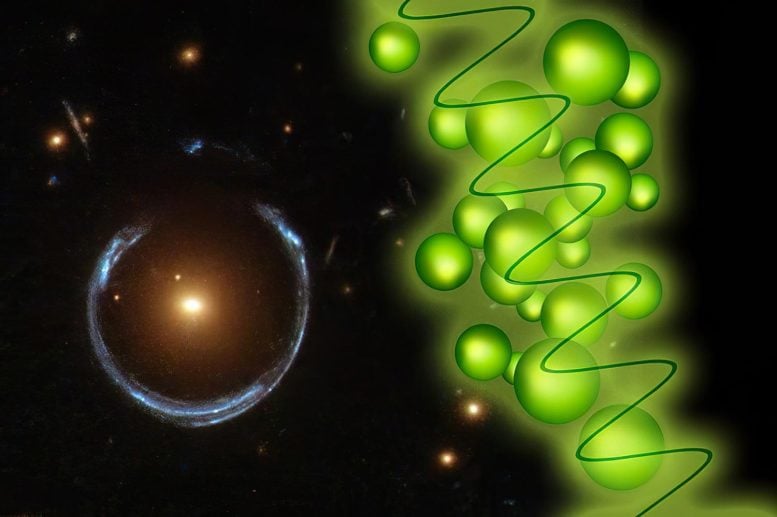
New techniques can answer questions that were previously inaccessible experimentally — including questions about the relationship between quantum mechanics and relativity.
Scientists at TU Wien and other institutions have developed a “quantum simulator” using ultracold atomic clouds to model quantum particles in curved spacetime, marking a major step toward reconciling quantum theory and the theory of relativity. The model system offers a tool to study gravitational lensing effects in a quantum field, which may lead to new insights in the elusive field of quantum gravity and other areas of physics.
The theory of relativity works well when you want to explain cosmic-scale phenomena — such as the gravitational waves created when black holes collide. Quantum theory works well when describing particle-scale phenomena — such as the behavior of individual electrons in an atom. But combining the two in a completely satisfactory way has yet to be achieved. The search for a “quantum theory of gravity” is considered one of the significant unsolved tasks of science.
This is partly because the mathematics in this field is highly complicated. At the same time, it is tough to perform suitable experiments: One would have to create situations in which phenomena of both the relativity theory play an important role, for example, a spacetime curved by heavy masses, and at the same time, quantum effects become visible, for example, the dual particle and wave nature of light.
At the TU Wien in Vienna, Austria, a new approach has now been developed for this purpose: A so-called “quantum simulator” is used to get to the bottom of such questions: Instead of directly investigating the system of interest (namely quantum particles in curved spacetime), one creates a “model system” from which one can then learn something about the system of actual interest by analogy. The researchers have now shown that this quantum simulator works excellently. The findings of this international collaboration involving physicists from the University of Crete, Nanyang Technological University, and FU Berlin are now published in the scientific journal Proceedings of the National Academy of Sciences of the USA (PNAS).
Learning From One System About Another
The basic idea behind the quantum simulator is simple: Many physical systems are similar. Even if they are entirely different kinds of particles or physical systems on different scales that, at first glance, have little to do with each other, these systems may obey the same laws and equations at a deeper level. This means one can learn something about a particular system by studying another.
“We take a quantum system that we know we can control and adjust very well in experiments,” says Prof. Jörg Schmiedmayer of the Atomic Institute at TU Wien. “In our case, these are ultracold atomic clouds held and manipulated by an atom chip with electromagnetic fields.” Suppose you properly adjust these atomic clouds so that their properties can be translated into another quantum system. In that case, you can learn something about the other system from the measurement of the atomic cloud model system – much like you can learn something about the oscillation of a pendulum from the oscillation of a mass attached to a metal spring: They are two different physical systems, but one can be translated into the other.
The Gravitational Lensing Effect
“We have now been able to show that we can produce effects in this way that can be used to resemble the curvature of spacetime,” says Mohammadamin Tajik of the Vienna Center for Quantum Science and Technology (VCQ) – TU Wien, first author of the current paper. In the vacuum, light propagates along a so-called “light cone.” The speed of light is constant; at equal times, the light travels the same distance in each direction. However, if the light is influenced by heavy masses, such as the sun’s gravitation, these light cones are bent. The light’s paths are no longer perfectly straight in curved spacetimes. This is called the “gravitational lens effect.”
The same can now be shown in atomic clouds. Instead of the speed of light, one examines the speed of sound. “Now we have a system in which there is an effect that corresponds to spacetime curvature or gravitational lensing, but at the same time, it is a quantum system that you can describe with quantum field theories,” says Mohammadamin Tajik. “With this, we have a completely new tool to study the connection between relativity and quantum theory.”
A Model System for Quantum Gravity
The experiments show that the shape of light cones, lensing effects, reflections, and other phenomena can be demonstrated in these atomic clouds precisely as expected in relativistic cosmic systems. This is not only interesting for generating new data for basic theoretical research – solid-state physics and the search for new materials also encounter questions that have a similar structure and can therefore be answered by such experiments.
“We now want to control these atomic clouds better to determine even more far-reaching data. For example, interactions between the particles can still be changed in a very targeted way,” explains Jörg Schmiedmayer. In this way, the quantum simulator can recreate physical situations that are so complicated that they cannot be calculated even with supercomputers.
The quantum simulator thus becomes a new, additional source of information for quantum research – in addition to theoretical calculations, computer simulations, and direct experiments. When studying the atomic clouds, the research team hopes to come across new phenomena that may have been entirely unknown up to now, which also take place on a cosmic, relativistic scale – but without a look at tiny particles, they might never have been discovered.
Reference: “Experimental observation of curved light-cones in a quantum field simulator” by Mohammadamin Tajik, Marek Gluza, Nicolas Sebe, Philipp Schüttelkopf, Federica Cataldini, João Sabino, Frederik Møller, Si-Cong Ji, Sebastian Erne, Giacomo Guarnieri, Spyros Sotiriadis, Jens Eisert and Jörg Schmiedmayer, 15 May 2023, Proceedings of the National Academy of Sciences.
DOI: 10.1073/pnas.2301287120
Never miss a breakthrough: Join the SciTechDaily newsletter.
Follow us on Google and Google News.
4 Comments
Finally the comparison between relativity and nature are having a chance to bound intelligence. I think of the yee old saying there are two sides to every coin but what is not said is the depth between the two sides have a common riegan of junction. To think one face of the coin are people that base our existence on science which is true, other people side with the bases our existence of the divine (nature) a set plan, is true also. No difference how thin the coin, there is a depth, to observe the depth a standard model of mathematical scale needs to be molded for the difference between the very large universe to the very small quantum, which way are we looking. I have a question ? would time exist without mass or even the Big Bang spark. How about the standard of life the large (Elephants) have lungs to breath but the very small (Dust Mites) absorb the life sustaining mixture where does the change in difference start. Maybe Dark matter and Dark energy have some of these same characteristics.
There is something in our standard on earth that shows me an example of gravitational lensing take a water glass and fill it to the brim with water the surface tension of the water bullaging at a point before allowing water to spill over shows an example of the barrier just like a gravitational barrier lens. A scaled observation may show comparison.
If something interesting about gravity (bent light-cones are a no-brainer) had emerged in the subject environment, then an interesting story would have resulted. Instead, it’s just a perfect excuse for shade-casting parody.
If you insist on gravitationally-bent space as a cooperative partner of sorts to collaborate linguistically with your basic gravitationally-bent light environment, also known as professional social engineering or double-think primacy, guiding people toward a helpful perspective … consider it’s only by ignoring bent (“light-clock”) time that realism in bent space emerges, sadly, when light starts deforming a little bit like matter instead of the opposite. Such time-agnostic realism makes anti-deSitter bending attractive because it compresses a vertical meter when the meter-stick is moved into stronger gravity existing closer to a gravity source. The bent-space lensing explanation that got Einstein (and all his political admirers) so famously excited gets no respect, of course, with anti-deSitterism. Fortunately, only a filmy screen of holographic implications is needed as a functional dust barrier to protect most eyes during any necessary spacetime renovations.
Most people have no idea what to think about time that is based only on reference light frequencies, not on reference constituent photon occurrence rates that only reveal frequency distortion besides conserving energy in a way general relativity’s “old one” ambitiously hopes will seem spooky, unneeded and impossible.
Frame-drag is eminently an information flow-based concept everywhere except with space wordlessly welded to time by spacetime fanatics. That was all the motivation needed to suppose gravity quantizes with a sub-nucleonic interaction cross-section, enabling the concept of portable gravity sensors peering underground based on entangled atom streams each acting as a series of perfect atom-sized “atomic clocks” where one stream temporarily goes lower that the other but both naturally need not go underground. It’s all in the relative timing of particle movements, however, not light frequency, so all it can show is gravity-type clock (water-clock, pendulum, etc.) action, which again is more anti-deSitter, like Einstein’s trampoline flipped upside down so no one can use gravity as a hyperdimensional crutch to explain gravity.
It’s pretty easy to balance energy with two different rates of time, I suppose, you can just use an extradimensional renormalization process with synthetic time. True story – in response to my curiosity on what a red line leads to, the spelling assistance on-site literally suggested “DeSutter” for me, of course with the ever-helpful ever-appreciated ultimate suggestion to be ignored.
Made a pt, above comment, bent light might resume from two states while still characteristically light and it’s measured as a photon. What’d I know divisions? The house pet already time travels 7:1.???