
Close Menu
    Facebook X (Twitter) Instagram
    SciTechDaily
    • Biology
    • Chemistry
    • Earth
    • Health
    • Physics
    • Science
    • Space
    • Technology
    Facebook X (Twitter) Pinterest YouTube RSS
    SciTechDaily
    Home»Space»New Radar Images from Cassini Show Familiar Forms on Titan’s Dunes
    Space

    New Radar Images from Cassini Show Familiar Forms on Titan’s Dunes

    By European Space AgencyApril 8, 2014No Comments2 Mins Read
    Facebook Twitter Pinterest Telegram LinkedIn WhatsApp Email Reddit
    Share
    Facebook Twitter LinkedIn Pinterest Telegram Email Reddit
    New Radar Images from Cassini Show Familiar Forms on Titans Dunes
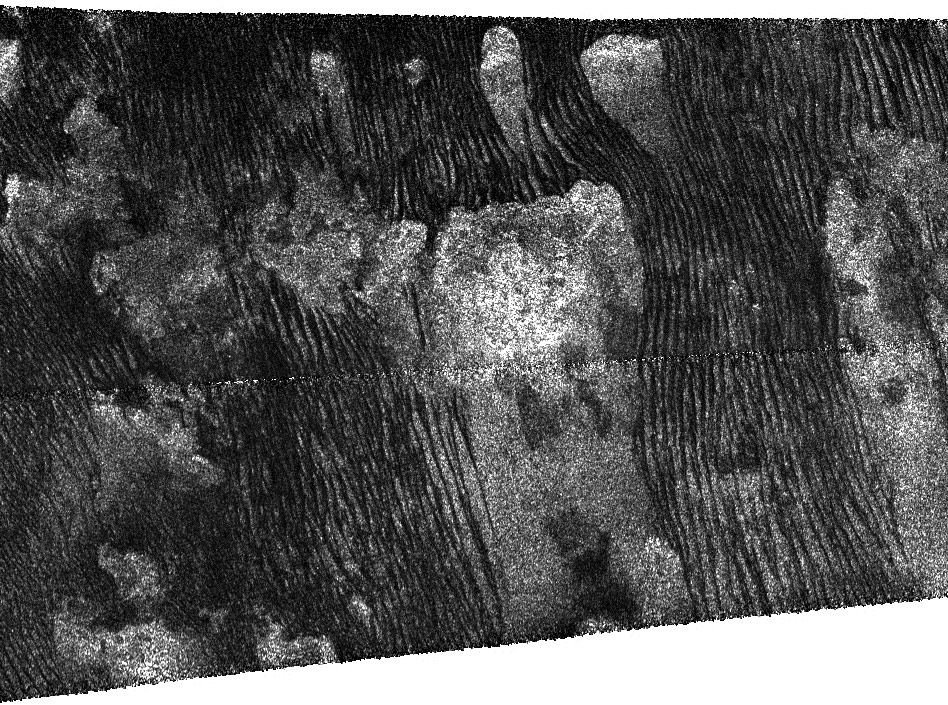
    Dark streaks carved into dunes on Saturn’s moon Titan. Credit: NASA/JPL-Caltech

    New radar images from the Cassini orbiter show dark streaks carved into dunes on Saturn’s moon Titan.

    The moons of our Solar System are brimming with unusual landscapes. However, sometimes they look a little more familiar, as in this new radar image from the Cassini orbiter. The image shows dark streaks carved into dunes reminiscent of those we might find on a beach on Earth, or raked with flowing lines in a Japanese Zen garden — but this scene is actually taking place on Saturn’s moon Titan.

    While our sand is composed of silicates, the ‘sand’ of these alien dunes is formed from grains of organic materials about the same size as particles of our beach sand. The small size and smoothness of these grains mean that the flowing lines carved into the dunes show up as dark to the human eye.

    These grains are shunted around by winds shifting over the moon’s surface. These winds aren’t particularly fast — only moving at around 1 m/s — but they blow in opposing directions throughout the year, causing Titan’s ‘sand’ to pile up in certain places over time.

    Titan seems to be full of features and phenomena that are quite familiar to those found on Earth. Since Cassini arrived in the Saturn system in 2004, and dropped off ESA’s Huygens probe in 2005, scientists have been studying the similarities between Titan and Earth by exploring sand dunes, channels, and lakes of liquid ethane and methane scattered across its surface.

    While previous images have spotted these eerily familiar patterns on Titan’s dunes, this new image shows them in greater detail. The image was obtained by Cassini’s Titan radar mapper on 10 July 2013, by a team led by Steve Wall at NASA’s Jet Propulsion Laboratory in California, USA. The horizontal seam near the center is an artifact of radar image data processing.

    The Cassini–Huygens mission is a cooperative project of NASA, ESA, and Italy’s ASI space agency.

    Never miss a breakthrough: Join the SciTechDaily newsletter.
    Follow us on Google and Google News.

    Astronomy Cassini-Huygens Mission European Space Agency Planetary Science Titan
    Share. Facebook Twitter Pinterest LinkedIn Email Reddit

    Related Articles

    Cassini Reveals Clues about Saturn’s Moon Titan

    New Cassini Images of Titan’s Hydrocarbon Seas and Lakes

    NASA’s Cassini Detects Propylene on Titan for the First Time

    Cassini Reveals a Rigid and Weathered Ice Shell on Titan

    Cassini Helps Explain the Mystery of the Missing Waves on Titan

    Cassini Data Confirms PAHs Play Major Role in Production of Lower Haze on Titan

    Scientists Use Cassini Data to Create First Global Topographic Map of Titan

    Titan’s Methane May Run Out

    Cassini Spots a Nile Like River Valley on Titan

    Leave A Reply Cancel Reply

    • Facebook
    • Twitter
    • Pinterest
    • YouTube

    Don't Miss a Discovery

    Subscribe for the Latest in Science & Tech!

    Trending News

    These Toads Are Surviving a Deadly Fungus – Scientists May Finally Know Why

    These Brain Cells May Explain Why We Eventually Have To Sleep

    Tomatoes Contain an Invisible Ingredient With Surprising Effects on Liver Health

    World’s First Heat-Powered Cooling System Turns Waste Heat Into Cold

    Antarctica Gained a Record 695 Billion Tons of Ice in Just Two Years

    Don’t Miss: A Brilliant Venus and Glowing Harvest Moon Light Up the Sky

    New Twist on the Einstein Problem Reveals Unexpected Physics

    JWST Captures Stunning Evidence of How Supermassive Black Holes Feed

    Follow SciTechDaily
    • Facebook
    • Twitter
    • YouTube
    • Pinterest
    • Newsletter
    • RSS
    SciTech News
    • Biology News
    • Chemistry News
    • Earth News
    • Health News
    • Physics News
    • Science News
    • Space News
    • Technology News
    Recent Posts
    • A Strange Photosynthesis Trick Could Help Crops Survive a Hotter, Drier World
    • This Tiny Organism Contracts 200 Times Faster Than You Can Blink – Scientists Finally Know How
    • Captive Crocodiles Released Into the Wild Did Something Researchers Didn’t Expect
    • A Massive 29-Square-Mile Iceberg Hit an Island and Kept Going
    • Nearly Destroyed DNA Reveals Two Extinct Giant Tortoise Lineages
    Copyright © 1998 - 2026 SciTechDaily. All Rights Reserved.
    • Science News
    • About
    • Contact
    • Editorial Board
    • Privacy Policy
    • Terms of Use

    Type above and press Enter to search. Press Esc to cancel.