
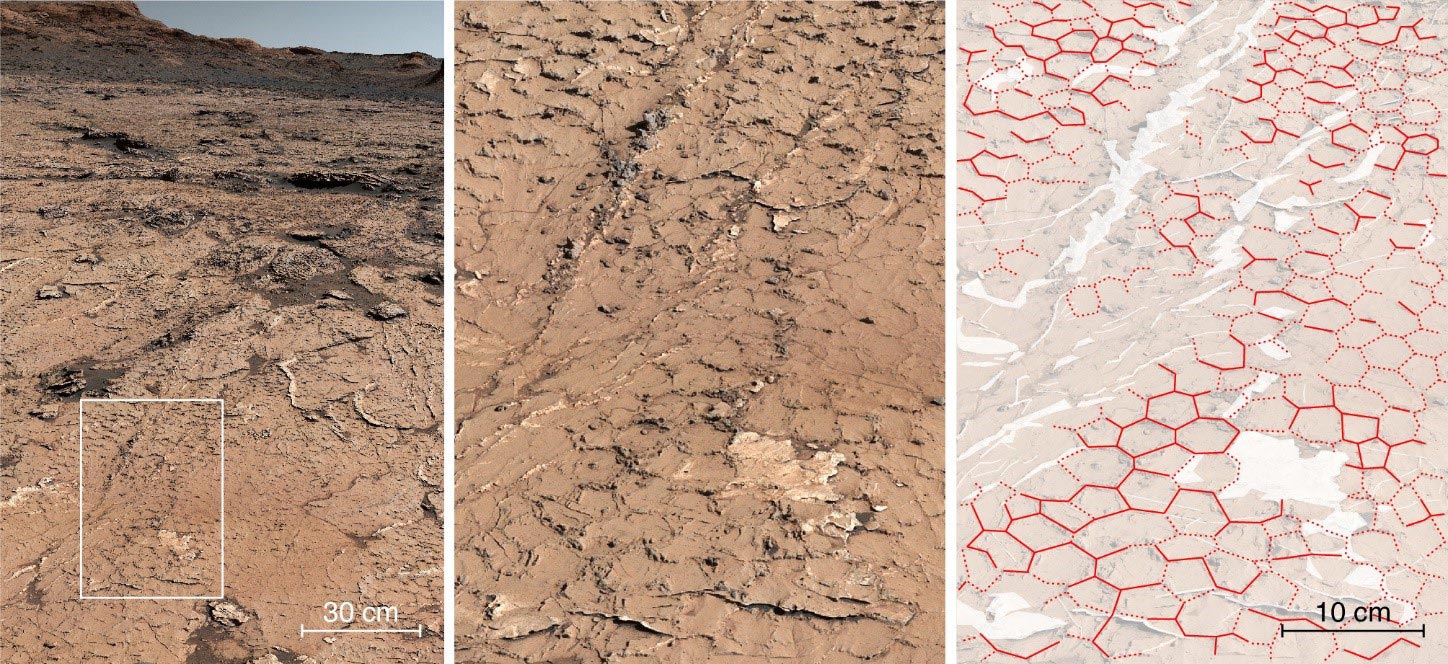
- Scientists have discovered fossil evidence of a cyclical climate on Mars, with wet and dry seasons like those on Earth.
- This environment, in which simple organic molecules have already been discovered, may have provided ideal conditions for the formation of complex organic compounds.
- This work opens up new prospects for research into the processes underlying the origin of life, of which no vestiges remain on Earth.
Using data from NASA’s Curiosity rover, scientists have discovered patterns on Mars that provide evidence of a cyclical climate similar to that of Earth. This major discovery opens up new prospects for research into the origin of life.
The results of the study, which was conducted by scientists at the CNRS, Université Toulouse III – Paul Sabatier, and Université Claude Bernard Lyon 1, with the participation of CNES, were published on August 9, 2023, in the journal Nature.
Mars’s Terrain and Previous Discoveries
The surface of Mars, unlike Earth’s, is not constantly renewed by plate tectonics. This has resulted in the preservation of massive terrain areas remarkable for their abundance in fossil rivers and lakes dating back billions of years. Since 2012, NASA’s Curiosity, the first rover to explore such ancient remains, had already detected the presence of simple organic molecules. These molecules can be formed by both geological and biological processes.
Conditions for Life Formation
However, the emergence of primitive life forms, as hypothesized by scientists, initially requires environmental conditions favorable to the spontaneous organization of these molecules into complex organic compounds. Such conditions are precisely what have recently been discovered by a research team from the Institut de Recherche en Astrophysique et Planétologie (CNRS/Université de Toulouse III – Paul Sabatier/CNES) and the Laboratoire de Géologie: Terre, Planètes, Environnement (CNRS/ENS de Lyon/Université Claude Bernard Lyon 1), together with their US and Canadian colleagues.
Evidence of Martian Climate Patterns
Using the Mastcam and the ChemCam instruments on Curiosity, they have discovered deposits of salts forming a hexagonal pattern in sedimentary layers dating from 3.8 to 3.6 billion years ago. Similar to the hexagons observed in terrestrial basins that dry out seasonally, they are the first fossil evidence of a sustained, cyclical, regular Martian climate with dry and wet seasons. By letting molecules repeatedly interact at different concentrations, independent laboratory experiments have shown that this kind of environment provides the ideal conditions for the formation of complex precursor and constituent compounds of life, such as RNA.
Conclusion: Future Research Opportunities
These new observations should enable scientists to take a fresh look at the large-scale images obtained from orbit, which have already identified numerous terrains with a similar composition. They now know where to look for traces of the natural processes that gave rise to life, of which no vestiges remain on Earth.
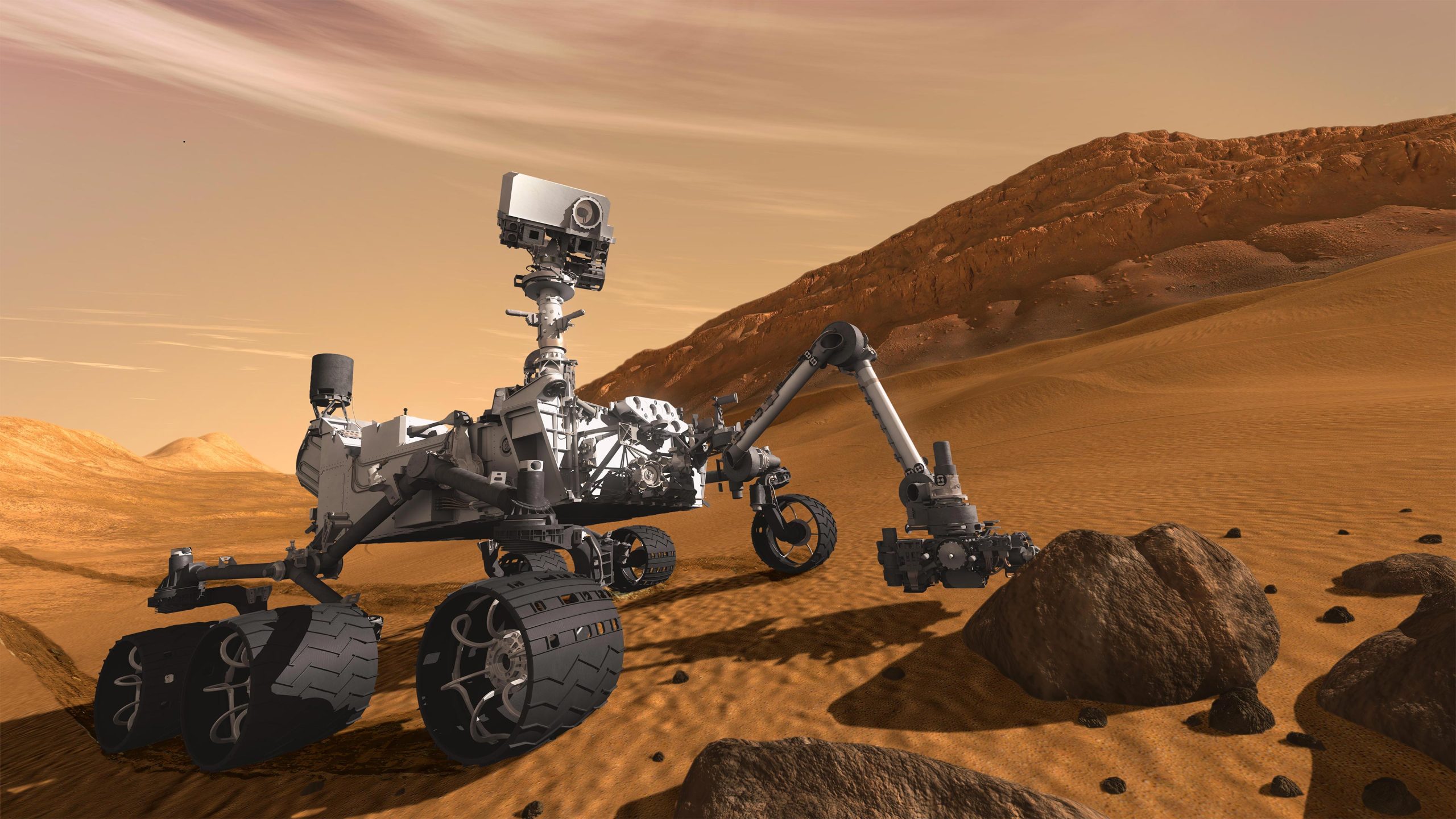
NASA’s Curiosity Rover
NASA’s Curiosity Rover is a car-sized robotic rover that has been exploring the Gale Crater on Mars since it landed on August 6, 2012. As part of NASA’s Mars Science Laboratory (MSL) mission, Curiosity’s primary objective is to determine whether Mars ever had the right environmental conditions to support microbial life. To this end, it is equipped with a variety of instruments that allow it to conduct unprecedented scientific studies of the Martian surface.
The Mastcam is a vital instrument aboard Curiosity and plays a crucial role in the exploration and analysis of Mars’ geological features. It is made up of two camera systems mounted on the rover’s “mast” or “head,” giving it a good vantage point for capturing images of the Martian terrain.
The ChemCam is a suite of remote sensing instruments, including a camera, a laser, and a spectrometer, used to investigate the chemistry of rocks and soils on Mars.
Together, the Mastcam and ChemCam instruments provide a detailed visual and chemical understanding of the Martian terrain, enabling scientists to study the planet’s geology and potential habitability with unparalleled depth and precision.
Reference: “Sustained wet–dry cycling on early Mars” by W. Rapin, G. Dromart, B. C. Clark, J. Schieber, E. S. Kite, L. C. Kah, L. M. Thompson, O. Gasnault, J. Lasue, P.-Y. Meslin, P. J. Gasda and N. L. Lanza, 9 August 2023, Nature.
DOI: 10.1038/s41586-023-06220-3
Never miss a breakthrough: Join the SciTechDaily newsletter.
Follow us on Google and Google News.
4 Comments
“Similar to the hexagons observed in terrestrial basins that dry out seasonally, …”
Why have they dismissed the possibility of these patterns being the result of repeated freeze-thaw events?
That would still be a wet-dry cycle.
They tell us whatever they want to tell us. Mars seems to be a very habitable planet. What do you think we’ll just travel light years and find one just like earth, doubtful the temperature on Mars is manageable there’s definitely water on Mars and if we wanted to add more crash some ice into the planet seems plausible I don’t understand why wrer not spreading seeds over mars just for the hell of it, yes it’s interesting watching the river but put it into high gear for the love ov god.
Q: We still have so many problems feeding and housing humans…why are scientists so focused on other planets?
A: We’re focusing on military superiority…”the high ground.”
Pitiful us.