
Scientists think meltwater beneath Martian ice could support microbial life.
NASA’s new research shows that Martian ice could harbor life-supporting pools of meltwater. The study explains how sunlight might penetrate dusty ice on Mars, creating conditions for photosynthesis, similar to Earth’s cryoconite holes. These meltwater pockets could exist in the planet’s tropics, offering potential sites for exploration.
Potential Life Beneath Martian Ice
Although no direct evidence of life on Mars has been discovered, a new NASA study suggests that microbes could potentially survive beneath the planet’s frozen surface.
Using computer models, the researchers demonstrated that enough sunlight can penetrate the water ice on Mars to allow photosynthesis in shallow meltwater pools just below the ice. On Earth, similar meltwater pools within ice are known to support life, hosting organisms like algae, fungi, and microscopic cyanobacteria, all of which rely on photosynthesis for energy.
“If we’re trying to find life anywhere in the universe today, Martian ice exposures are probably one of the most accessible places we should be looking,” said the paper’s lead author, Aditya Khuller of NASA’s Jet Propulsion Laboratory (JPL) in Southern California.

Dust-Driven Ice Melting
Mars has two kinds of ice: frozen water and frozen carbon dioxide. For their paper, published in Nature Communications Earth & Environment, Khuller and colleagues looked at water ice, large amounts of which formed from snow mixed with dust that fell on the surface during a series of Martian ice ages in the past million years. That ancient snow has since solidified into ice, still peppered with specks of dust.
Although dust particles may obscure light in deeper layers of the ice, they are key to explaining how subsurface pools of water could form within ice when exposed to the Sun: Dark dust absorbs more sunlight than the surrounding ice, potentially causing the ice to warm up and melt up to a few feet below the surface.
Mars scientists are divided about whether ice can actually melt when exposed to the Martian surface. That’s due to the planet’s thin, dry atmosphere, where water ice is believed to sublimate — turn directly into gas — the way dry ice does on Earth. But the atmospheric effects that make melting difficult on the Martian surface wouldn’t apply below the surface of a dusty snowpack or glacier.

Cryoconite Holes: Earth’s Ice Ecosystem
On Earth, dust within ice can create what are called cryoconite holes — small cavities that form in ice when particles of windblown dust (called cryoconite) land there, absorb sunlight, and melt farther into the ice each summer. Eventually, as these dust particles travel farther from the Sun’s rays, they stop sinking, but they still generate enough warmth to create a pocket of meltwater around them. The pockets can nourish a thriving ecosystem for simple lifeforms.
“This is a common phenomenon on Earth,” said co-author Phil Christensen of Arizona State University in Tempe, referring to ice melting from within. “Dense snow and ice can melt from the inside out, letting in sunlight that warms it like a greenhouse, rather than melting from the top down.”
Christensen has studied ice on Mars for decades. He leads operations for a heat-sensitive camera called THEMIS (Thermal Emission Imaging System) aboard NASA’s 2001 Mars Odyssey orbiter. In past research, Christensen and Gary Clow of the University of Colorado Boulder used modeling to demonstrate how liquid water could form within dusty snowpack on the Red Planet. That work, in turn, provided a foundation for the new paper focused on whether photosynthesis could be possible on Mars.
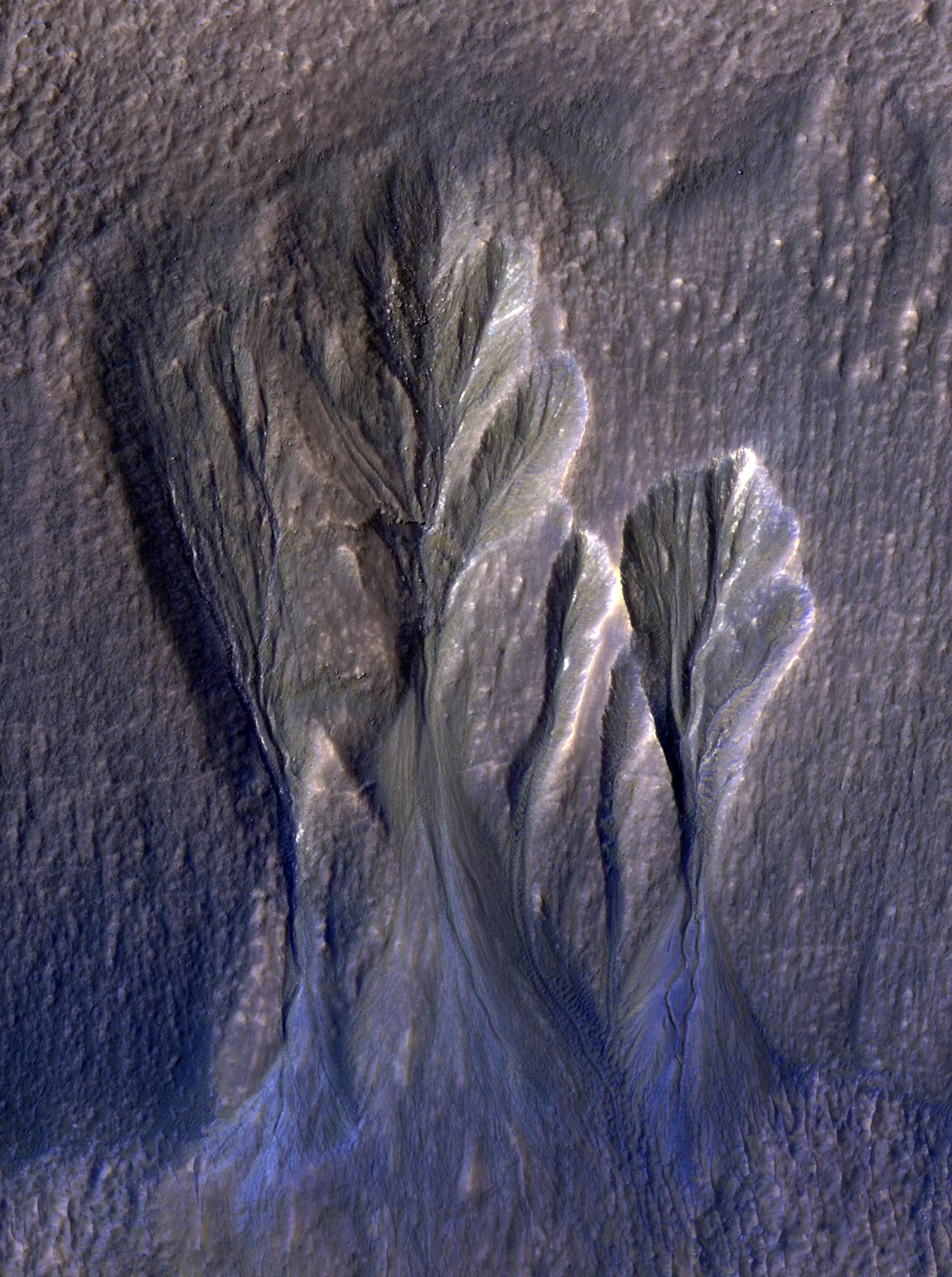
In 2021, Christensen and Khuller co-authored a paper on the discovery of dusty water ice exposed within gullies on Mars, proposing that many Martian gullies form by erosion caused by the ice melting to form liquid water.
Photosynthesis on Mars: The Possibility
This new paper suggests that dusty ice lets in enough light for photosynthesis to occur as deep as 9 feet (3 meters) below the surface. In this scenario, the upper layers of ice prevent the shallow subsurface pools of water from evaporating while also providing protection from harmful radiation. That’s important, because unlike Earth, Mars lacks a protective magnetic field to shield it from both the Sun and radioactive cosmic ray particles zipping around space.
The study authors say the water ice that would be most likely to form subsurface pools would exist in Mars’ tropics, between 30 degrees and 60 degrees latitude, in both the northern and southern hemispheres.
Khuller next hopes to re-create some of Mars’ dusty ice in a lab to study it up close. Meanwhile, he and other scientists are beginning to map out the most likely spots on Mars to look for shallow meltwater — locations that could be scientific targets for possible human and robotic missions in the future.
For more on this research, see Mars’ Icy Mid-Latitudes Could Harbor Hidden Life.
Reference: “Potential for photosynthesis on Mars within snow and ice” by Aditya R. Khuller, Stephen G. Warren, Philip R. Christensen and Gary D. Clow, 17 October 2024, Communications Earth & Environment.
DOI: 10.1038/s43247-024-01730-y
Never miss a breakthrough: Join the SciTechDaily newsletter.
Follow us on Google and Google News.
4 Comments
Just stop. I don’t understand now. 💔
And I can’t post about it. Certainly American companies are evil. You guys destroy live for self benefit with no remorse or true understanding
Whatever you say snowflake maybe you should look at what other counties are doing such as the world leader in historical carbon emissions China who was burning hundreds of thousands of tons of cold since the least the 11th century.
Or maybe how the u.k. just switch to another form of slavery called indentured services
23:10:24. Am telling you now what I know about Space, Life, Death, Grave, Middle of the Earth, Heaven and Hell. So eventually when we met again we don’t have misunderstanding. Before now there’s Bible and Quran. Which was given to you so you know or knew how to behave yourself. Also you all have Brain you should know what rights from wrong. If you brings or causes Sorrows or any problems to this Planet I will see you in Hell and if you do good and brings joy to people you will Surely rewarded. Be good allways. We have met before and We are surely going to meet again. Stay away from my problems. For my sake. So till then Peace be upon you and to this World. Thanks. To be continued. M. Luke.
Come on we know Mars was like Earth with Civilizations in ancient times, so why interest in ancient microbes?