
Close Menu
    Facebook X (Twitter) Instagram
    SciTechDaily
    • Biology
    • Chemistry
    • Earth
    • Health
    • Physics
    • Science
    • Space
    • Technology
    Facebook X (Twitter) Pinterest YouTube RSS
    SciTechDaily
    Home»Science»Hydrogen-Bubble-Powered Microrockets Could Deliver Drugs Directly Into Patient’s Bodies
    Science

    Hydrogen-Bubble-Powered Microrockets Could Deliver Drugs Directly Into Patient’s Bodies

    By SciTechDailyJanuary 23, 2012No Comments3 Mins Read
    Facebook Twitter Pinterest Telegram LinkedIn WhatsApp Email Reddit
    Share
    Facebook Twitter LinkedIn Pinterest Telegram Email Reddit
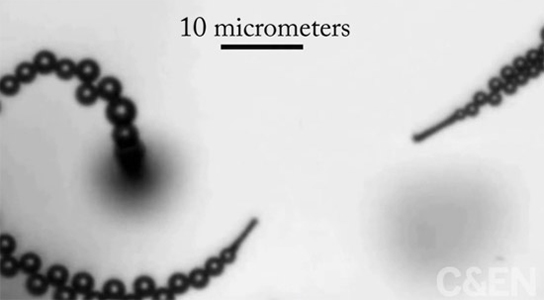
    microrockets-launching
    Scientists have developed a micromotor that can move through acidic environments using only hydrogen bubbles. Credit: Wei Gao et al.

    Researchers have been designing a wide variety of self-propelled micromotors, many which operate using an oxygen-bubble propulsion mechanism that requires a high concentration of hydrogen peroxide as fuel, which in turn is hazardous at high concentrations, hindering its usefulness in biomedical applications. In a new study, scientists have created a new type of micromotor that can propel itself through acidic environments using only hydrogen bubbles. At low pH levels, the micromotors can travel at speeds of up to 100 body lengths per second, prompting the colloquial use of microrockets to designate these devices.
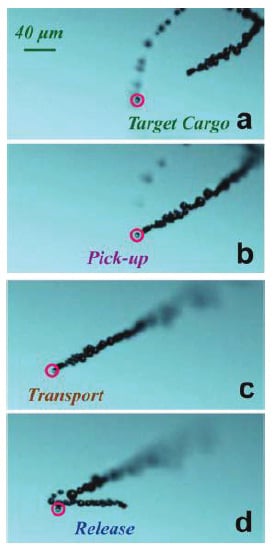
    microrockets-pickup
    Credit: Wei Gao et al.

    Wei Gao, Ayesegul Uygun and Joseph Wang from the University of California, San Diego, published their study on hydrogen-bubble-powered mircorockets in the most recent issue of the Journal of the American Chemical Society. They state that this is the first reported use of chemically-powered microrockets that can be self-propelled without any external fuel. These acid-powered microrockets could expand the scope of nano- and microscale motor applications in extreme environments, such as the human stomach or silicon wet-etching baths. This could lead to targeted drug delivery systems or nano-imaging.

    The microrockets in questions are the shape of tiny tubes, measuring about 10 micrometers in length, with diameters of 2 to 5 micrometers, and were fabricated out of common polymer polyaniline using templates, then electro-deposited on a thin layer of zinc on the inner surface. When the rockets are immersed in a highly acidic solution, the zinc loses its electrons, and due to having a more negative redox potential than hydrogen, promotes the production of hydrogen bubbles. Experimentally, zinc produced more bubbles than iron or lead.

    The speed of the microrockets seems to increase as the pH of the solution decreases, and the fastest speed of 1,050 micrometers per second was achieved by a 5-micrometer-diameter microrocket at a pH of 0.2. Tests show that the speed decreased about 10 micrometers per second at a pH of 1.3. Researchers noted that these microrockets could be used safely in human stomachs and in some types of human serum. The overall lifetime of the microrockets varies from 10 seconds to 2 minutes, depending on the rate of zinc dissolution.

    The microrockets can move around autonomously, but they have been controlled by depositing a magnetic layer on the microrocket’s outer surface, allowing a magnet to guide the device into the right direction. The researchers showed that a microrocket could magnetically capture a polystyrene cargo, transport it on a predetermined path, and then release it.

    In acid rich environments, the scope of the micromotors could be further expanded but researchers hope to optimize and improve the microrockets so that they will function in milder settings, as well as extending their lifetime.

    Never miss a breakthrough: Join the SciTechDaily newsletter.
    Follow us on Google and Google News.

    Biomedical Bubbles Hydrogen Medical Microtechnology Nanotechnology Oxygen Stomach
    Share. Facebook Twitter Pinterest LinkedIn Email Reddit

    Related Articles

    For the First Time Ever: Watch Water Form Out of Thin Air

    Innovative Hydrogen Boride Nanosheets: Huge Potential As Hydrogen Carrier

    Researchers Uncover Why Lithium Iron Phosphate Works So Well

    DNA Motor Navigates Programmable Network of Tracks

    Women’s Hearts Getting Bad Message from BPA

    Maggots May Clean Wounds Faster Than Surgery

    Will a New Drug that Boosts Mouse Memory be Alzheimer’s Cure?

    Microscopic Origami Boxes Fold-Up on Their Own

    Shock the Brain for Faster Learning

    Leave A Reply Cancel Reply

    • Facebook
    • Twitter
    • Pinterest
    • YouTube

    Don't Miss a Discovery

    Subscribe for the Latest in Science & Tech!

    Trending News

    Scientists Recreate a Nuclear Fireball and Uncover Fallout’s Hidden Chemistry

    These Tiny Gut Particles Could Be Accelerating Aging Throughout the Body

    Doctors Changed One Thing and Weight Gain Stopped

    Magnetic Fields May Solve a Longstanding Binary Star Mystery

    The Probiotic Breakthrough for Natural Anxiety Relief and Better Mental Health

    Animal vs. Plant Protein: Scientists Found a Surprising Nutritional Difference

    According to Scientists, This Simple Dietary Change Is Linked to Lower Depression Scores

    Researchers Discover a Hidden Vitamin D Problem That Persists Year-Round

    Follow SciTechDaily
    • Facebook
    • Twitter
    • YouTube
    • Pinterest
    • Newsletter
    • RSS
    SciTech News
    • Biology News
    • Chemistry News
    • Earth News
    • Health News
    • Physics News
    • Science News
    • Space News
    • Technology News
    Recent Posts
    • Astronomers Find Strongest Evidence Yet for Magnetic Fields on Alien Worlds
    • Astronomers Unveil Record-Breaking Haul of 161 New Black Hole Collisions
    • Ancient Meteorite Reveals a Forgotten Planet That Existed 4.5 Billion Years Ago
    • Mini Brain Organoids Expose Hidden Biological Differences in Alzheimer’s Disease
    • Scientists Recommend Doing This To Reduce Anxiety During Pregnancy
    Copyright © 1998 - 2026 SciTechDaily. All Rights Reserved.
    • Science News
    • About
    • Contact
    • Editorial Board
    • Privacy Policy
    • Terms of Use

    Type above and press Enter to search. Press Esc to cancel.