
Close Menu
    Facebook X (Twitter) Instagram
    SciTechDaily
    • Biology
    • Chemistry
    • Earth
    • Health
    • Physics
    • Science
    • Space
    • Technology
    Facebook X (Twitter) Pinterest YouTube RSS
    SciTechDaily
    Home»Science»DNA Motor Navigates Programmable Network of Tracks
    Science

    DNA Motor Navigates Programmable Network of Tracks

    By Kyoto UniversityJanuary 23, 2012No Comments2 Mins Read
    Facebook Twitter Pinterest Telegram LinkedIn WhatsApp Email Reddit
    Share
    Facebook Twitter LinkedIn Pinterest Telegram Email Reddit
    DNA origami tile with a built-in network of tracks
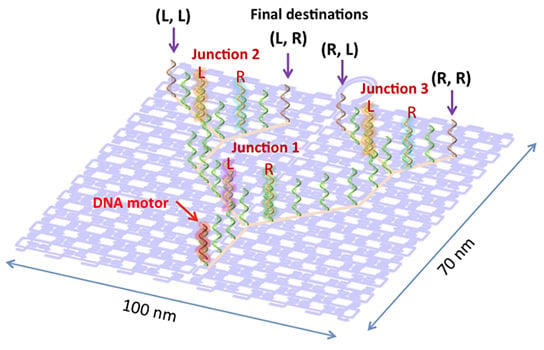
    A depiction of a DNA origami tile with a built-in network of tracks. The DNA engine or motor, in red, can be programmed to navigate a series of junctions to reach one of four desired endpoints. Credit: Sugiyama Lab, Kyoto University iCeMS

    Researchers at Kyoto University and the University of Oxford utilized DNA origami to build a motor capable of traversing a network of tracks and switches. This technology demonstrates the capability of nanoscale devices to function autonomously, and may pave the way for even more complex systems.

    Kyoto, Japan — Expanding on previous work with engines traveling on straight tracks, a team of researchers at Kyoto University and the University of Oxford have successfully used DNA building blocks to construct a motor capable of navigating a programmable network of tracks with multiple switches. The findings, published in the January 22 online edition of the journal Nature Nanotechnology, are expected to lead to further developments in the field of nanoengineering.

    The research utilizes the technology of DNA origami, where strands of DNA molecules are sequenced in a way that will cause them to self-assemble into desired 2D and even 3D structures. In this latest effort, the scientists built a network of tracks and switches atop DNA origami tiles, which made it possible for motor molecules to travel along these rail systems.

    “We have demonstrated that it is not only possible to build nanoscale devices that function autonomously,” explained Dr. Masayuki Endo of Kyoto University’s Institute for Integrated Cell-Material Sciences (iCeMS), “but that we can cause such devices to produce predictable outputs based on different, controllable starting conditions.”

    The team, including lead author Dr. Shelley Wickham at Oxford, expects that the work may lead to the development of even more complex systems, such as programmable molecular assembly lines and sophisticated sensors.

    This research is published as “A DNA-based molecular motor that can navigate a network of tracks” in Nature Nanotechnology and in the Kyoto University Research Information Repository (KURENAI).

    Reference: “A DNA-based molecular motor that can navigate a network of tracks” by Shelley F. J. Wickham, Jonathan Bath, Yousuke Katsuda, Masayuki Endo, Kumi Hidaka, Hiroshi Sugiyama and Andrew J. Turberfield, 22 January 2012, Nature Nanotechnology.
    DOI: 10.1038/nnano.2011.253

    Never miss a breakthrough: Join the SciTechDaily newsletter.
    Follow us on Google and Google News.

    DNA DNA Origami Kyoto University Nanotechnology University of Oxford
    Share. Facebook Twitter Pinterest LinkedIn Email Reddit

    Related Articles

    Researchers Successfully Extract Ancient DNA From 2,900-Year-Old Clay Brick

    Triplex Origami: A Game-Changer in Gene Therapy and DNA Nanotechnology

    DNA Nano-Device Injection Found To Be Safe for Medical Use

    Silk’s Nano-Scale Fibrils Give It Cryogenic Toughness to Thrive in Outer Space Temperatures

    Nanoscale Cage Allows Before-and-After Sequencing of DNA Strand

    New Computer Model Designs Complicated 3D Structures From DNA

    Study Shows Nanoparticles in Consumer Products Can Damage DNA

    Microscopic Origami Boxes Fold-Up on Their Own

    The Less Birds Know, The Better

    Leave A Reply Cancel Reply

    • Facebook
    • Twitter
    • Pinterest
    • YouTube

    Don't Miss a Discovery

    Subscribe for the Latest in Science & Tech!

    Trending News

    New Study Reveals Why Ozempic Works Better for Some People Than Others

    Climate Change Is Altering a Key Greenhouse Gas in a Way Scientists Didn’t Expect

    New Study Suggests Gravitational Waves May Have Created Dark Matter

    Scientists Discover Why the Brain Gets Stuck in Schizophrenia

    Scientists Engineer “Tumor-Eating” Bacteria That Devour Cancer From Within

    Even “Failed” Diets May Deliver Long-Term Health Gains, Study Finds

    NIH Scientists Discover Powerful New Opioid That Relieves Pain Without Dangerous Side Effects

    Collapsing Plasma May Hold the Key to Cosmic Magnetism

    Follow SciTechDaily
    • Facebook
    • Twitter
    • YouTube
    • Pinterest
    • Newsletter
    • RSS
    SciTech News
    • Biology News
    • Chemistry News
    • Earth News
    • Health News
    • Physics News
    • Science News
    • Space News
    • Technology News
    Recent Posts
    • The Surprising Reason You Might Want To Sleep Without a Pillow
    • Household Cats Could Hold the Secret to Fighting Breast Cancer
    • Scientists Say This Natural Hormone Reverses Obesity by Targeting the Brain
    • This 15,000-Year-Old Discovery Changes What We Know About Early Human Creativity
    • 35-Million-Year-Old Mystery: Strange Arachnid Discovered Preserved in Amber
    Copyright © 1998 - 2026 SciTechDaily. All Rights Reserved.
    • Science News
    • About
    • Contact
    • Editorial Board
    • Privacy Policy
    • Terms of Use

    Type above and press Enter to search. Press Esc to cancel.