

Close Menu
    Facebook X (Twitter) Instagram
    SciTechDaily
    • Biology
    • Chemistry
    • Earth
    • Health
    • Physics
    • Science
    • Space
    • Technology
    Facebook X (Twitter) Pinterest YouTube RSS
    SciTechDaily
    Home»Space»Revolutionary “New Lens” Into the Universe’s Most Energetic Particles
    Space

    Revolutionary “New Lens” Into the Universe’s Most Energetic Particles

    By Osaka Metropolitan UniversityOctober 12, 2023No Comments3 Mins Read
    Facebook Twitter Pinterest Telegram LinkedIn WhatsApp Email Reddit
    Share
    Facebook Twitter LinkedIn Pinterest Telegram Email Reddit
    Energetic Particles Space Art Concept
    Scientists from Osaka Metropolitan University have harnessed the Subaru Telescope to observe cosmic-ray showers with unprecedented clarity. This new method could lead to profound discoveries about the Universe, including insights into dark matter.

    Cosmic-ray extensive air showers observed by Subaru Hyper Suprime-Cam with unprecedented precision.

    Showers in bathrooms bring us comfort; showers from space bring astrophysicists joy. Osaka Metropolitan University scientists have observed, with their novel method, cosmic-ray extensive air showers with unprecedented precision, opening the door to new insights into the Universe’s most energetic particles.

    Subaru Telescope’s Unexpected Potential

    When a high-energy cosmic ray collides with the Earth’s atmosphere, it generates an enormous number of particles known as an extensive air shower. A research team led by Associate Professor Toshihiro Fujii from the Graduate School of Science and Nambu Yoichiro Institute of Theoretical and Experimental Physics at Osaka Metropolitan University, along with graduate student Fraser Bradfield, has discovered that the prime-focus wide field camera mounted on the Subaru Telescope, situated atop the Mauna Kea volcano in Hawaii, can capture these extensive air showers with extremely high resolution.
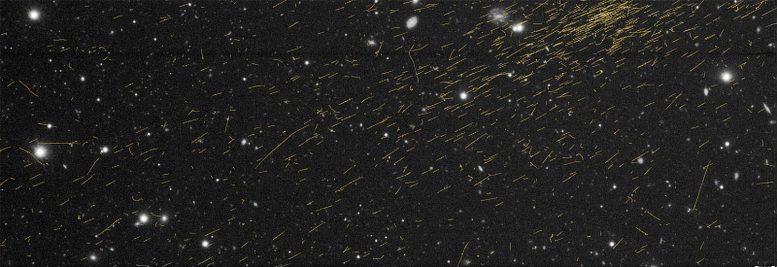
    Cosmic-Ray Extensive Air Shower
    An example of a cosmic-ray extensive air shower recorded by the Subaru Telescope. The highlighted tracks, which are mostly aligned in similar directions, show the shower particles induced from a high-energy cosmic ray. Credit: National Astronomical Observatory of Japan, Hyper Suprime-Cam (HSC) Collaboration

    The Subaru Telescope was designed for observational astronomy. Cosmic rays, appearing as “tracks” on the observed images and obscuring the targeted stars or galaxies, are dismissed as noise by usual astronomical data processing. However, this team’s research focuses on that very “noise.” Analyzing approximately 17,000 images captured between 2014 and 2020, the research team pinpointed 13 images that contained extensive air showers. These images displayed a far larger number of particle tracks than usual.

    Revolutionizing Observational Methods

    “With conventional observation methods, it is challenging to distinguish between the types of particles that constitute extensive air showers,” explained Professor Fujii. “Our method, on the other hand, has the potential to determine the nature of individual particles.”

    Professor Fujii added, “Furthermore, by integrating our method with conventional approaches, we hope to advance our understanding of extensive air showers. This technique may allow us to search for dark matter or other exotic particles, offering additional insights into the transition of the Universe into a matter-dominated era.”

    Their results are set for publication in Scientific Reports on October 12, 2023.

    Reference: “Observing cosmic-ray extensive air showers with a silicon imaging detector” by Satoshi Kawanomoto, Michitaro Koike, Fraser Bradfield, Toshihiro Fujii, Yutaka Komiyama, Satoshi Miyazaki, Tomoki Morokuma, Hitoshi Murayama, Masamune Oguri and Tsuyoshi Terai, 12 October 2023, Scientific Reports.
    DOI: 10.1038/s41598-023-42164-4

    Never miss a breakthrough: Join the SciTechDaily newsletter.
    Follow us on Google and Google News.

    Astronomy Astrophysics Osaka Metropolitan University Popular
    Share. Facebook Twitter Pinterest LinkedIn Email Reddit

    Related Articles

    AI Cracks a Cosmic Mystery, Revealing Hidden Bubbles in the Milky Way

    Not Science Fiction: Earth Hit by Unknown, Extremely High-Energy Particle

    Cosmic X-Rays Reveal a Distinctive Signature of Black Hole Event Horizons

    Popular Theory About the Early Solar System Called Into Doubt by Meteorite Evidence

    Massive Hunt for Extraterrestrial Life Completed: What Astronomers Found in Search of 10 Million Star Systems for Alien Technology

    Closing In on Source of Fast Radio Bursts: VLBA Makes First Direct Distance Measurement to Magnetar

    A White Dwarf’s Surprise Planetary Companion: First-of-Its-Kind Exoplanet Detected Around Dead Star

    The Evolving Volatile Chemistry of Protoplanetary Disks

    How Fast Is the Universe Expanding? Measuring Cosmic Expansion With Radio Astronomy and Gravitational Waves

    Leave A Reply Cancel Reply

    • Facebook
    • Twitter
    • Pinterest
    • YouTube

    Don't Miss a Discovery

    Subscribe for the Latest in Science & Tech!

    Trending News

    JWST Finds a “Star” 100 Billion Times Brighter Than Any Star Should Be

    Scientists Find a Hidden Biological Link Across Different Forms of Autism

    Astronomers Discover a Ghostly River of Stars That Could Reveal Dark Matter

    Why Is Colorectal Cancer Rising in People Under 50? New Clues Point to the Environment

    Quantum Fluctuations Break a Crystal’s Symmetry Rules

    Why Does an Irregular Heartbeat Strike 40 Years Early in Some People?

    Scientists Reveal How ADHD Could Fuel Creative Thinking

    Scientists Find Just 3 Minutes of Sprinting Can Transform Blood Chemistry

    Follow SciTechDaily
    • Facebook
    • Twitter
    • YouTube
    • Pinterest
    • Newsletter
    • RSS
    SciTech News
    • Biology News
    • Chemistry News
    • Earth News
    • Health News
    • Physics News
    • Science News
    • Space News
    • Technology News
    Recent Posts
    • T Cells Have a Hidden Ability Scientists Never Knew Existed
    • This Grain-of-Rice-Sized “Rainbow” Chip Could Transform 6G Communications
    • Physicists Discover Time Crystals Can Communicate Across a Semiconductor
    • Scientists Finally Solve a 20-Year Mystery About Diamond Melting
    • Common Vape Flavor May Disrupt Early Human Development
    Copyright © 1998 - 2026 SciTechDaily. All Rights Reserved.
    • Science News
    • About
    • Contact
    • Editorial Board
    • Privacy Policy
    • Terms of Use

    Type above and press Enter to search. Press Esc to cancel.