
Close Menu
    Facebook X (Twitter) Instagram
    SciTechDaily
    • Biology
    • Chemistry
    • Earth
    • Health
    • Physics
    • Science
    • Space
    • Technology
    Facebook X (Twitter) Pinterest YouTube RSS
    SciTechDaily
    Home»Space»Closing In on Source of Fast Radio Bursts: VLBA Makes First Direct Distance Measurement to Magnetar
    Space

    Closing In on Source of Fast Radio Bursts: VLBA Makes First Direct Distance Measurement to Magnetar

    By National Radio Astronomy ObservatorySeptember 19, 2020No Comments4 Mins Read
    Facebook Twitter Pinterest Telegram LinkedIn WhatsApp Email Reddit
    Share
    Facebook Twitter LinkedIn Pinterest Telegram Email Reddit
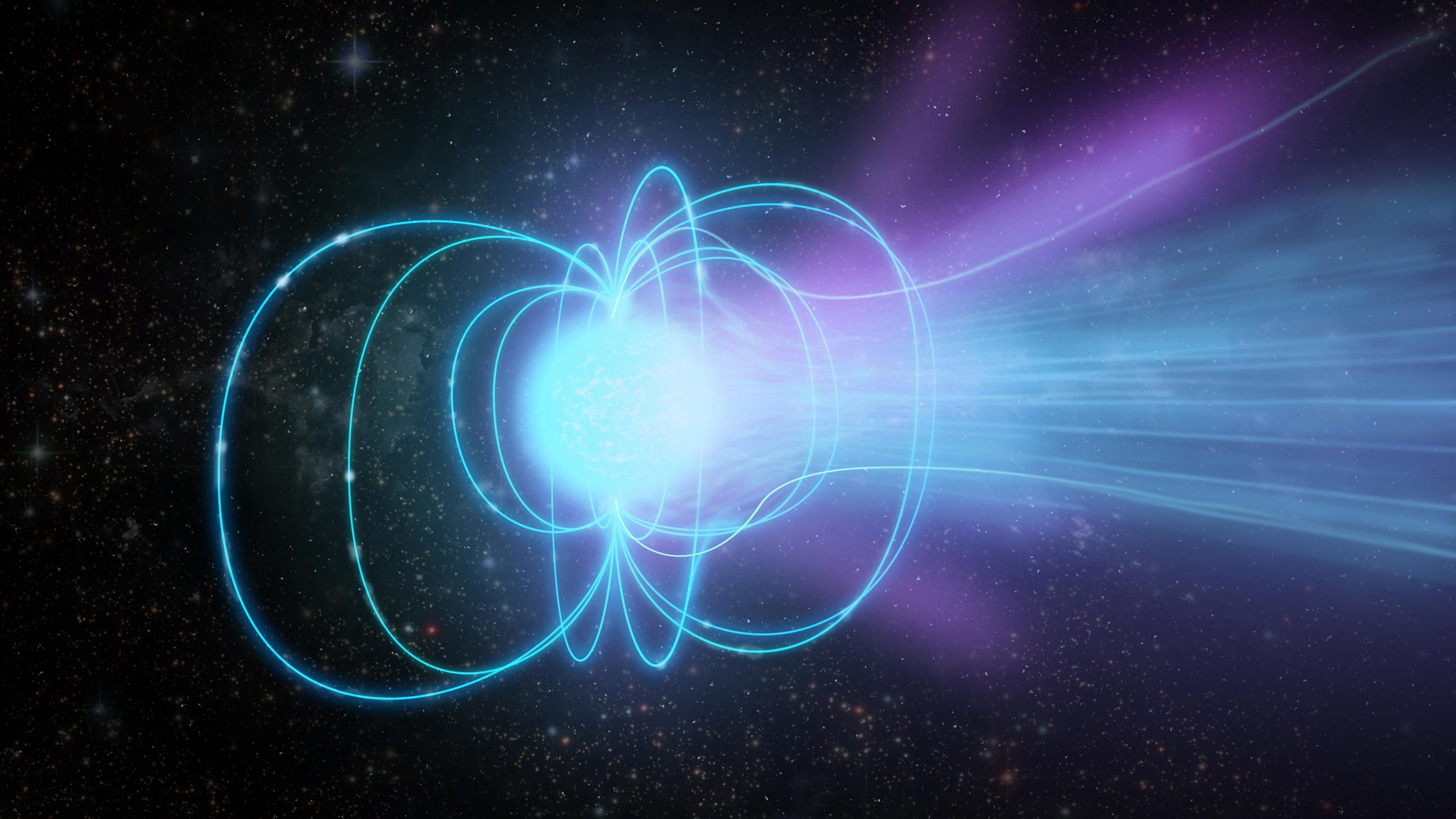
    Magnetar Artists Conception
    Artist’s conception of a magnetar — a superdense neutron star with an extremely strong magnetic field. In this illustration, the magnetar is emitting a burst of radiation. Credit: Sophia Dagnello, NRAO/AUI/NSF

    Astronomers using the National Science Foundation’s Very Long Baseline Array (VLBA) have made the first direct geometric measurement of the distance to a magnetar within our Milky Way Galaxy — a measurement that could help determine if magnetars are the sources of the long-mysterious Fast Radio Bursts (FRBs).

    Magnetars are a variety of neutron stars — the superdense remains of massive stars that exploded as supernovae — with extremely strong magnetic fields. A typical magnetar magnetic field is a trillion times stronger than the Earth’s magnetic field, making magnetars the most magnetic objects in the Universe. They can emit strong bursts of X-rays and gamma rays, and recently have become a leading candidate for the sources of FRBs.

    A magnetar called XTE J1810-197, discovered in 2003, was the first of only six such objects found to emit radio pulses. It did so from 2003 to 2008, then ceased for a decade. In December 2018, it resumed emitting bright radio pulses.

    A team of astronomers used the VLBA to regularly observe XTE J1810-197 from January to November 2019, then again during March and April of 2020. By viewing the magnetar from opposite sides of the Earth’s orbit around the Sun, they were able to detect a slight shift in its apparent position with respect to background objects much more distant. This effect, called parallax, allows astronomers to use geometry to directly calculate the object’s distance.
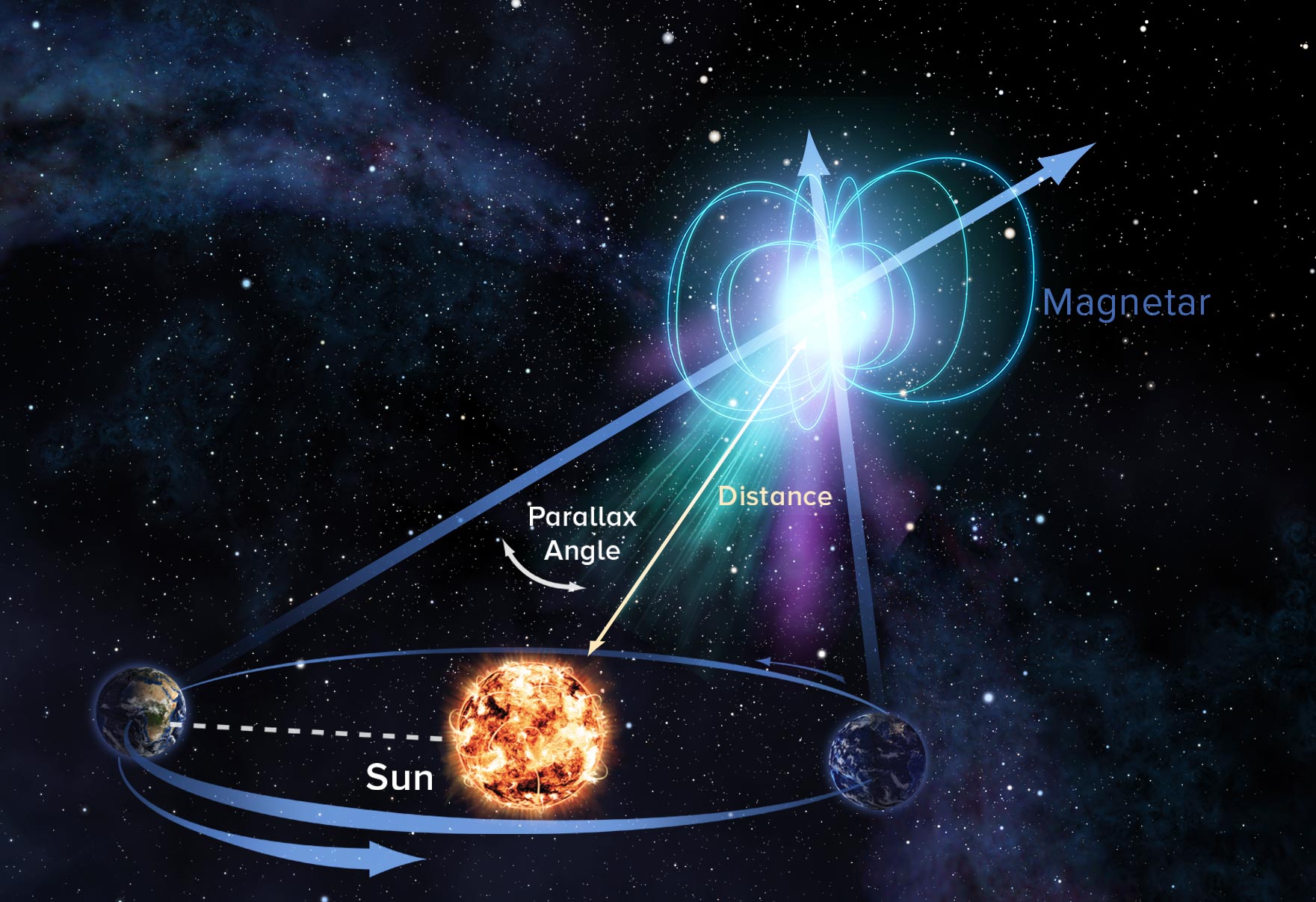
    Parallax Magnetar
    By observing an object from opposite sides of the Earth’s orbit around the Sun, as illustrated in this artist’s conception, astronomers were able to detect the slight shift in the object’s apparent position with respect to much more distant background objects. This effect, called parallax, allows scientists then to use geometry to directly calculate the distance to the object — in this case a magnetar within our own Milky Way galaxy. The illustration is not to scale. Credit: Sophia Dagnello, NRAO/AUI/NSF

    “This is the first parallax measurement for a magnetar, and shows that it is among the closest magnetars known — at about 8100 light-years — making it a prime target for future study,” said Hao Ding, a graduate student at the Swinburne University of Technology in Australia.

    On April 28, a different magnetar, called SGR 1935+2154, emitted a brief radio burst that was the strongest ever recorded from within the Milky Way. While not as strong as FRBs coming from other galaxies, this burst suggested to astronomers that magnetars could generate FRBs.

    Fast radio bursts were first discovered in 2007. They are very energetic, and last at most a few milliseconds. Most have come from outside the Milky Way. Their origin remains unknown, but their characteristics have indicated that the extreme environment of a magnetar could generate them.

    “Having a precise distance to this magnetar means that we can accurately calculate the strength of the radio pulses coming from it. If it emits something similar to an FRB, we will know how strong that pulse is,” said Adam Deller, also of Swinburne University. “FRBs vary in their strength, so we would like to know if a magnetar pulse comes close or overlaps with the strength of known FRBs,” he added.

    “A key to answering this question will be to get more distances to magnetars, so we can expand our sample and obtain more data. The VLBA is the ideal tool for doing this,” said Walter Brisken, of the National Radio Astronomy Observatory.

    In addition, “We know that pulsars, such as the one in the famous Crab Nebula, emit ‘giant pulses,’ much stronger than their usual ones. Determining the distances to magnetars will help us understand this phenomenon, and learn if maybe FRBs are the most extreme example of giant pulses,” Ding said.

    The ultimate goal is to determine the exact mechanism that produces FRBs, the scientists said.

    Ding, Deller, Brisken, and their colleagues reported their results in the Monthly Notices of the Royal Astronomical Society.

    Reference: “A magnetar parallax” by H Ding, A T Deller, M E Lower, C Flynn, S Chatterjee, W Brisken, N Hurley-Walker, F Camilo, J Sarkissian and V Gupta, 21 August 2020, Monthly Notices of the Royal Astronomical Society.
    DOI: 10.1093/mnras/staa2531

    The National Radio Astronomy Observatory is a facility of the National Science Foundation, operated under cooperative agreement by Associated Universities, Inc.

    Never miss a breakthrough: Join the SciTechDaily newsletter.
    Follow us on Google and Google News.

    Astronomy Astrophysics National Radio Astronomy Observatory Popular
    Share. Facebook Twitter Pinterest LinkedIn Email Reddit

    Related Articles

    Stellar Collision Triggers Supernova Explosion – “This Is the First Time We’ve Actually Seen Such an Event”

    Gas Re-Accretion Observed in Dying Galaxies for the First Time

    Mind the Gap: Direct Link Uncovered Between Protoplanetary Disk Structures and Giant Exoplanets

    Young Chaotic Star System Reveals Secrets of Planet Formation

    Map of the Nearby Universe Created by Cosmic Cartographers Reveals the Diversity of Star-Forming Galaxies

    Cosmic Lens Reveals Faint Radio Galaxy More Than 8 Billion Light-Years From Earth

    Astronomers Discover Powerful, Newborn, Radio-Emitting Jets in Distant Galaxies

    Volcanic Impact on Jupiter’s Moon Io Shown Directly for the First Time

    How Fast Is the Universe Expanding? Measuring Cosmic Expansion With Radio Astronomy and Gravitational Waves

    Leave A Reply Cancel Reply

    • Facebook
    • Twitter
    • Pinterest
    • YouTube

    Don't Miss a Discovery

    Subscribe for the Latest in Science & Tech!

    Trending News

    The Universe Is Expanding Too Fast and Scientists Can’t Explain Why

    “Like Liquid Metal”: Scientists Create Strange Shape-Shifting Material

    Early Warning Signals of Esophageal Cancer May Be Hiding in Plain Sight

    Common Blood Pressure Drug Shows Surprising Power Against Deadly Antibiotic-Resistant Superbug

    Scientists Uncover Dangerous Connection Between Serotonin and Heart Valve Disease

    Scientists Discover a “Protector” Protein That Could Help Reverse Hair Loss

    Bone-Strengthening Discovery Could Reverse Osteoporosis

    Scientists Uncover Hidden Trigger Behind Stem Cell Aging

    Follow SciTechDaily
    • Facebook
    • Twitter
    • YouTube
    • Pinterest
    • Newsletter
    • RSS
    SciTech News
    • Biology News
    • Chemistry News
    • Earth News
    • Health News
    • Physics News
    • Science News
    • Space News
    • Technology News
    Recent Posts
    • Scientists Overcome Major Quantum Bottleneck, Potentially Transforming Teleportation and Computing
    • Quantum Physics’ Strangest Problem May Hold the Key to Time Itself
    • Scientists Create “Liquid Gears” That Spin Without Touching
    • The Simple Habit That Could Help Prevent Cancer
    • Forgotten Medicinal Plant Shows Promise in Fighting Dangerous Superbugs
    Copyright © 1998 - 2026 SciTechDaily. All Rights Reserved.
    • Science News
    • About
    • Contact
    • Editorial Board
    • Privacy Policy
    • Terms of Use

    Type above and press Enter to search. Press Esc to cancel.