
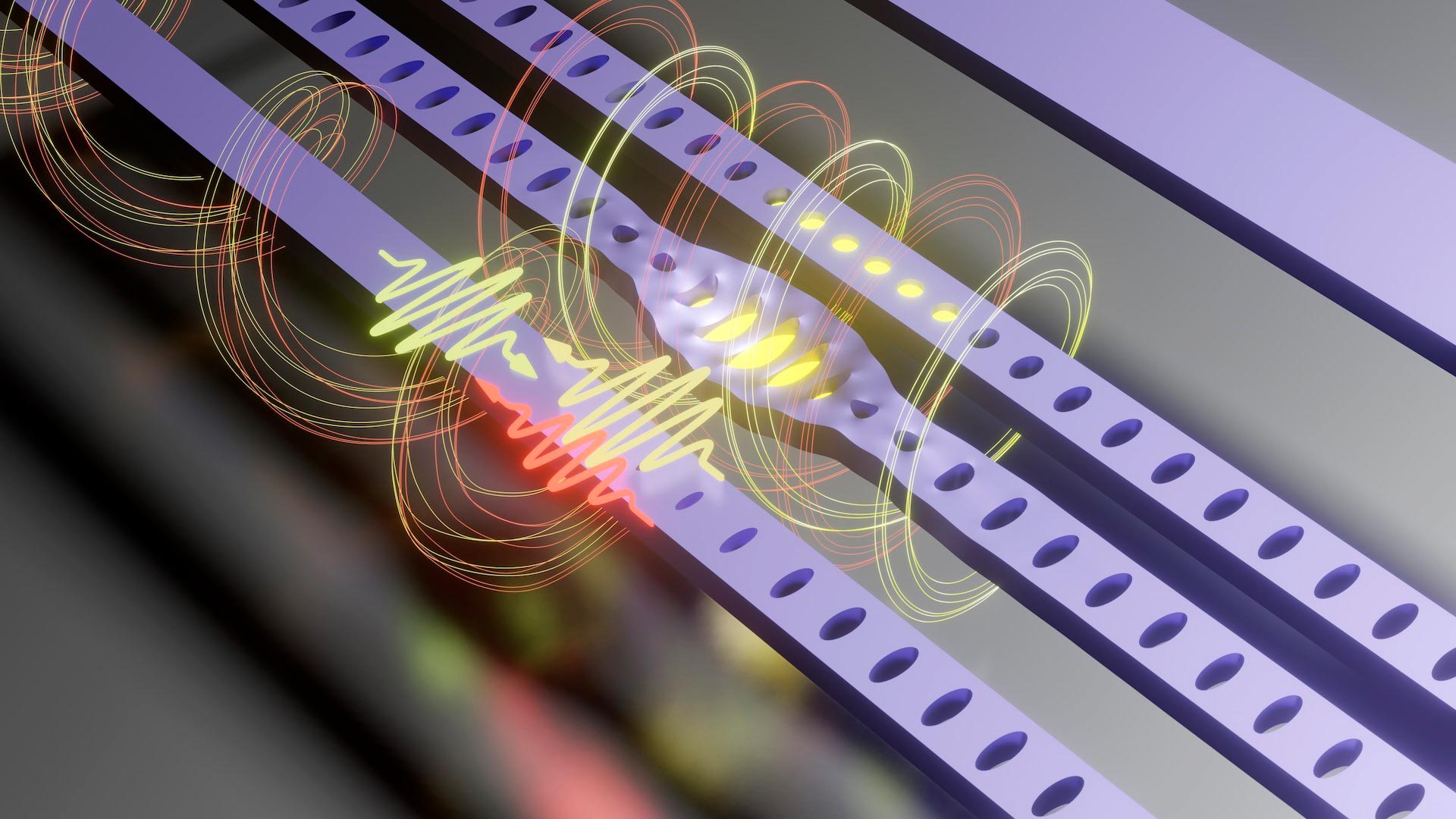
A groundbreaking study introduces advanced nanometric optomechanical cavities, paving the way for more efficient quantum networks and improving quantum computing and communication technologies.
The ability to transmit information coherently in the band of the electromagnetic spectrum from microwave to infrared is vitally important to the development of the advanced quantum networks used in computing and communications.
A study conducted by researchers at the State University of Campinas (UNICAMP) in Brazil, in collaboration with colleagues at ETH Zurich in Switzerland and TU Delft in the Netherlands, focused on the use of nanometric optomechanical cavities for this purpose. These nanoscale resonators promote interaction between high-frequency mechanical vibrations and infrared light at wavelengths used by the telecommunications industry.
An article on the study was published recently in the journal Nature Communications.
Bridging Superconducting Circuits and Optical Fibers
“Nanomechanical resonators act as bridges between superconducting circuits and optical fibers. Superconducting circuits are currently among the most promising technologies for quantum computing, while optical fibers are routinely used as long-distance transmitters of information with little noise and no signal loss,” said Thiago Alegre, a professor at the Gleb Wataghin Institute of Physics (IFGW-UNICAMP) and last author of the article.
According to Alegre, one of the key innovations in the study was the introduction of dissipative optomechanics. Traditional optomechanical devices rely on purely dispersive interaction, where only photons confined in the cavity are efficiently dispersed. In dissipative optomechanics, photons can be scattered directly from waveguide to resonator.“Optoacoustic interaction can be controlled more tightly as a result,” he said.
Achieving Higher Mechanical Frequencies in Optomechanics
Prior to this study, dissipative optomechanical interaction had been demonstrated only at low mechanical frequencies, precluding important applications such as quantum state transfer between the photonic (optical) and phononic (mechanical) domains. The study demonstrated the first dissipative optomechanical system operating in a regime where the mechanical frequency exceeded the optical linewidth.
“We succeeded in raising mechanical frequency by two orders of magnitude and achieved a tenfold rise in the optomechanical coupling rate. This offers highly promising prospects for the development of even more effective devices,” Alegre said.
Constructing Quantum Networks
Fabricated in collaboration with TU Delft, the devices were designed to use technologies that are well-established in the semiconductor industry. Nanometric silicon beams were suspended and free to vibrate, so that infrared light and mechanical vibrations were confined simultaneously. A laterally placed waveguide positioned to permit the coupling of the optical fiber to the cavity gave rise to dissipative coupling, the key ingredient of the results presented by the researchers.
The study offers novel possibilities for the construction of quantum networks. In addition to this immediate application, it lays a basis for future fundamental research. “We expect to be able to manipulate mechanical modes individually and mitigate optical non-linearities in optomechanical devices,” Alegre said.
Reference: “Dissipative optomechanics in high-frequency nanomechanical resonators” by André G. Primo, Pedro V. Pinho, Rodrigo Benevides, Simon Gröblacher, Gustavo S. Wiederhecker and Thiago P. Mayer Alegre, 18 September 2023, Nature Communications.
DOI: 10.1038/s41467-023-41127-7
The other co-authors are André Garcia Primo, Pedro Vinícius Pinho and Gustavo Silva Wiederhecker, all of whom are also affiliated with UNICAMP; Rodrigo da Silva Benevides at ETH Zürich; and Simon Gröblacher at TU Delft. The study received funding from FAPESP via seven projects (19/09738-9, 20/15786-3, 19/01402-1, 18/15577-5, 18/15580-6, 18/25339-4 and 22/07719-0).
Never miss a breakthrough: Join the SciTechDaily newsletter.
Follow us on Google and Google News.