
Close Menu
    Facebook X (Twitter) Instagram
    SciTechDaily
    • Biology
    • Chemistry
    • Earth
    • Health
    • Physics
    • Science
    • Space
    • Technology
    Facebook X (Twitter) Pinterest YouTube RSS
    SciTechDaily
    Home»Space»The Senkyo Region of Titan
    Space

    The Senkyo Region of Titan

    By NASAMarch 5, 2015No Comments2 Mins Read
    Facebook Twitter Pinterest Telegram LinkedIn WhatsApp Email Reddit
    Share
    Facebook Twitter LinkedIn Pinterest Telegram Email Reddit
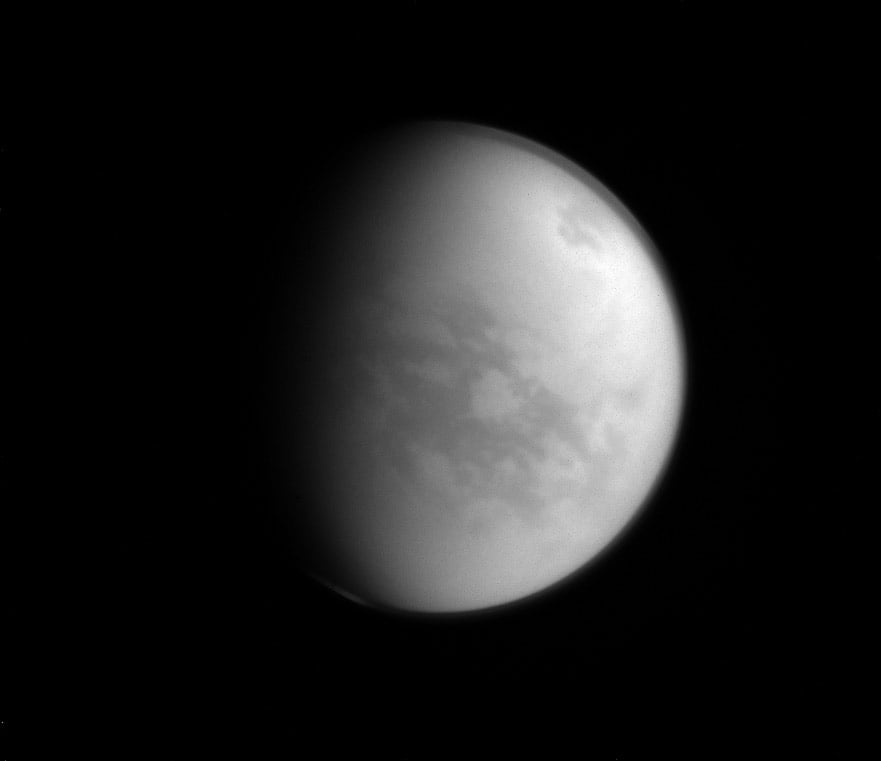
    New Image of Titan
    This image looks toward the Saturn-facing side of Titan. Credit: NASA/JPL-Caltech/Space Science Institute

    This new Cassini image was acquired at a distance of approximately 1.2 million miles and looks toward the Saturn-facing side of Titan.

    Named after a Japanese paradise, the Senkyo region of Titan (the dark area below and to the right of the center) is a bit less welcoming than its namesake.

    With a very inhospitable average temperature of approximately 290 degrees below zero Fahrenheit (-180 degrees Celsius), water on Titan (3,200 miles or 5,150 kilometers across) freezes hard enough to be essentially considered rock.

    This view looks toward the Saturn-facing side of Titan. North on Titan is up and rotated 33 degrees to the right. The image was taken with the Cassini spacecraft narrow-angle camera on January 8, 2015, using a near-infrared filter which is centered at 938 nanometers.

    The view was acquired at a distance of approximately 1.2 million miles (1.9 million kilometers) from Titan. The image scale is 7 miles (11 kilometers) per pixel.

    The Cassini mission is a cooperative project of NASA, the European Space Agency, and the Italian Space Agency. The Jet Propulsion Laboratory, a division of the California Institute of Technology in Pasadena, manages the mission for NASA’s Science Mission Directorate, Washington, D.C. The Cassini orbiter and its two onboard cameras were designed, developed, and assembled at JPL. The imaging operations center is based at the Space Science Institute in Boulder, Colorado.

    Learn more about Saturn.

    Never miss a breakthrough: Join the SciTechDaily newsletter.
    Follow us on Google and Google News.

    Astronomy Cassini-Huygens Mission Planetary Science Titan
    Share. Facebook Twitter Pinterest LinkedIn Email Reddit

    Related Articles

    Cassini Reveals Clues about Saturn’s Moon Titan

    New Cassini Images of Titan’s Hydrocarbon Seas and Lakes

    NASA’s Cassini Detects Propylene on Titan for the First Time

    Cassini Reveals a Rigid and Weathered Ice Shell on Titan

    Cassini Helps Explain the Mystery of the Missing Waves on Titan

    Cassini Data Confirms PAHs Play Major Role in Production of Lower Haze on Titan

    Scientists Use Cassini Data to Create First Global Topographic Map of Titan

    Titan’s Methane May Run Out

    Cassini Spots a Nile Like River Valley on Titan

    Leave A Reply Cancel Reply

    • Facebook
    • Twitter
    • Pinterest
    • YouTube

    Don't Miss a Discovery

    Subscribe for the Latest in Science & Tech!

    Trending News

    Scientists Recreate a Nuclear Fireball and Uncover Fallout’s Hidden Chemistry

    These Tiny Gut Particles Could Be Accelerating Aging Throughout the Body

    Doctors Changed One Thing and Weight Gain Stopped

    Magnetic Fields May Solve a Longstanding Binary Star Mystery

    The Probiotic Breakthrough for Natural Anxiety Relief and Better Mental Health

    Animal vs. Plant Protein: Scientists Found a Surprising Nutritional Difference

    According to Scientists, This Simple Dietary Change Is Linked to Lower Depression Scores

    Researchers Discover a Hidden Vitamin D Problem That Persists Year-Round

    Follow SciTechDaily
    • Facebook
    • Twitter
    • YouTube
    • Pinterest
    • Newsletter
    • RSS
    SciTech News
    • Biology News
    • Chemistry News
    • Earth News
    • Health News
    • Physics News
    • Science News
    • Space News
    • Technology News
    Recent Posts
    • Astronomers Find Strongest Evidence Yet for Magnetic Fields on Alien Worlds
    • Astronomers Unveil Record-Breaking Haul of 161 New Black Hole Collisions
    • Ancient Meteorite Reveals a Forgotten Planet That Existed 4.5 Billion Years Ago
    • Mini Brain Organoids Expose Hidden Biological Differences in Alzheimer’s Disease
    • Scientists Recommend Doing This To Reduce Anxiety During Pregnancy
    Copyright © 1998 - 2026 SciTechDaily. All Rights Reserved.
    • Science News
    • About
    • Contact
    • Editorial Board
    • Privacy Policy
    • Terms of Use

    Type above and press Enter to search. Press Esc to cancel.