
Researchers analyzed emission data from quasar 3C 273 using two theoretical models, revealing complexities in understanding quasar behavior and the mechanics of supermassive black holes.
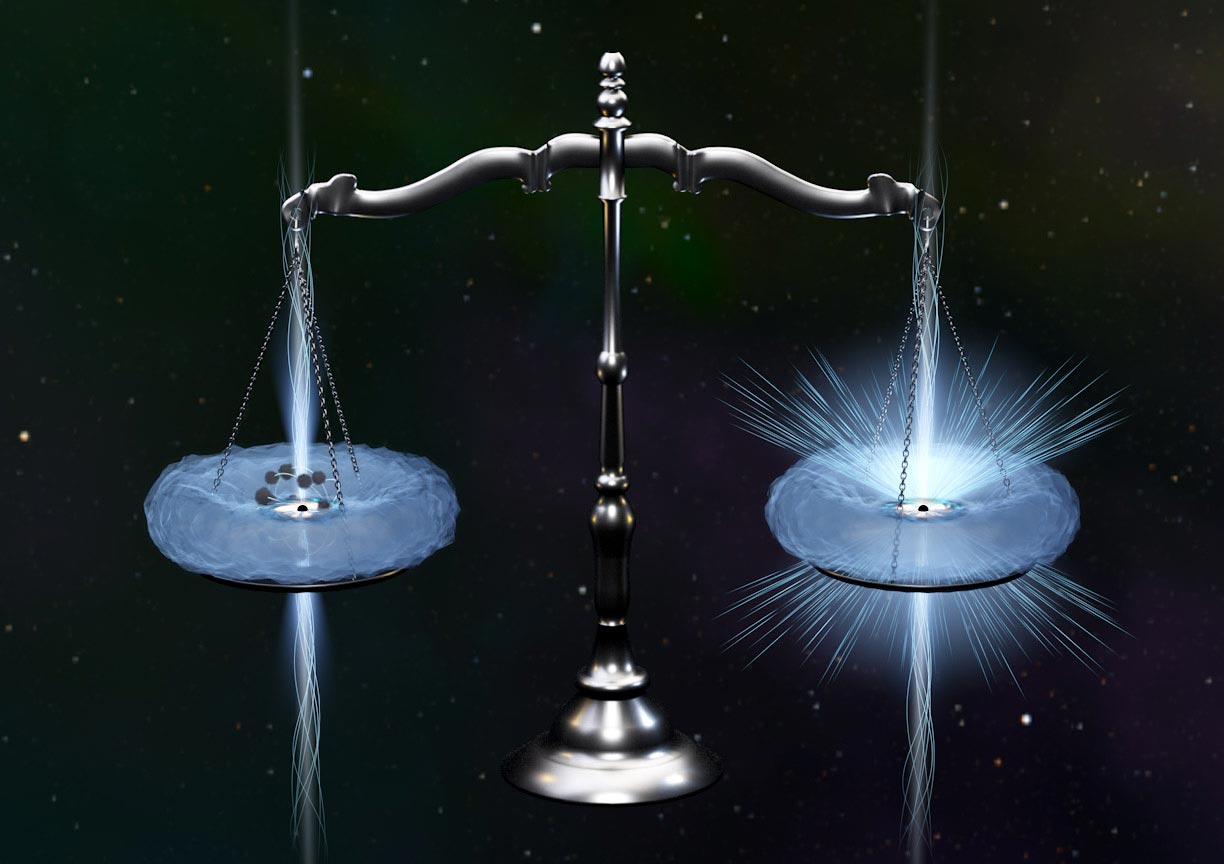
In a new paper in The Astrophysical Journal, JILA Fellow Jason Dexter, graduate student Kirk Long, and other collaborators compared two main theoretical models for emission data for a specific quasar, 3C 273. Using these theoretical models, astrophysicists like Dexter can better understand how these quasars form and change over time.
Quasars, or active galactic nuclei (AGN), are believed to be powered by supermassive black holes at their centers. Among the brightest objects in the universe, quasars emit a brilliant array of light across the electromagnetic spectrum. This emission carries vital information about the nature of the black hole and surrounding regions, providing clues that astrophysicists can exploit to better understand the black hole’s dynamics.
A Tale of Two Models
Light emission from a quasar gives astrophysicists many insights into the mechanics of the supermassive black hole. For Dexter and Long, the emission data from quasar 3C 273 came from GRAVITY, an instrument on Chile’s VLT (Very Large Telescope). “Specifically, we used near-infrared light (too red for your eyes to see but still close enough to the visible spectrum that a ‘normal’ telescope mirror reflects it) to look at quasar 3C 273 in this work, as the emission line we care about emits in this wavelength regime,” explained Long.
Per previous findings, Long and Dexter expected the GRAVITY emission data to reveal one peak for quasar 3C 273. While this single peak is a hallmark of quasar emission spectra, the mechanism that produces it is still up for debate, as some people believe that this comes from the emission falling into the black hole and swirling within the galactic whirlpool.
Theoretical Models and Black Hole Dynamics
“But how far does this geometry extend?” asked Long. “If you were to think about this area where these emission lines come from—which we call the broad-line region—if you imagine that as a spinning disk emitting isotropically, where every part of the disk is glowing at the same temperature, you would expect to see two emission peaks.”
This is because one peak is red-shifted toward the viewer and one blue-shifted away from the viewer due to the Doppler effect.
However, as seen in the data from quasar 3C 273 (and many other quasars), there aren’t two peaks but just one. This means that the emission from the quasar is not following the simplest model, and something more complicated is happening. Astrophysicists apply various models to their data to examine the mechanisms causing the one emission peak.
Cloud and Disk-Wind Model Analysis
To better understand the data variations, Dexter and Long looked at the two main theoretical models proposed as possible underlying mechanisms: the cloud and disk-wind models. For Dexter, comparing these two models could offer more insight into the modeling process itself.
“One of the important takeaways from this is that you can actually measure the uncertainty in the mass of the black hole to quantify how wrong you are if you have the wrong model,” he added. “In this particular case, we can also check consistency because we know how we look at this black hole from other data. The view that [a] particular model [may pick may] not match the other data. So we can say that that’s probably a disfavored solution. It’s important for future work to keep in mind that the model you choose impacts the measurements you get. So, we aren’t going to know how we’re looking at these systems in general, which means it’s important to try to figure out which of these models holds water in the biggest number of cases.”
Delving Into Quasar Emission Mechanics
The cloud model proposes that the emission lines observed in quasar spectra arise from clouds of ionized gas near the central black hole. Long elaborated: “There are basically a bunch of clouds chaotically spinning around the black hole. Those clouds make the single peak because you’ve filled in more of a spherical type geometry instead of just a disk, like a star. So, you can get one peak because most of the emitting gas isn’t moving towards or away from you. The clouds are on weird tilted orbits but still in stable orbits so you can weigh the black hole.”
While the cloud model fits several quasar data sets, the mechanics don’t seem to add up. “There’s this mystery that you assume that the clouds should be falling in and swirling around in this disk,” Dexter stated. “But, if this process produces atomic gas transitions, it should produce these two peaks where you see lines. But that’s not what we see; it’s always the single peak.” To explain this difference, several astrophysicists theorize that the atomic gases have puffed up, causing a change in the emission spectra.
To address the disparity between the one and two peak emissions, other astrophysicists proposed a different model called the disk-wind model. This model suggests that the observed quasar emissions “come from the footprints of winds embedded in the disk,” Long explained. “In this model, you can still have a thin disk all the way out to the broad-line region, but now your extra assumption is that you will add shears to the disk. In our study, we added a couple of different shears because we see observational evidence for outflows and inflows, where gases are being blown away or blown in from this region.”
Comparing Models and Data
Using the University of Colorado Boulder’s supercomputing system, Dexter and Long applied the disk-wind model to the quasar 3C 273 data set to see how well it fit. From their computations, Dexter and Long found that the disk-wind model would indeed change the calculated amount for black hole mass by a factor of 5.
But the disk-wind model had more uncertainties than the cloud model, which Dexter previously analyzed. “I think, while we disfavored the disk-wind model based on our results, the only reason we can disfavor it for quasar 3C 273 is not that it actually fits the data that much worse—it actually fits the data about as well as the cloud model—it’s that it requires you to be looking at the disk in a different way than the way you would be looking at the clouds,” Long explained.
By fitting the disk-wind model to the data, Long and Dexter had to reorient their view of 3C 273 and look at it sideways. “That tells us that maybe this version of our proposed model is wrong,” added Long. “But there may be other things we could add to the disk-wind model that could better align it to the jet, so we don’t rule it out completely.”
From their results, Dexter and Long can better understand how these uncertainties may affect the larger process of “weighing” supermassive black holes, which can be leveraged by other astrophysicists when looking further into the dynamics of quasars.
Reference: “Confronting a Thin Disk-wind Launching Mechanism of Broad-line Emission in Active Galactic Nuclei with GRAVITY Observations of Quasar 3C 273” by Kirk Long, Jason Dexter, Yixian Cao, Ric Davies, Frank Eisenhauer, Dieter Lutz, Daryl Santos, Jinyi Shangguan, Taro Shimizu and Eckhard Sturm, 18 August 2023, The Astrophysical Journal.
DOI: 10.3847/1538-4357/ace4bb
Never miss a breakthrough: Join the SciTechDaily newsletter.
Follow us on Google and Google News.