
Close Menu
    Facebook X (Twitter) Instagram
    SciTechDaily
    • Biology
    • Chemistry
    • Earth
    • Health
    • Physics
    • Science
    • Space
    • Technology
    Facebook X (Twitter) Pinterest YouTube RSS
    SciTechDaily
    Home»Space»Black Hole Winds Are 100 Times More Powerful Than Astronomers Thought
    Space

    Black Hole Winds Are 100 Times More Powerful Than Astronomers Thought

    By Tohoku UniversitySeptember 10, 2026No Comments4 Mins Read
    Facebook Twitter Pinterest Telegram LinkedIn WhatsApp Email Reddit
    Share
    Facebook Twitter LinkedIn Pinterest Telegram Email Reddit
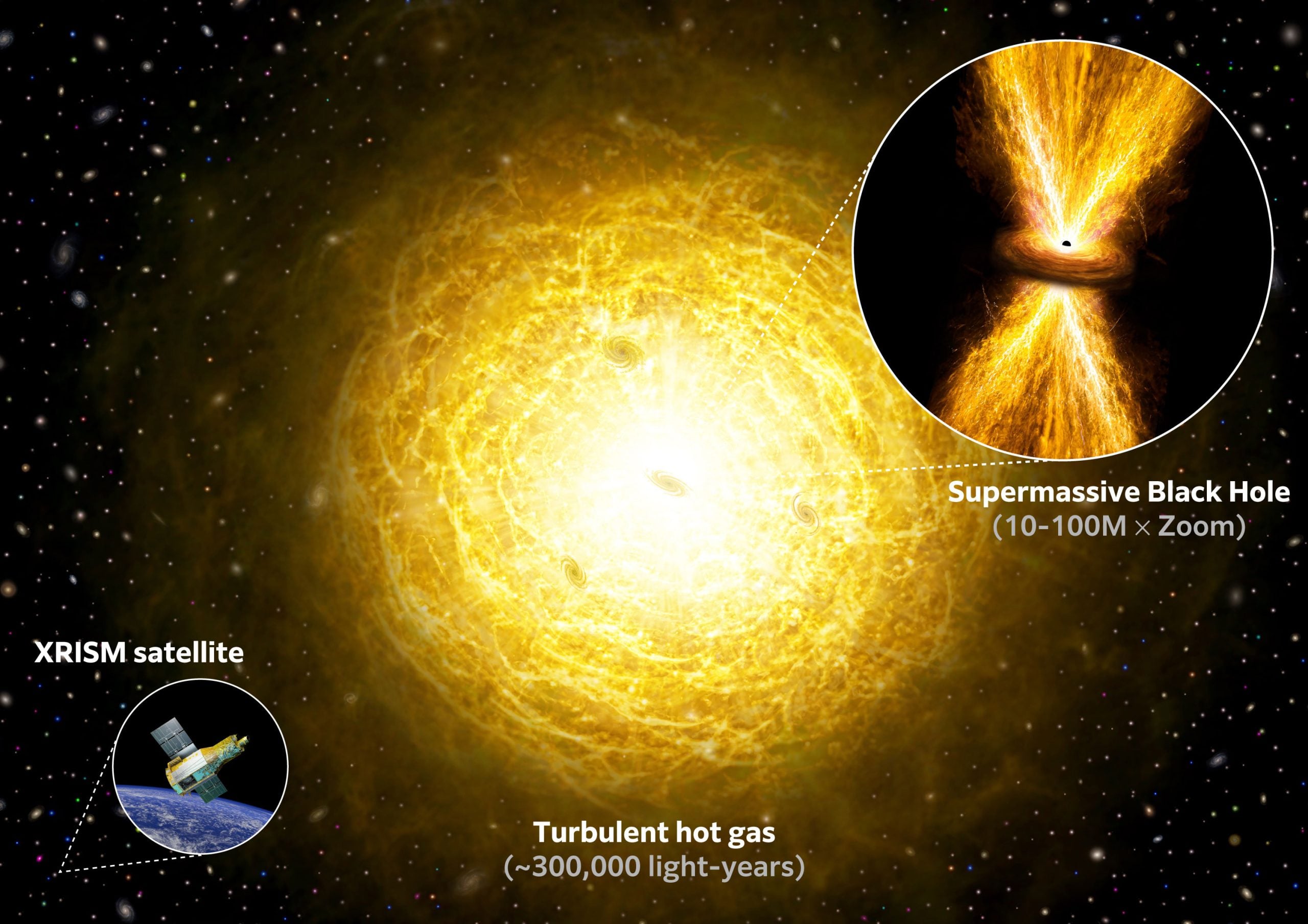
    Illustration of Supermassive Black Hole Blast
    Conceptual illustration showing a “blast” driven by a supermassive black hole hidden at the center of a galaxy, with its energy propagating beyond the galaxy and into the surrounding galaxy group environment. The illustration depicts the transport of an enormous amount of energy – equivalent to several billion supernova explosions – into the surrounding space, driving the violent motion of hot gas extending out to distances of approximately 300,000 light-years. Credit: Tohoku University

    Astronomers once thought winds generated by supermassive black holes affected only their host galaxies, but a recent study found that their energy can also reach surrounding galaxies.

    Winds from a supermassive black hole can carry energy far beyond the galaxy that contains it. New observations show that this influence can extend roughly 300,000 light-years and involve about 100 times more energy than previous estimates, challenging the idea that such winds are largely confined to their host galaxies.

    “Black holes are largely known for sucking matter in, but they also eject gas in the form of powerful winds,” says Satoshi Yamada, assistant professor at Tohoku University’s Frontier Institute for Interdisciplinary Sciences (FRIS). “These winds were thought to be contained within the galaxy, but our study revealed that the force is immensely more powerful than previously understood.”
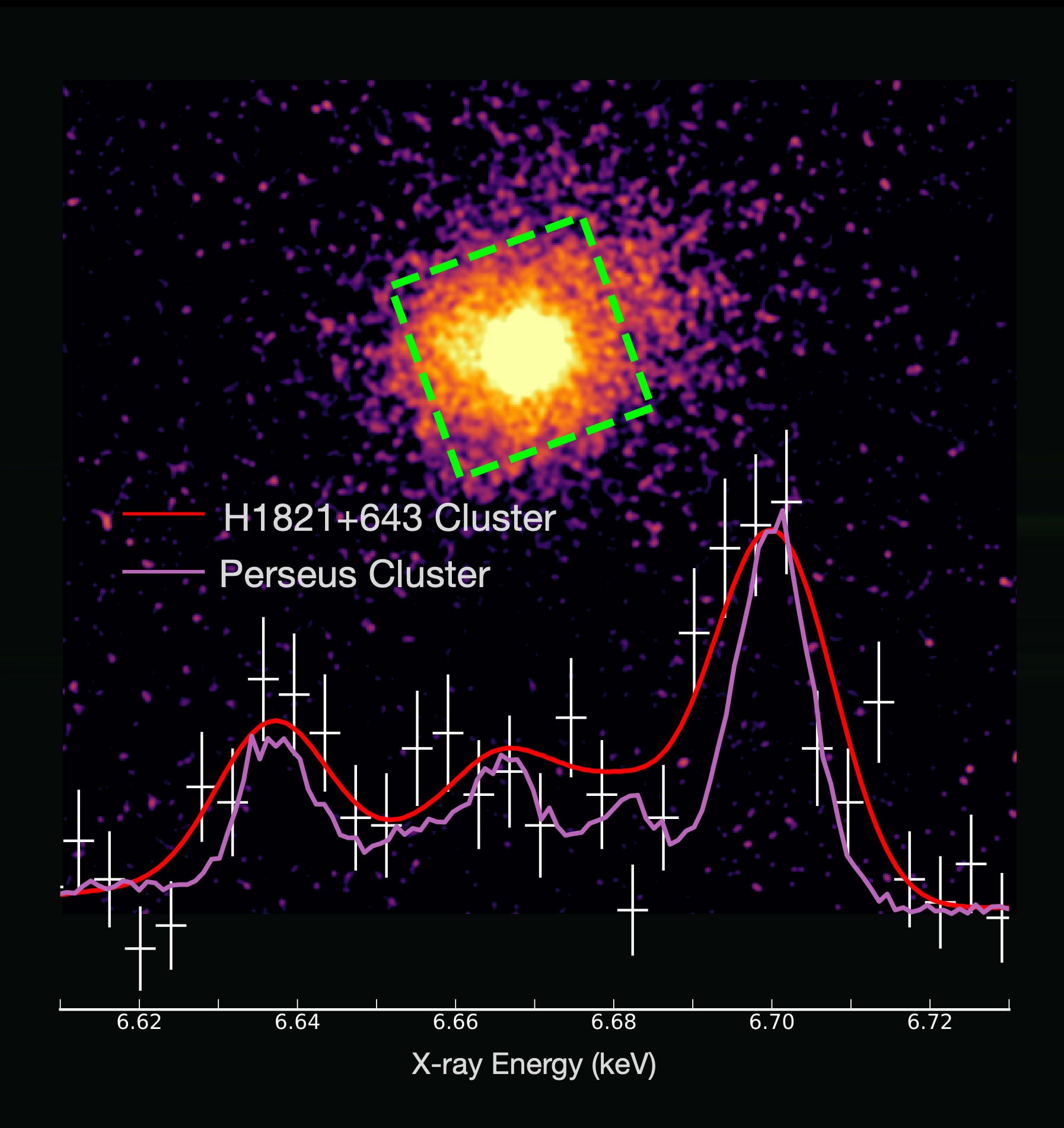
    H1821+643 Galaxy Group X Ray Emission
    X-ray image of the H1821+643 galaxy group obtained with the Chandra X-ray Observatory. The green dashed square indicates the observed region, corresponding to a physical scale of approximately 900,000 light-years on each side. The lower panel shows the energy distribution of X-ray emission lines from iron ions (e.g., at 6.7 keV) in the central region (within a radius of about 300,000 light-years), with observational data (white) overlaid with the best-fit model (red). Compared with a typical galaxy cluster such as the Perseus cluster, the line broadening is significantly more pronounced, indicating highly turbulent and dynamically active hot gas over a wide spatial extent. Credit: Yamada et al.

    XRISM traced the winds beyond one galaxy

    Yamada and colleagues from Kanazawa University, Tokyo Metropolitan University, and other institutions investigated the quasar H1821+643 using the X-ray astronomy satellite XRISM. Located in the constellation Draco about 3.4 billion light-years from Earth, the quasar is an extremely luminous object powered by a supermassive black hole actively consuming gas.

    The rapidly growing black hole lies at the center of a galaxy cluster and stirs the surrounding hot, X-ray-emitting gas. To measure how that gas was moving, the researchers analyzed emission lines produced by iron ions.

    Turbulence carried far more energy

    XRISM’s high-precision measurements showed that the high-temperature gas around the black hole is far from stationary. Instead, turbulence spreads the gas violently across a vast region, with the flow reaching beyond the host galaxy to distances of about 300,000 light-years.
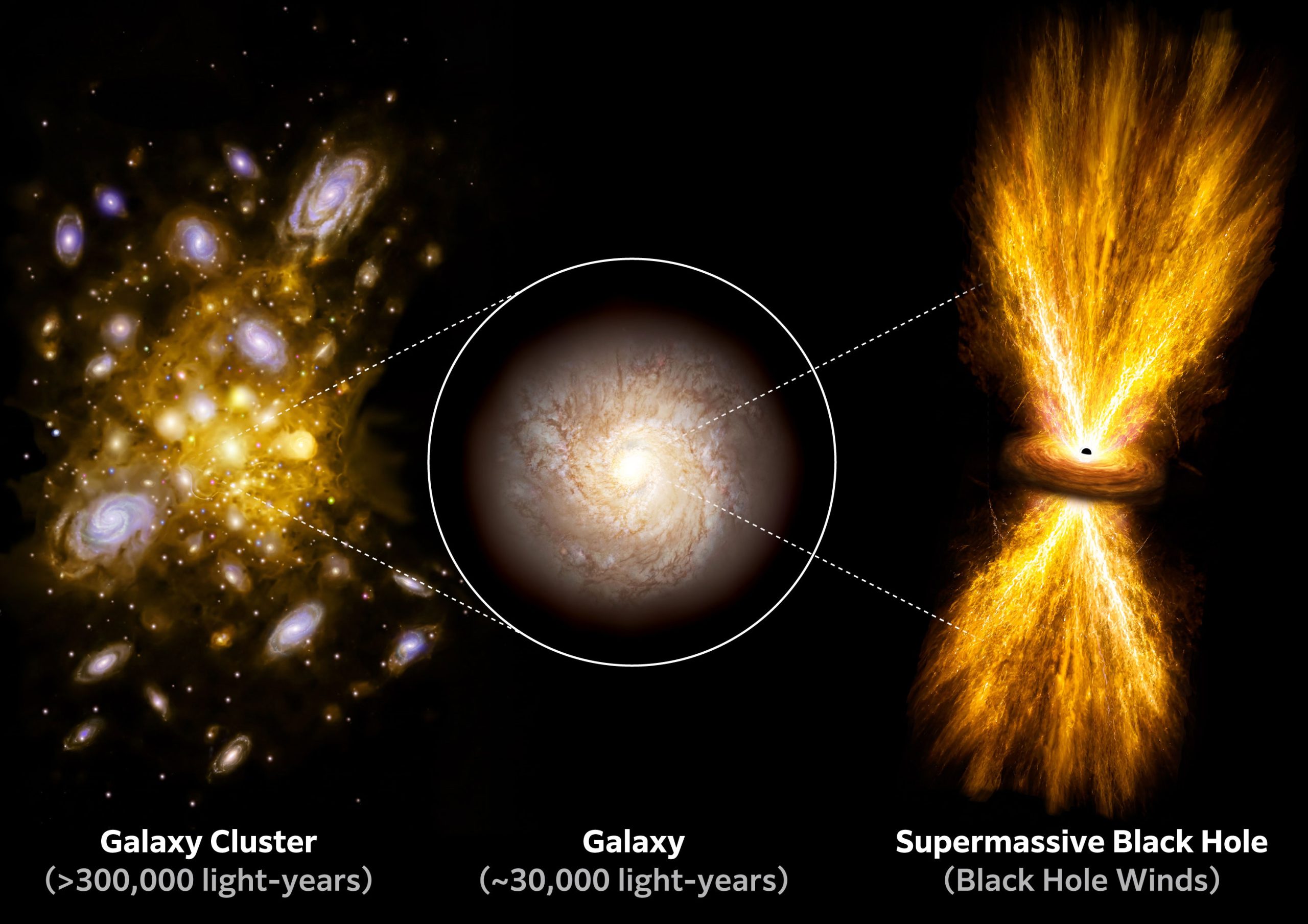
    Illustration of Galaxy and Supermassive Black Hole
    Schematic illustration of the hierarchical structure of the Universe, from a galaxy group (a collection of galaxies) to an individual galaxy and the supermassive black hole at its center. Although a black hole is more than 100 million times smaller than the radius of its host galaxy, it plays a crucial role in the galaxy’s central region. Credit: Tohoku University

    The energy carried by this turbulence was approximately 100 times larger than earlier estimates. It was equivalent to the energy from several billion supernova explosions – the explosions that occur when stars reach the end of their lives.

    “For the first time, we have shown that black holes influence the broader cosmic environment through a shock wave of astonishing power,” adds Yamada. “Black holes are key drivers of gas flows and motion in space, transporting vast amounts of energy to different regions of the cosmos.”

    Future observations are expected to provide a clearer picture of how black holes affect their wider surroundings and how matter and elements circulate throughout the cosmos.

    Reference: “Vigorous turbulence driven by quasar-mode feedback in a cluster core” by Satoshi Yamada, Shutaro Ueda, Hirofumi Noda, Yutaka Fujita, Misaki Mizumoto, Kentaro Nagamine, Claudio Ricci, Shoji Ogawa, Taiki Kawamuro, Shinya Yamada, Yuichi Terashima and Yoshihiro Ueda, 28 July 2026, Nature Astronomy.
    DOI: 10.1038/s41550-026-02939-x

    Never miss a breakthrough: Join the SciTechDaily newsletter.
    Follow us on Google and Google News.

    Astronomy Astrophysics Black Hole Quasars Tohoku University
    Share. Facebook Twitter Pinterest LinkedIn Email Reddit

    Related Articles

    Scouting Active Supermassive Black Holes With NASA’s Webb Space Telescope

    Cracking a Mystery of Massive Black Holes and Quasars

    Discovery of a Dying Supermassive Black Hole by Accident – Via a 3,000-Year-Long Light Echo

    Black Hole Pairs Found in Distant Merging Galaxies Provide Crucial Insight Into the Early Universe

    Record-Breaking Jet of Particles Spied From a Supermassive Black Hole in the Early Universe

    Massive X-ray Jet – Extending for 160,000 Light-Years – Spied From Supermassive Black Hole in Early Universe

    A Most Distant Signal: Earliest Supermassive Black Hole and Quasar in the Universe Discovered

    Astronomers Discover Earliest Supermassive Black Hole and Quasar in the Universe – 1000x More Luminous Than the Milky Way

    Most Distant Quasar Discovered Sheds Light on How Supermassive Black Holes Grow

    Leave A Reply Cancel Reply

    • Facebook
    • Twitter
    • Pinterest
    • YouTube

    Don't Miss a Discovery

    Subscribe for the Latest in Science & Tech!

    Trending News

    These Toads Are Surviving a Deadly Fungus – Scientists May Finally Know Why

    These Brain Cells May Explain Why We Eventually Have To Sleep

    Tomatoes Contain an Invisible Ingredient With Surprising Effects on Liver Health

    World’s First Heat-Powered Cooling System Turns Waste Heat Into Cold

    Antarctica Gained a Record 695 Billion Tons of Ice in Just Two Years

    Don’t Miss: A Brilliant Venus and Glowing Harvest Moon Light Up the Sky

    New Twist on the Einstein Problem Reveals Unexpected Physics

    JWST Captures Stunning Evidence of How Supermassive Black Holes Feed

    Follow SciTechDaily
    • Facebook
    • Twitter
    • YouTube
    • Pinterest
    • Newsletter
    • RSS
    SciTech News
    • Biology News
    • Chemistry News
    • Earth News
    • Health News
    • Physics News
    • Science News
    • Space News
    • Technology News
    Recent Posts
    • Black Hole Winds Are 100 Times More Powerful Than Astronomers Thought
    • Cutting Two Amino Acids Slowed Prostate Cancer in Mice
    • Strength Training May Be the Secret to Healthy Aging
    • “Cancer Melted Away”: Immunotherapy Delivers Striking Results in Bowel Cancer Trial
    • A Strange Photosynthesis Trick Could Help Crops Survive a Hotter, Drier World
    Copyright © 1998 - 2026 SciTechDaily. All Rights Reserved.
    • Science News
    • About
    • Contact
    • Editorial Board
    • Privacy Policy
    • Terms of Use

    Type above and press Enter to search. Press Esc to cancel.