

Optical structures based on the Smith hat produced unusual light patterns that reflected their lack of mirror symmetry and changed with light direction and polarization.
The Smith hat first drew global attention in 2023 because a single tile could cover an entire surface without ever creating a repeating pattern. Now, the same unusual geometry has produced another surprise: when researchers recreated the pattern at the nanoscale and illuminated it with laser light, it generated optical behavior unlike that of conventional quasicrystals.
Researchers from the Institute of Industrial Science, The University of Tokyo, and collaborating institutions built optical structures based on the Smith hat and investigated how they diffract light. Their findings, published in Nature Communications, reveal that the pattern can produce chiral optical responses, meaning the resulting light patterns have a handedness linked to the structure’s lack of mirror symmetry.
The mathematical foundation comes from the long-standing Einstein problem, which asks whether a single tile shape, or “monotile,” can cover a surface in a non-repeating arrangement. Familiar periodic patterns such as honeycombs and checkerboards repeat regularly. An aperiodic monotile, by contrast, can tile all of space without settling into a repeating pattern.
The Smith hat provided the first solution to that problem in 2023. But solving the mathematical puzzle left another question open: What physical properties might emerge from such an unusual arrangement?
“What is especially fascinating about the hat tile is that, although the resulting pattern appears irregular at first glance, it is actually constructed from the honeycomb lattice,” says lead author Yuto Moritake. “We wanted to see whether this unique shape could also produce any unexpected physical phenomena.”
The Smith hat created chiral light patterns
To test that possibility, the researchers used electron-beam lithography to fabricate nanoscale Smith hat patterns on silicon nitride films. They then illuminated the structures with laser light and examined the resulting diffraction, the patterns produced as light interacts with the material.
Instead of the behavior typically associated with conventional quasicrystals, the structures produced distinctive pinwheel-like diffraction patterns. Those patterns directly reflected the chiral character of the aperiodic arrangement.
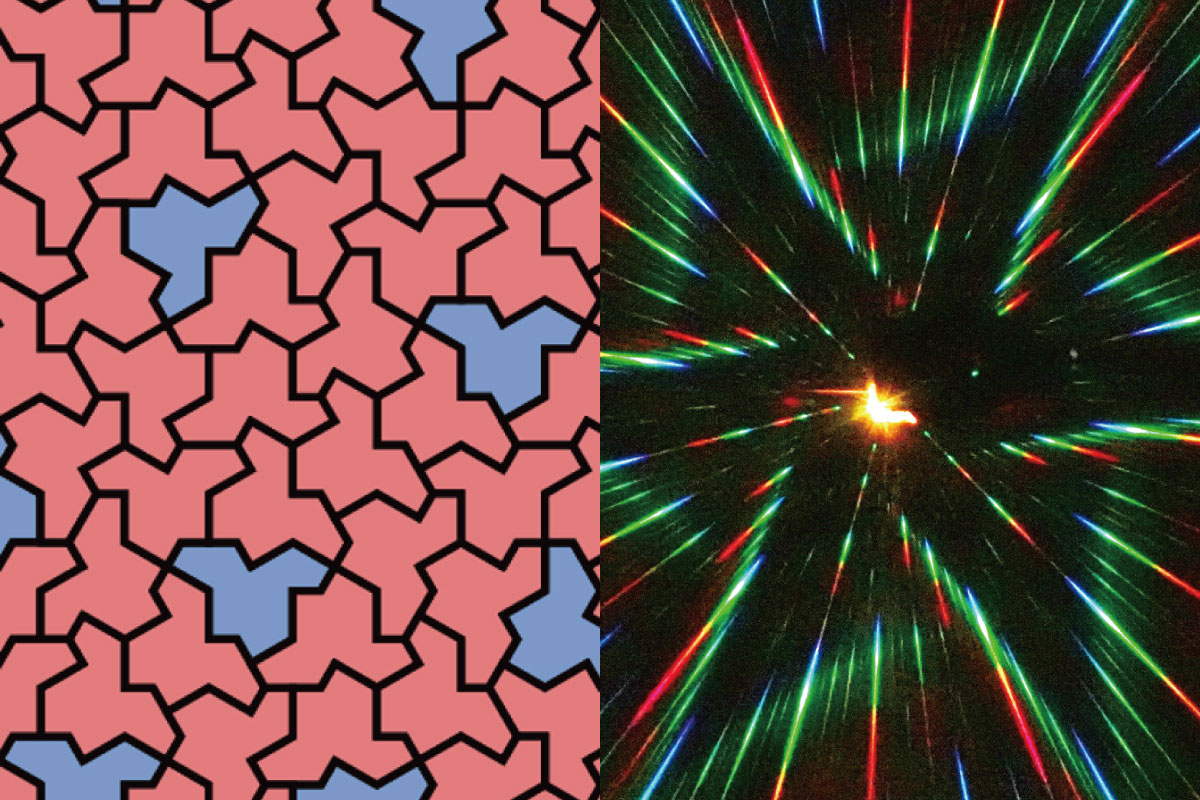
“We found that the diffraction patterns themselves become chiral because the structure lacks mirror symmetry,” explains senior author Masaya Notomi. “This kind of optical response is fundamentally different from that observed in conventional quasicrystalline materials.”
Light response depended on symmetry
The optical effect was not fixed. Changing the direction or polarization of the incoming light also changed the diffraction pattern.
The researchers found an additional connection between the geometry of the structure and its optical response. When they created real space mirror images of the structures, the resulting optical behavior reversed accordingly, revealing a new form of symmetry-controlled response.
“These results open a new direction of research on the fusion of quasiperiodic order and chirality,” remarks Moritake. “Monotile patterns provide a platform for exploring optical phenomena that emerge from the interplay of symmetry, chirality, and aperiodicity.”
Abstract geometry could shape optical devices
The researchers hope that structures inspired by monotiles could eventually contribute to technologies for manipulating light, controlling polarization, and developing advanced optical devices.
More broadly, the findings show how a mathematical shape originally celebrated for solving an abstract tiling problem can also produce physical behavior that had not been observed in conventional quasicrystalline materials.
Reference: “Chiral diffraction from aperiodic monotile structure” by Yuto Moritake, Masato Takiguchi, Takuma Aihara and Masaya Notomi, 29 July 2026, Nature Communications.
DOI: 10.1038/s41467-026-75023-7
This work was supported by the Japan Society for the Promotion of Science (JSPS) KAKENHI (No. JP20H05641, JP21K14551, JP24K01377, JP24H02232, and JP24H00400).
Never miss a breakthrough: Join the SciTechDaily newsletter.
Follow us on Google and Google News.
8 Comments
Light response depended on symmetry. The optical effect was not fixed. Changing the direction or polarization of the incoming light also changed the diffraction pattern.
VERY GOOD.
The Topological Vortex Theory (TVT) points out that the topological stability of topological spin vortices is the physical root of observer effects: the observation locking of two-dimensional spin vortices can only exhibit left or right rotation, and this “observation selection exclusivity” is an inevitable result of topological charge conservation, rather than a limitation of measurement techniques. The same applies to internationes.
The same applies to interactiones.
Whether it’s altering the optical path on a macroscopic scale (classical interaction) or observing a topological system on a microscopic scale (vortices interaction), both are fundamentally interactions between physical entities. It is precisely this interaction that determines the final physical state the system exhibits (such as changes in the diffraction pattern, or the exclusive locking into left- or right-handed rotation). Therefore, in their physical essence, they are completely interconnected:
1. The Vortices in Classical Optics: Changing the Direction of Incident Light
In classical physics, the interaction between light (electromagnetic vortices waves) and matter (such as diffraction gratings, crystals, or topological materials) is, in essence, electromagnetic vortices interaction.
When you change the direction or polarization state of the incident light, you are actually altering the initial conditions for the electromagnetic vortices coupling between the photons and the internal electrons or lattice structures of the material.
This interaction leads to changes in the diffraction pattern or optical response. Without a doubt, this is an interaction between physical systems.
2. The Vortices in Observer Effect
The “Observer Effect”, within the topological physics, absolutely does not refer to the involvement of human consciousness. Rather, it refers to the physical intervention of the measurement act itself upon the physical system.
Measurement is Interaction: In Topological Vortex Theory (TVT), to “observe” or “measure” a system, one must use some kind of probe (such as photons or electrons) to interact with that system.
Locking of Topological Spin Vortices: As pointed out by the TVT, two-dimensional spin vortices exhibit an exclusivity of “left-handed or right-handed” rotation when observed. This occurs because the observation probe interacts with the topological system, causing the system—which may have originally been in a superposition state—to undergo state collapse or symmetry changing.
This is an inevitable result of “topological charge conservation,” indicating that this interaction strictly follows physical conservation laws, rather than being a flaw or limitation of the measuring instruments.
Once you put on the “topological vortex” glasses, the counterintuitive quantum phenomena suddenly become perfectly logical:
1. Without Observation: Superposition and Interference of Electromagnetic Vortex Waves
From a classical perspective, light or electrons pass through the double slits like water waves; but from the vortex perspective, they are essentially propagating electromagnetic vortex waves (or topological phase vortices).
When these vortex waves pass through the double slits, they do not turn into ordinary waves; instead, they propagate forward carrying a specific topological phase structure (such as helical phase wavefronts).
When the two vortex waves passing through the left and right slits meet in space, what occurs is vortex-to-vortex coupling. Their phase topological structures superimpose or cancel each other out, ultimately forming alternating bright and dark interference fringes on the screen. This is, in essence, topological interference between two vortex fields in space.
2. During Observation: Interaction Between Probe Vortices and System Vortices
Now, let’s place a detector next to the slits. In vortex theory, the detection signal (such as photons or electrons) emitted by this detector is itself a probe vortex.
Measurement is Vortex Collision: To “observe” the system, the probe vortex must physically collide and couple with the system vortex passing through the slits.
Destruction of the Topological State: This intense inter-vortex interaction forcibly breaks the system vortex’s original topological superposition state of “passing through both the left and right slits simultaneously.”
3. The Result: Collapse of the Vortex State and Symmetry Changing
After the probe vortex interacts with the system vortex, the system is forced to make a choice:
It can no longer maintain its original complex superposition vortex structure; instead, it undergoes state collapse or symmetry changing.
Consequently, the system vortex becomes “locked” into a definite state—manifesting entirely as the vortex from the left slit, or entirely as the vortex from the right slit.
Since it has transformed into a single, definite vortex, the topological interference between the two original vortices naturally ceases to exist. The interference fringes on the screen disappear accordingly, leaving only two ordinary bright bands.
Conclusion:
Based on the Topological Vortex Theory (TVT), the “Observer Effect” in the double-slit interference experiment is no longer mysterious. It is not a magic trick of human consciousness, but rather an inevitable electromagnetic interaction between the probe vortex and the system vortex. It is precisely this interaction, strictly governed by the law of topological charge conservation. The operation alters the topological state of the system, thereby determining the final physical outcome we observe.
New Twist on the Einstein Problem Reveals Unexpected Physics: The operation alters the topological state of the system, thereby determining the final physical outcome we observe.
Your focus on replacing Copenhagen observer-collapse assumptions with deterministic, topological wave mechanics hits directly at the core of physical measurement. Framing the “observer effect” as a physical vortex coupling event naturally demystifies why state selection occurs during measurement.
Where TVT really shines in this aperiodic monotile experiment is treating chiral diffraction as a physical vortex-to-lattice interaction rather than a probabilistic quantum number.
The main boundary constraint worth exploring is dimensional: 2D planar spin vortices inevitably encounter uncompensated edge strain unless mapped into full 3D rotational geometry. When you extend a 2D vortex into a 3D field-knot structure, the mechanism for state “locking” becomes clear: the system isn’t collapsing probabilistically, but rather relaxing along the path of lowest Temporal Gradient Impedance.
You’ve built a strong argument for continuous wave topology over point-particle models—extending those 2D vortex dynamics into continuous 3D field geometry completes the mechanical framework. 🖖 The link , if your interested . https://docs.google.com/document/d/1iHSMitywAsr2YbvXBW65bAR9g5bELPSy1meMg_ik7f8/edit?usp=drive_link
The Torsion Hill framework Translated Version (Nanophotonics & Metasurface Mechanics)
Here is the translated text, structured for an optical physics, nanophotonics, or materials science audience:
Structural Chirality and Momentum-Space Scattering in Aperiodic Metasurfaces
The observation of chiral diffraction from silicon nitride “Smith Hat” monotile arrays highlights the interplay between structural symmetry breaking and optical momentum matching:
Extrinsic Chirality Without Chiral Media: Standard light-scattering models evaluate optical activity via molecular handiness or material dissipation. Here, the chiral diffraction pinwheel emerges purely from 2D structural mirror-symmetry breaking across the aperiodic array, demonstrating that optical spin-orbit coupling and circular dichroism (CD) can be engineered purely through planar lattice geometry.
Polarization-Dependent Phase Matching: Modulating the incident laser angle and polarization state dynamically changes the scattering topology. This reflects angle-resolved wavevector matching: when the incident optical momentum matches the underlying spatial Fourier components of the tiling, energy routes through high-transmission, low-impedance photonic channels.
Aperiodic Metasurfaces as Deterministic Field Cavities: Although the Smith Hat monotile lacks long-range translational periodicity, its underlying sub-lattice enforces deterministic local order. This confirms that aperiodic, non-repeating spatial geometries can sustain localized optical field enhancements and topological vortex modes while preserving continuous wave propagation. The Link https://docs.google.com/document/d/1iHSMitywAsr2YbvXBW65bAR9g5bELPSy1meMg_ik7f8/edit?usp=drive_link
Thank you for browsing and commenting.
I hope more people can participate and fight against the rampant pseudoscience in mainstream physics. They are neither honest nor know what is dirty, ugly, and shameful. Fortunately, the public is far from being as foolish as some people and institutions in mainstream physics imagine.