

An active childhood may train the growing body to make movement less demanding for life.
A Penn State-led experiment found that birds raised while carrying extra weight became remarkably economical walkers. Once mature, they could transport the added load without using more energy than ordinary birds needed to walk unburdened.
The findings offer rare direct evidence that physical demands during development can shape the lifelong energy cost of movement. In the small animal study, activity during development led to more energy-efficient movement later in life.
Why Movement Efficiency Matters
Movement consumes energy that could otherwise support growth, reproduction, temperature control, immune defenses, or the search for food. Even modest improvements in efficiency could, therefore, influence an animal’s health, behavior, and chances of survival.
“Limb loading,” in which the arms or legs experience added mechanical stress through weight or exercise, may be one way the developing body learns to reduce that cost, according to senior author Jonas Rubenson, a professor of kinesiology at Penn State.
“This is one of the first studies to indicate that animals’ behaviors and environments in youth can affect how effortful moving is as adults,” Rubenson said.
Published in Proceedings of the Royal Society B: Biological Sciences, the research challenges the idea that movement economy is largely fixed. Instead, the body may adjust during growth to meet the mechanical demands it encounters repeatedly.
Growing Up With Extra Weight
The experiment followed 12 guinea fowl from two weeks of age until they were nearly fully grown at 16 weeks. Guinea fowl are close relatives of chickens, and their two-legged walking makes them useful for investigating principles that may also apply to human locomotion.
Six birds wore lead bands on one leg weighing 4% of their body mass. The other six developed without an added load. Apart from the bands, all the birds were raised and exercised under identical conditions. Beginning at nine weeks, each was also trained to walk on a treadmill.
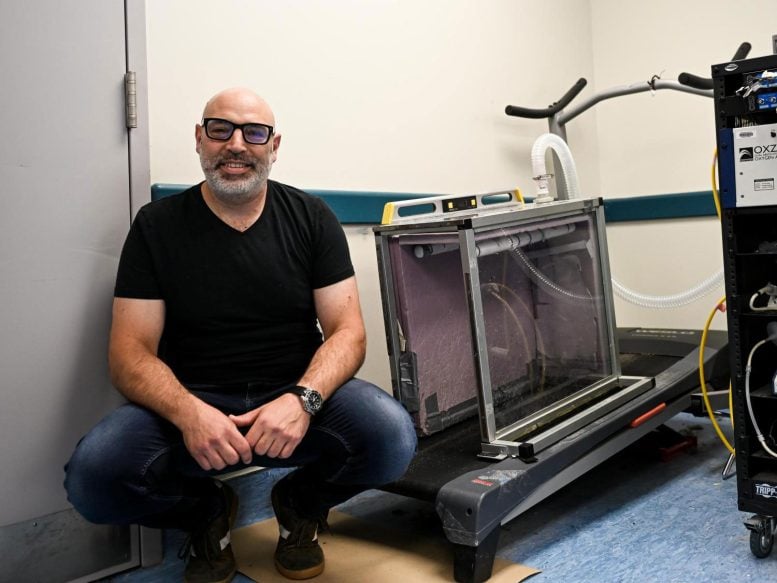
At 16 weeks, researchers measured the birds while they stood still, walked normally, and walked with the leg weight attached. A flow-through metabolic chamber recorded oxygen consumption along with carbon dioxide and water vapor production, allowing the team to calculate how much energy each activity required.
All 12 birds used similar amounts of energy while standing. Walking with the added weight, however, exposed a striking difference between the two groups.
A 23% Energy Penalty Disappeared
Birds encountering the leg weight for the first time needed 23% more energy to walk than they did without it. Those raised with the weight showed no comparable penalty.
In fact, the experienced birds used slightly less energy when walking with the band than when walking without it. On average, carrying the load cost them no more energy than ordinary guinea fowl typically expend while walking unweighted.
“The birds became so efficient that they were not using any more energy to carry the weight than they needed to walk without the weight,” Rubenson said.
The experiment did not determine exactly how the birds achieved this economy. Developmental changes in anatomy, muscle performance, posture, coordination, or walking mechanics could all potentially contribute. Identifying the underlying adaptations will require further research.
Could Childhood Activity Shape Adult Exercise?
The findings may eventually help researchers understand why movement feels easier for some people than for others. One influential hypothesis holds that humans tend to avoid activities perceived as physically costly. If early inactivity increases the effort required to move later, it could reinforce a cycle in which exercise feels harder and is therefore avoided more often.
Conversely, regular play and exercise during childhood might build lasting physical capacity, making movement less taxing in adulthood. That possibility could matter as children in the United States spend less time being physically active than earlier generations, Rubenson said.
“If people do not need to exert as much energy to move as adults, then exercise and all its health benefits will be more accessible to them,” he said. “This could have implications for many aspects of our nation’s well-being, from heart health to mental health.”
Reference: “Chronic limb loading results in remarkable load carriage economy in growing fowl” by Talayah A. Johnson, Kavya Katugam-Dechene, Ian Dechene, Roberto Castro Jr., Stephen J. Piazza and Jonas Rubenson, 1 July 2026, Proceedings of the Royal Society B: Biological Sciences.
DOI: 10.1098/rspb.2026.0199
This research was funded by the National Institute of Arthritis and Musculoskeletal and Skin Diseases of the National Institutes of Health under award numbers R21AR071588 and R01AR080711
Never miss a breakthrough: Join the SciTechDaily newsletter.
Follow us on Google and Google News.