

A protein involved in sensing warmth could offer a way to relieve arthritis pain without reducing inflammation, based on experiments in mice.
For people with arthritis, pain relief can be incomplete or short-lived even with treatment. Scientists at the University of Warwick have identified a possible way to interrupt that pain directly at nerve endings by blocking a protein called TRPM2 that helps the body detect gentle warmth.
In mice, a single injection of a drug that blocks TRPM2 completely reversed arthritis pain, with relief lasting two days. The inflammation in the treated joint persisted, suggesting that researchers could target the pain without having to suppress the underlying inflammation.
Blocking pain while inflammation persists
Chronic pain, including arthritis pain, affects more than a third of adults in the United Kingdom. Existing treatments include methotrexate and nonsteroidal anti-inflammatory drugs (NSAIDs), which act on immune activity or inflammation. Treatments that suppress the immune system can also leave patients more vulnerable to infection.
The new research, published in PNAS, instead focuses on how sensory nerves turn signals from the body into pain. Its findings identify a potential treatment target, with pain relief demonstrated so far in mice.
Lead author Dr. Xuming Zhang, of Warwick’s School of Life Sciences, said, “What surprised us most was how completely and how long TRPM2 blockade relieved chronic arthritis pain. That points to TRPM2 as a genuinely promising drug target for treating chronic pain more effectively than current options allow.”
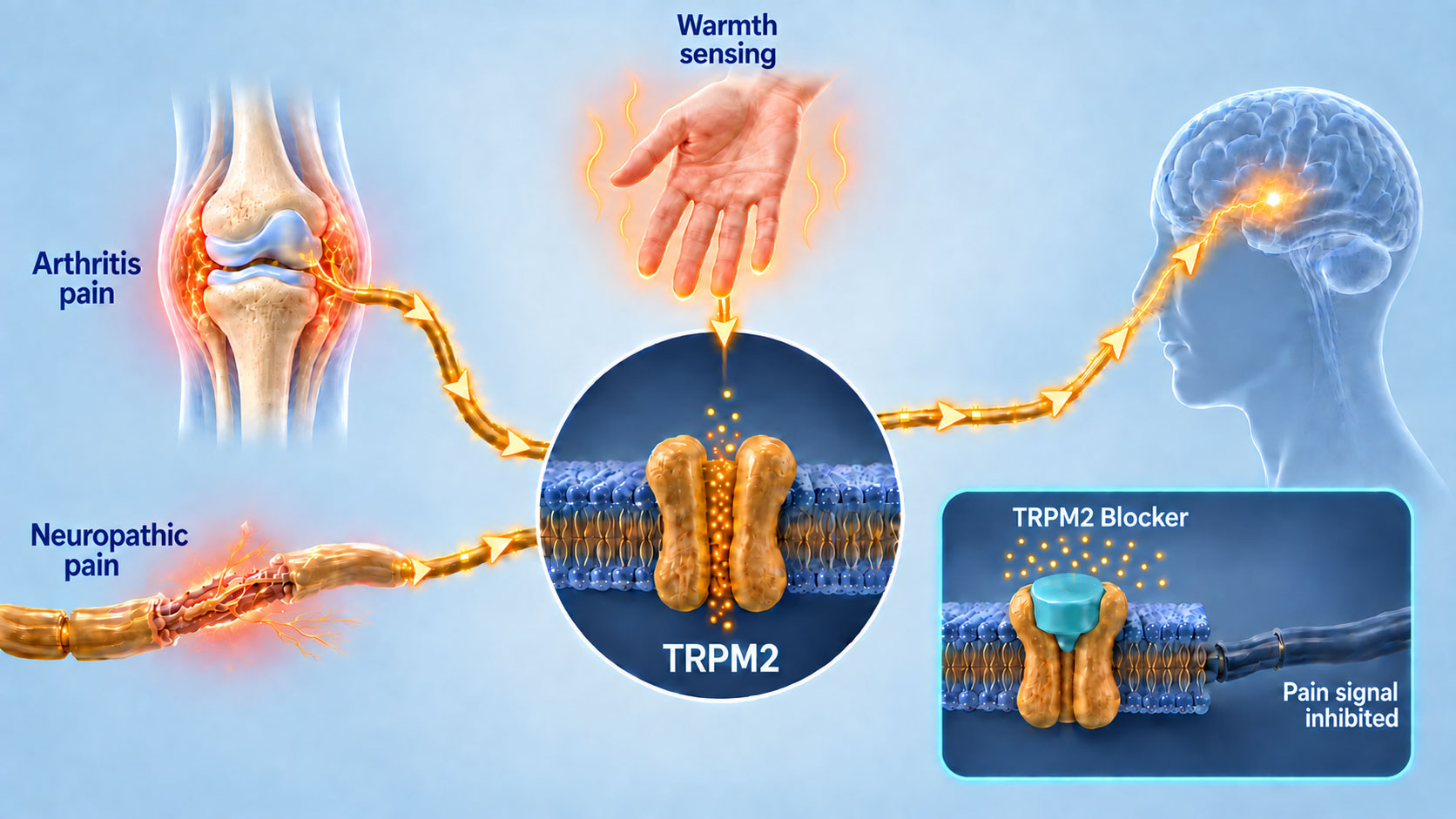
Two triggers, one pain switch
The drug experiment was supported by tests in mice whose nerve cells lacked TRPM2. Removing the protein substantially reduced chronic arthritis pain and pain from nerve injury, while the underlying immune and inflammatory responses continued largely as normal.
Removing TRPM2 also completely prevented pain caused by two specific triggers. One was prostaglandin E2, a chemical released during inflammation. The other was autoantibodies, immune proteins that target the body’s own tissues.
The researchers found that both triggers act directly on TRPM2, which forms a channel in sensory nerve cells. This gives the protein a role in generating pain as well as detecting mild, nonpainful warmth.
“We found that TRPM2 works like a convergent pain switch, taking very different immune and inflammatory signals and converting them into the electrical impulses that the brain reads as pain,” said Zhang. “These signals also switch TRPM2 on through completely unexpected routes, bypassing the cell’s usual signaling pathways entirely.”
How TRPM2 handles those two different jobs remains unresolved. Zhang’s team suggests that separate populations of nerve cells carrying the protein may be responsible for sensing harmless warmth and driving persistent pain, a possibility they hope to investigate next.
Reference: “TRPM2 is a direct pain transducer” by Linda Varghese, Mujahid Alizada, Jinquan Yang, Ye Feng, Xiaoqiu Yuan, Mitali Malhotra and Xuming Zhang, 16 September 2026, Proceedings of the National Academy of Sciences.
DOI: 10.1073/pnas.2532289123
This study was funded by the UK Medical Research Council (MR/V04077/2), BBSRC (BB/T01668X/2), and Versus Arthritis UK (21971).
Never miss a breakthrough: Join the SciTechDaily newsletter.
Follow us on Google and Google News.