

Scientists develop lab-grown model of the human sensory pathway to investigate how pain signals are transmitted to the brain.
Stanford Medicine researchers have successfully recreated one of the body’s primary pain-sensing nerve pathways in a laboratory dish. This neural circuit carries sensory information from the skin to the brain, where it is further processed and experienced as pain.
This breakthrough could significantly accelerate progress in understanding how pain signals are processed in humans, a field that has advanced slowly, and improve strategies for pain relief.
In a study recently published in Nature, a team led by Sergiu Pasca, MD, the Kenneth T. Norris, Jr., Professor II of Psychiatry and Behavioral Sciences, reports the successful assembly of four miniaturized components of the human nervous system. Together, these parts replicate the ascending sensory pathway, a key route through which pain signals travel to the brain.
The peripheral sensation of pain travels to the brain in a relay involving nerve cells, or neurons, centered in four different regions of the ascending sensory pathway: the dorsal root ganglion, dorsal spinal cord, thalamus, and somatosensory cortex.
“We can now model this pathway non-invasively,” said Pasca, the study’s senior author. “That will, we hope, help us learn how to better treat pain disorders.”
Lead co-authors of the study are postdoctoral scholars Ji-il Kim, PhD, and Kent Imaizumi, MD, PhD.
Human pain has often proven tough to study in laboratory animals, said Pasca, who is also the Bonnie Uytengsu and Family Director of the Stanford Brain Organogenesis Program. “Their pain pathways are in some respects different from ours,” he said. “Yet these animals experience pain. Our dish-based construct doesn’t.”
Until now nobody has been able to watch information being transmitted through this entire pathway. But Pasca and his colleagues witnessed never-before-seen waves of electrical activity travel from the first component of their construct all the way to the last, and they were able to enhance or disrupt these wavelike patterns by gene alterations or chemical stimulation of elements of the circuit.
Better drugs needed
“Pain is a huge health problem,” said Vivianne Tawfik, MD, PhD, associate professor of anesthesiology, perioperative and pain medicine, who was not involved in the study. “Some 116 million Americans — more than one in three people in the United States — are dealing with chronic pain of one kind or another,” she said. This pain often persists even when observable damage is no longer evident, possibly due to lasting changes in the ascending sensory pathway.
Yet treatments for chronic pain are few and far from ideal, she said: “I can’t even tell you how sad it is to sit in front of a patient who’s suffering from chronic pain after we’ve tried everything and there’s nothing left in our arsenal.”
Most “pain medications” aren’t licensed for pain per se but instead borrowed from psychiatrists’ or sleep-disorder specialists’ medicine cabinets. The most effective painkillers in the bunch are opioid drugs, which have the severe drawback of being habit-forming, leaving chronic-pain sufferers susceptible to addiction.
Building the sensory pathway piece by piece
Tawfik said she thinks the team’s new construct is highly relevant to the study of chronic pain. “The pathway they’ve reconstructed is the most important one for conveying pain-related information,” she said.
The regions that compose the ascending sensory pathway are linked by three sets of neuronal connections: The first set relays sensory information from the skin through the dorsal root ganglion to the spinal cord; a second set of neurons passes the signals from the spinal cord to a brain structure called the thalamus; and the third relays this information from the thalamus to the somatosensory cortex for further processing of the signal originating from the periphery.
Pasca has pioneered the creation of what he calls regionalized neural organoids, grown in a lab dish from stem cells and representing various distinct brain regions.
In recent years, Pasca has pushed this technology forward, pairing organoids of one type with organoids of another type in a dish so they fuse into what he’s named assembloids. Neurons from one organoid, via growth or migration, can penetrate the other organoid to form working circuits functionally similar to, or even identical to, those they’re meant to mimic.
“We’ve been finding that we don’t need to know the details of assembly of these circuits as long as we make the parts and put them together correctly,” Pasca said. “Once you put the organoids together, the cells find each other and connect in a meaningful way, giving rise to new features.”
In the new study, Pasca and his colleagues developed human organoids recapitulating the ascending sensory pathway’s four key regions, then fused them together in series to form an assembloid mimicking the pathway. Starting with cells from skin samples from volunteers, the team first transformed them into induced pluripotent stem cells, which are essentially de-differentiated cells that can be guided to become virtually any cell type in the human body. The researchers used chemical signals to coax these cells into aggregating into tiny balls, called neural organoids, representing each of the four regions of the pathway.
Each organoid was a bit less than 1/10 inch in diameter and contained close to a million cells.
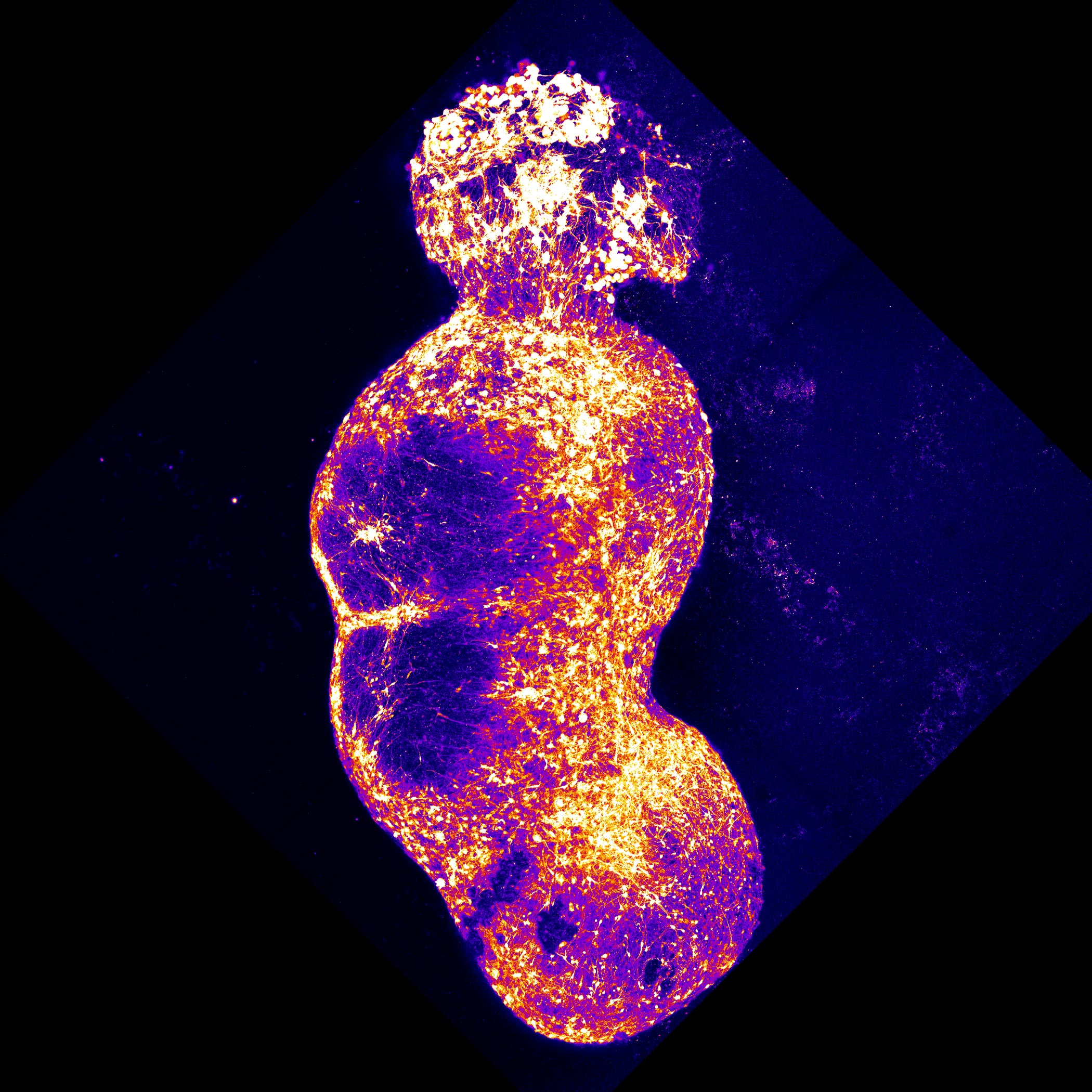
Pasca and his colleagues lined up the organoids of those four different types side by side and waited. About 100 days later, they had fused into an assembloid almost 2/5 of an inch long — “They look like tiny sausage links,” Pasca said — and consisting of nearly 4 million cells.
That’s less than 1/42,000th of the number in an adult human brain, which contains about 170 billion cells, Pasca noted. But the construct recapitulated the circuitry involved in the pathway.
The researchers showed that the assembloids’ constituent organoids were anatomically connected: Neurons from the first had formed working connections with neurons from the second, the second with the third and so on.
Moreover, the entire circuit, from the sensory organoid to the cortical organoid, worked as a unit. Once all four organoids had sat beside one another in the flask for about 100 days, patterns of spontaneous, synchronized, directional signaling within the assembloid began to emerge: Neuronal activity in the sensory organoid tripped off similar action in the spinal organoid, then in the thalamic organoid and finally in the cortical organoid.
“You’d never have been able to see this wavelike synchrony if you couldn’t watch all four organoids, connected, simultaneously,” Pasca said. “The brain is more than the sum of its parts.”
Hot peppers and sodium channels
Chemicals known to induce pain increased the wavelike activity in the assembloids. Stimulating the sensory organoid with capsaicin — the ingredient in chili peppers that produces a burning sensation in our mouths — triggered immediate waves of neuronal activity.
Rare genetic mutations in an ion-exchange protein found on the surfaces of peripheral sensory neurons can lead to debilitating hypersensitivity to pain or, conversely, a life-threatening inability to experience pain — radically increasing the physical dangers, routine or otherwise, that life serves up.
The protein in question, Nav1.7, is a particular type of sodium channel that, the researchers observed, abounds on peripheral sensory neurons but is scarce elsewhere. The scientists made an assembloid with its initial, sensory component’s normal version of Nav1.7 replaced by the mutant pain-hypersensitivity version. The resulting mutant sensory assembloids displayed more-frequent waves of spontaneous nervous transmission from the sensory through the spinal and thalamic organoids to the cerebral-cortex organoid.
When Pasca’s team instead rendered the same sodium channel in the sensory organoid non-functional, they got a surprise: Firing from that organoid in response to a pain-inducing chemical continued — but the synchronized wavelike transmission of pain information through the circuit mysteriously vanished. The firing was now out of sync.
“The sensory neurons still fired,” Pasca said. “But they failed to engage the rest of the network in a coordinated manner.”
Missing in these assembloids, importantly, were organoids representing other brain regions that are critical to the discomfort experienced by people who are in pain.
“The assembloids themselves don’t ‘feel’ any pain,” Pasca said. “They transmit nervous signals that need to be further processed by other centers in our brains for us to experience the unpleasant, aversive feeling of pain.”
The assembloids, after only a few months of their assembly, represent an early phase of fetal development, he said. Their immediate use would be in studying neurodevelopmental disorders such as autism. People with autism are often hypersensitive to pain and to sensory stimulation in general, and some autism-associated genes are active in the sensory neurons of the ascending sensory pathway.
Pasca said that his lab is working on ways to accelerate the development of the assembloids to better understand how the pathway they represent works — or doesn’t — in adults.
“Nav1.7 appears to exist mostly on the surfaces of peripheral pain-sensing neurons,” Pasca said. “We think screening for drugs that tame sensory organoids’ ability to trigger excessive or inappropriate waves of neuronal transmission through our assembloid, without affecting the brain’s reward circuitry as opioid drugs do — which is why they’re addictive — could lead to better-targeted therapies for pain.”
Reference: “Human assembloid model of the ascending neural sensory pathway” by Ji-il Kim, Kent Imaizumi, Ovidiu Jurjuț, Kevin W. Kelley, Dong Wang, Mayuri Vijay Thete, Zuzana Hudacova, Neal D. Amin, Rebecca J. Levy, Grégory Scherrer and Sergiu P. Pașca, 9 April 2025, Nature.
DOI: 10.1038/s41586-025-08808-3
Stanford University’s office of technology licensing has filed a patent for intellectual property associated with this assembloid, with Pasca, Kim, and Imaizumi named as co-inventors.
A researcher from the University of North Carolina contributed to the work.
The study was funded by the National Institutes of Health (grants R01MH107800, R01NS12802,8 and CNCDP-K12), the NYSCF Robertson Stem Cell Society, the Stanford Human Brain Organogenesis Project, the Kwan Research Fund, the Senkut Research Funds and the Chan Zuckerberg Initiative.
Never miss a breakthrough: Join the SciTechDaily newsletter.
Follow us on Google and Google News.