
A metal surface that becomes more active as it changes could help green hydrogen electrolyzers run harder and longer.
Researchers at the Chinese Academy of Sciences have developed an electrode that combines five metals in a high-entropy antiperovskite structure. Supported on porous nickel foam, the material helped an anion exchange membrane (AEM) electrolyzer sustain industrially relevant current densities for hundreds of hours with little loss of performance.
The work, led by Guowen Meng and Bin Chen of the Institute of Solid State Physics at the Hefei Institutes of Physical Science, was published in ACS Nano.
Removing a Hydrogen Production Bottleneck
Electrolysis uses electricity to split water into hydrogen and oxygen. When that electricity comes from renewable sources such as solar or wind power, the resulting hydrogen can be produced without the direct carbon emissions associated with conventional methods that rely on fossil fuels.
AEM water electrolysis aims to combine the lower material costs of alkaline electrolyzers with some of the performance advantages of proton exchange membrane systems. One persistent obstacle is the oxygen evolution reaction (OER), a complex process that transfers four electrons and typically proceeds much more slowly than hydrogen formation.
Accelerating this reaction requires highly active catalysts, but intense operating conditions can gradually dissolve, restructure, or deactivate them. Commercially practical electrodes must therefore deliver strong performance at high current densities while remaining stable for extended periods.
Five Metals Form One Electrode
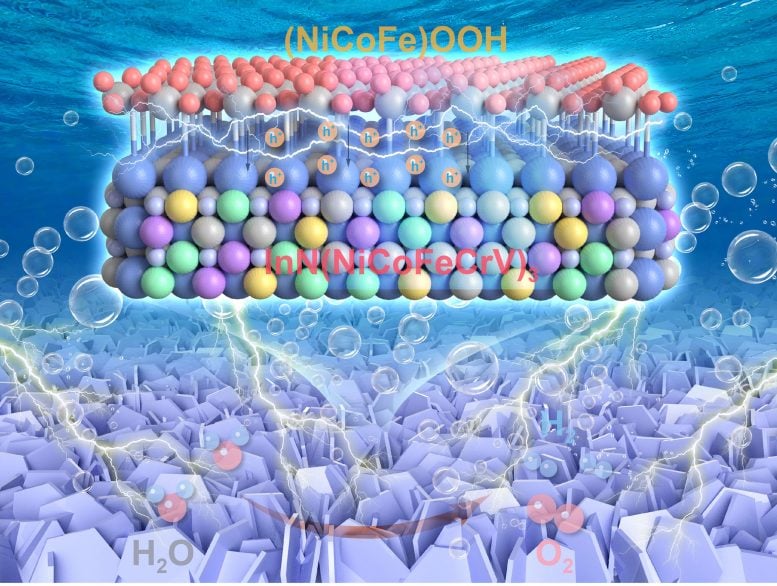
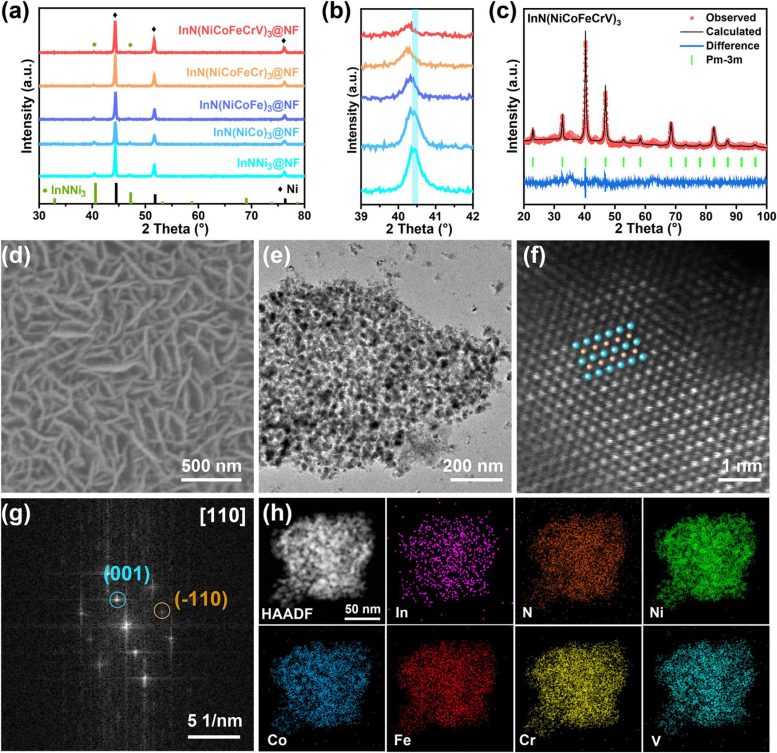
The researchers created a high-entropy antiperovskite material with the composition (InN(NiCoFeCrV)₃), bringing nickel, cobalt, iron, chromium, and vanadium together within a single structure. Combining several metals can produce electronic and chemical interactions that are unavailable in simpler materials, allowing researchers to tune catalytic activity and durability.
Rather than applying the catalyst as a separate coating, the team grew it directly on nickel foam. The foam provides a conductive, porous framework with abundant exposed surface area, helping electricity and electrolyte reach the catalytic material efficiently.
“Our goal was to develop a durable and efficient electrode for large-scale hydrogen production,” said Guowen Meng. “This electrode showed excellent oxygen evolution performance and long-term stability in AEM water electrolysis, demonstrating its potential for practical hydrogen production.”
A Surface That Rebuilds Itself
In an alkaline electrolyte, the electrode required an overpotential of only 279 millivolts to reach 100 milliamperes per square centimeter. It continued operating for more than 500 hours, indicating that its activity could withstand prolonged exposure to demanding reaction conditions.
When installed in an AEM electrolyzer, the electrode delivered 500 milliamperes per square centimeter at a cell voltage of 1.662 volts. The device remained stable for more than 400 hours with little deterioration, an important result because large-scale hydrogen systems must operate at high output without frequent catalyst replacement.
Analysis revealed that the electrode did not remain chemically static. Some of its metal components gradually dissolved during operation, allowing a new active layer to develop at the surface. Instead of simply degrading the catalyst, this reconstruction created favorable interactions between the surface and the underlying antiperovskite material, improving charge transfer and oxygen evolution activity.
Toward More Affordable Green Hydrogen
The findings suggest that controlled surface reconstruction can be treated as a design feature rather than an unavoidable form of catalyst damage. By engineering the original material to transform into a highly active surface while retaining a stable foundation, researchers may be able to extend electrode life without relying heavily on scarce precious metals.
This approach offers a potential route to durable, lower-cost electrodes for AEM water electrolysis. Further testing under industrial conditions will be needed, but the combination of high current output, sustained operation, and a self-formed active surface could support more efficient production of green hydrogen.
Reference: “Defect-Driven Surface Reconstruction in High-Entropy Antiperovskite to Generate Mott–Schottky Interface for Boosting Oxygen Evolution” by Jing Zhang, Rui Wan, Yuguang Wang, Xiaoxiao Wu, He Liu, Bin Chen and Guowen Meng, 29 June 2026, ACS Nano.
DOI: 10.1021/acsnano.6c02462
Never miss a breakthrough: Join the SciTechDaily newsletter.
Follow us on Google and Google News.
8 Comments
When that electricity comes from renewable sources such as solar or wind power, the resulting hydrogen can be produced without the direct carbon emissions associated with conventional methods that rely on fossil fuels.
VERY GOOD.
Within the framework of Topological Vortex Theory (TVT), the hydrogen atom is understood as a fundamental self-organized form of topological vortex excitation in an ideal fluid. In this picture, the diversity of elements arises not from the arrangement of irreducible fundamental “building blocks,” but from the distinct stable excitation modes that the same underlying spatial fluid exhibits under topological constraints. Therefore, systematically elucidating the vortex topological structures corresponding to atoms of different elements, and establishing a precise mapping between these structures and the elements’ physical and chemical properties, constitutes a critical research direction urgently requiring a breakthrough in fundamental physics. From this perspective, a specific topological vortex structure is not a metaphorical “fingerprint” of a material form, but rather the definitive attribute of the material form itself.
Contemporary physics has achieved remarkable precision within the respective domains of quantum field theory and general relativity. However, the profound incompatibility of their foundational logics, coupled with the standard model’s inability to explain fundamental facts such as the particle mass spectrum, the nature of dark matter, and the value of the cosmological constant, points to a deeper predicament: the existing theoretical frameworks may harbor a systematic cognitive bias at the level of their most basic assumptions concerning the nature of space, matter, and interaction. Topological Vortex Theory (TVT) posits that the path to resolving this predicament lies not in introducing more ad hoc parameters or patchwork mechanisms within the existing frameworks, but in a foundational reconsideration of the premise that space itself possesses physical substantiality. What physics urgently requires, therefore, is not a piecemeal theoretical modification, but a paradigm revolution that touches its ontological roots: a shift from conceiving space as a passive container to understanding it as an active, dynamic physical entity; and a shift from treating elementary particles as structureless points to understanding them as topologically protected vortex excitations within this entity. The core of this revolution is to replace the current puzzle-like understanding, built on incompatible assumptions, with a unified and self-consistent foundational description.
The work, led by Guowen Meng and Bin Chen of the Institute of Solid State Physics at the Hefei Institutes of Physical Science, was published in ACS Nano.
Ask the researchers of Chinese Academy of Sciences:
Are the so-called peer-reviewed publications respectful of science?
A Tale of Officialdom in Contemporary Physics: A Critiquing for the Academic Establishment
I. Core Thesis
Using the absurd allegory A Tale of Officialdom in Contemporary Physics as a starting point, this critique reveals that contemporary academia (particularly in the field of physics) has devolved into a power game orchestrated by a few authorities. Through authority worship, paradigm barriers, and the alienation of evaluation systems, the academic establishment has constructed a mechanism of “rational slumber,” systematically excluding heterogeneous ideas and stifling genuine academic innovation.
II. The Alienation of the Academic Establishment (Allegorical Mapping and Practical Critique)
Academic Oligarchy and Authority Worship (The Metaphor of “Grandpa PRL”)
Allegorical Mapping: PRL is personified as an aging “grandpa” who, despite his senility, wields absolute power. Truth is no longer determined by nature, but by authoritative endorsement.
Practical Critique: Academic hegemony relies on administrative power and discourse monopoly to enforce autocracy and dictate standards of knowledge production. In the natural sciences, the statements of authoritative figures are treated as sacred dogma; challenging authority is tantamount to academic suicide. Scientific debate degenerates into factional alignment, with critical thinking replaced by partisan loyalty.
Alienation of Evaluation Criteria and Collective Collusion (The Metaphor of “The Nobel Committee and SB”)
Allegorical Mapping: The Nobel Committee and SB blindly worship authority and “classics.” Even if the floor is covered in garbage (candy wrappers), as long as authority declares it a classic, the entire community falls to its knees in worship.
Practical Critique: The current system exhibits alienated tendencies such as “journal-mania” and “title-obsession,” reducing academic endeavors to a quantitative “tournament.” Faced with authority or mainstream paradigms, the academic community chooses “rational slumber” and collective collusion based on self-interest and cognitive safety, sustaining a false prosperity.
Suppression of Dissent and Paradigm Exclusion (The Metaphor of “Smashing the Brooms”)
Allegorical Mapping: SB flies into a rage at children attempting to sweep away the garbage (pursuing truth), rebuking them as “childish.” This perfectly captures the arrogance and exasperation of academic bureaucrats when confronted with questioning.
Practical Critique: The academic system operates on a precise “logic of exclusion.” The standard is not “true vs. false,” but “digestible vs. indigestible.” Heterogeneous concepts that do not conform to the mainstream paradigm or possess disruptive potential (such as Topological Vortex Theory) are systematically marginalized, exposing dissenters to the risk of professional exile.
III. Deep-Rooted Causes of the Crisis in the Academic Establishment
Misguided Management Thinking and the Usurpation of Instrumental Rationality: There is an over-reliance on incentive mechanisms and competition, managing academia through engineering and administrative mindsets. Stringent monitoring and assessments stifle genius-level creativity, reducing researchers to “academic workers” and allowing instrumental rationality to usurp the value rationality of exploring the unknown.
Solidification of Resource Distribution and the “Matthew Effect”: Evaluation systems are deeply intertwined with resource allocation, creating an academic oligarchic structure characterized by “winner-takes-all.” Young scholars without prestigious “titles” or factional backing fall into “resource poverty,” causing innovative ideas to perish from lack of support.
Low Level of Institutionalization and Utilitarianism: Academic value is overly dependent on external metrics, resulting in weak academic autonomy. A utilitarian orientation fosters a culture of short-termism, even catalyzing academic misconduct and corruption, ultimately leading to the disintegration of the scientific community’s collaborative mechanisms.
IV. Breaking the Deadlock: Reconstructing the Academic Ecology and Micro-Resistance
Dismantling Hegemonic Logic and Establishing Pluralistic Dialogue: Breaking the “center-periphery” structure, opposing academic hegemony, promoting a model of pluralistic coexistence, and building independent disciplinary systems and evaluation standards.
Returning to Intrinsic Academic Values and Abandoning the “Five Onlys”: Correcting evaluation orientations obsessed with “only papers, only titles, etc.,” respecting the long cycles and uncertainties of scientific research, and providing a tolerant soil for high-risk, long-term “0-to-1” original innovations.
Advocating Micro-Political Practices and “Technologies of the Self”: Encouraging scholars to break free from the tyranny of impact factors through critical thinking, non-utilitarian writing, and the reconstruction of mutual-aid networks. Adopting a posture of “différance” toward knowledge production, continuously exposing the fictitious nature of the system within its cracks, and cultivating genuine academic freedom.
The short and sweet optimization conclusion of “Controlled Reconstruction: Why High-Entropy Antiperovskites Prevent Electrode Degradation”
The key innovation in this work is turning surface dissolution from a failure mode into a self-correcting boundary process:
Self-Limiting Active Layer: Under harsh anodic potentials, selective leaching of surface metals forms a porous, highly active oxyhydroxide skin while the dense antiperovskite core retains structural integrity.
Configurational Entropy: Combining five transition metals (Ni, Co, Fe, Cr, V) creates a dense distribution of varying electronic states, lowering energy barriers for oxygen evolution without precious metals.
Direct Growth Continuity: Growing the material directly on porous nickel foam eliminates polymer binders, preventing active-site isolation and delamination under high gas evolution. In Layman’s terms , Instead of wearing out over time, this new electrode uses its own environment to continuously repair itself while making clean hydrogen fuel