
Close Menu
    Facebook X (Twitter) Instagram
    SciTechDaily
    • Biology
    • Chemistry
    • Earth
    • Health
    • Physics
    • Science
    • Space
    • Technology
    Facebook X (Twitter) Pinterest YouTube RSS
    SciTechDaily
    Home»Physics»Complications for Clean Energy Storage and Transportation Created by Hydrogen Embrittlement
    Physics

    Complications for Clean Energy Storage and Transportation Created by Hydrogen Embrittlement

    By SciTechDailyOctober 6, 20201 Comment3 Mins Read
    Facebook Twitter Pinterest Telegram LinkedIn WhatsApp Email Reddit
    Share
    Facebook Twitter LinkedIn Pinterest Telegram Email Reddit
    Hydrogen Can Cause Brittleness in Metals
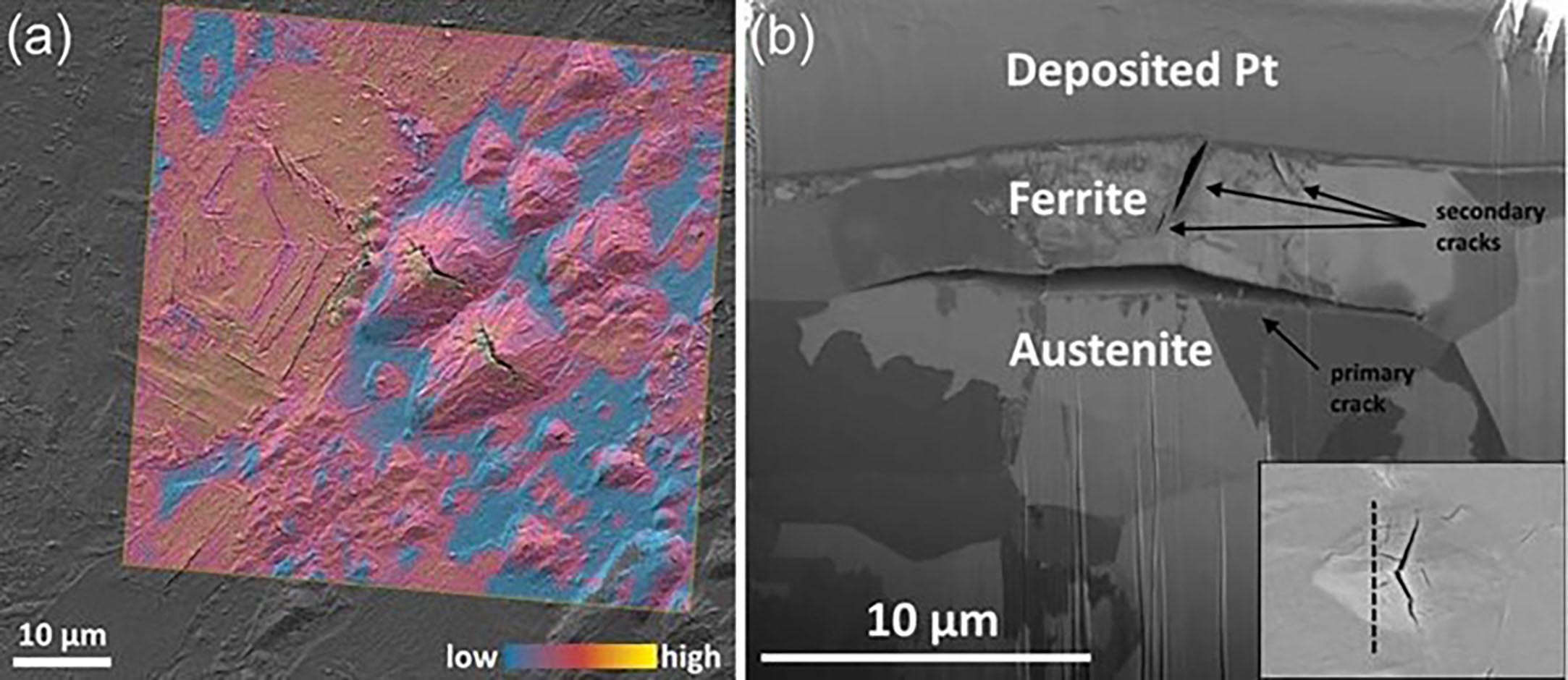
    Hydrogen can cause brittleness in several metals including ferritic steel, but recent advancements provide insight into the embrittlement process. a) The arrowhead-shaped delaminations in stainless steel reveal cracks with significantly higher deuterium concentrations b) Secondary ion cross-sectional profile for one such delamination. Credit: O. Sobol, G. Holzlechner, G. Nolze, T. Wirth, D. Eliezer, T. Boellinghaus, and W.E.S. Unger

    Methods reveal understanding of the location of hydrogen in ferritic steels.

     As the global energy market shifts from coal, petroleum fuel, and natural gas to more environmentally friendly primary energy sources, hydrogen is becoming a crucial pillar in the clean energy movement. Developing safe and cost-effective storage and transportation methods for hydrogen is essential but complicated given the interaction of hydrogen with structural materials.

    Hydrogen can cause brittleness in several metals including ferritic steel — a type of steel used in structural components of buildings, automobile gears and axles, and industrial equipment. Recent advancements in experimental tools and multiscale modeling are starting to provide insight into the embrittlement process.

    A review of various methods, published in Applied Physics Reviews, from AIP Publishing, has improved the understanding of the structure, property, and performance of ferritic steels that are subjected to mechanical loading in a hydrogen environment. While there are many studies of stainless steel, the researchers concentrated on ferritic steel, a cheaper steel that is used in the construction of pipelines and other large structures.

    “Determining the location of the hydrogen in the host metal is the million-dollar question,” said May Martin, one of the authors.

    Specifically, understanding where the hydrogen goes under strain in a bulk material is critical to understanding embrittlement.

    “We haven’t answered this question but by combining techniques, we are getting closer to that answer,” said Martin.

    The researchers highlighted several combinations of techniques and methods, including atom probe tomography. APT is a measurement tool that combines a field ion microscope with a mass spectrometer to enable 3D imaging and chemical composition measurements at the atomic scale, even for light elements like hydrogen.

    Other techniques that show promise are 2D mapping by secondary ion mass spectrometry to answer the question of where hydrogen lies in a material. Ion mass spectrometry is a technique used to analyze the composition of solid surfaces and thin films by sputtering the surface of the specimen with a focused primary ion beam and collecting and analyzing the ejected secondary ions.

    The researchers said it is particularly in the last decade that large advances have been made in hydrogen embrittlement, thanks to the development of new experimental capabilities. As new experimental techniques are refined it is expected the field will continue to develop at a remarkable pace.

    “As the field expands, we hope our paper is a good resource for those getting into the field,” said Martin.

    Reference: “Hydrogen embrittlement in ferritic steels” by May Ling Martin, Matthew Connolly, Frank W. DelRio, and Andrew Slifka, 6 October 2020, Applied Physics Reviews.
    DOI: 10.1063/5.0012851

    Never miss a breakthrough: Join the SciTechDaily newsletter.
    Follow us on Google and Google News.

    Energy Hydrogen Materials Science Mechanical Engineering
    Share. Facebook Twitter Pinterest LinkedIn Email Reddit

    Related Articles

    Hydrogen Mapping Breakthrough Could Transform Energy Storage and Technology

    Ancient Arts of Origami and Kirigami Inspire Mechanical Metamaterials

    New Crystalline Form of Silicon Could Enable Next-Gen Electronic and Energy Devices

    Breakthrough Boost for Solar-Powered Fuel Made by Splitting Water

    Efficiently Converting Light Energy Into Surface Waves on Graphene

    Invisible Solar Panels: How Tomorrow’s Windows Will Generate Electricity

    Cold Neutrons Uncover “Floppy” Atomic Dynamics That Help Turn Heat Into Electricity

    Harvesting Hot Electrons Without Tricks Could Increase Solar Panel Efficiency

    Innovative Hydrogen Boride Nanosheets: Huge Potential As Hydrogen Carrier

    1 Comment

    1. Joe Milosch on October 7, 2020 3:31 am

      One may brush off a story like this, deeming it inconsequential to our current lives, but solving it is of the utmost importance for a clean future. A successful method will earn some corporation much wealth.

      Reply
    Leave A Reply Cancel Reply

    • Facebook
    • Twitter
    • Pinterest
    • YouTube

    Don't Miss a Discovery

    Subscribe for the Latest in Science & Tech!

    Trending News

    One of the Universe’s Largest Stars May Be Getting Ready To Explode

    Scientists Discover Enzyme That Could Supercharge Ozempic-Like Weight Loss Drugs

    Popular Sweetener Linked to DNA Damage – “It’s Something You Should Not Be Eating”

    Ancient “Rock” Microbes May Reveal How Complex Life Began

    Researchers Capture Quantum Interference in One of Nature’s Rarest Atoms

    “A Plague Is Upon Us”: The Mass Death That Changed an Ancient City Forever

    Scientists Discover Game-Changing New Way To Treat High Cholesterol

    This Small Change to Your Exercise Routine Could Be the Secret to Living Longer

    Follow SciTechDaily
    • Facebook
    • Twitter
    • YouTube
    • Pinterest
    • Newsletter
    • RSS
    SciTech News
    • Biology News
    • Chemistry News
    • Earth News
    • Health News
    • Physics News
    • Science News
    • Space News
    • Technology News
    Recent Posts
    • Scientists Prove There Are Just Six Degrees of Separation in a Social Network
    • Bee Bacteria Could Fix a Major Flaw in Plant-Based Milk
    • Scientists Discover a Surprising Way To Make Bread Healthier and More Nutritious
    • Natural Compounds Boost Bone Implant Success While Killing Bacteria and Cancer Cells
    • After 60 Years, Scientists Uncover Unexpected Brain Effects of Popular Diabetes Drug Metformin
    Copyright © 1998 - 2026 SciTechDaily. All Rights Reserved.
    • Science News
    • About
    • Contact
    • Editorial Board
    • Privacy Policy
    • Terms of Use

    Type above and press Enter to search. Press Esc to cancel.