
In this episode of American Chemical Society Reactions, they head to Portland, Oregon, to learn how blacksmithing is just as much chemistry as it is an art form.
This is Arnon.
Arnon Kartmazov: It’s all authentic, man. You know I worked for three hours to get that dirt on just right.
He’s a blacksmith who loves chemistry. Arnon founded Bridgetown Forge in Portland, Oregon in the early 2000s, and that’s where the Reactions team met up with him.
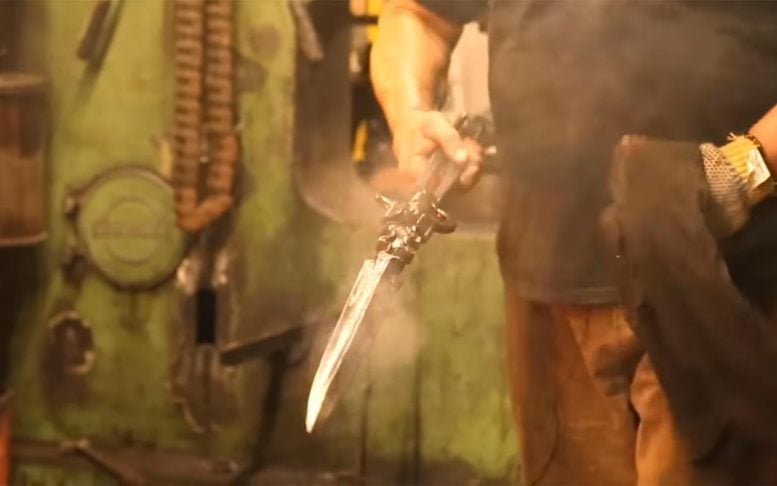
We were lucky enough to get some time with Arnon, who showed us how to make this sweet dagger by blending together art and chemistry.
Arnon started with a cylinder of metal and drew it out to what you see here. To do this, he heated the metal in a forge, then molded it by using a pneumatic power hammer and some good old fashioned hammering. Then Arnon repeated this process until he was happy with how the blade looked. But more on that later.
First up…
AK: Blacksmithing is just a very generic term describing somebody who heats metal, usually steel, and hammers it.
Hundreds of years ago, blacksmiths played a key role in society—making all of this stuff. And you might be thinking…didn’t the Industrial Revolution drive them to extinction? Not quite. You can still find blacksmiths making swords and daggers, and more common stuff like furniture, kitchen cutlery, and sculptures in their shop—called a forge or a smithy.
Blacksmiths mostly work with mixtures of metals. Mixing different metals creates what’s called an alloy — a new substance that has its own characteristics…and personality. Brass, for example, is an alloy of copper and zinc, and it’s really resistant to corrosion and has great acoustic properties, so it’s used in instruments like the trumpet.
Blacksmiths usually choose an alloy you know: steel. Steel is mostly made of iron, some carbon, and oftentimes other elements. The exact steel alloy a blacksmith chooses to work with depends on what they’re making.
Knives and tools that can cut through metal need to be strong and able to keep a sharp edge. To make that happen, blacksmiths use high carbon steel, which usually has between 0.8% and 1.5% carbon mixed in. This steel will hold an edge better, but the downside is it’s also more brittle.
If a blacksmith wants flexibility, like for a foil, they’ll use low carbon steel, which usually has <0.1-0.3% carbon. The less carbon, the weaker the steel, so it won’t hold an edge as well, but it’s also more flexible.
Here’s why.
Pure iron looks kinda like this, with atoms neatly organized. When carbon is added to iron to make steel, the carbon sits between the iron atoms. The structure becomes distorted, making it harder for the iron atoms to move—making the overall steel stronger but less flexible.
Over centuries, blacksmiths have played with different combinations of materials to maximize both strength and flexibility. But, how do you know what’s actually in a piece of metal before you start working with it? You can either keep track of where you get your steel, or you could do what’s called a…
AK: spark test, holding a piece of steel to a grinding wheel or grinding belt and observing the complexity and the color and number of the sparks.
So now that we have our steel alloy picked out, let’s get to making our dagger. Arnon needs to heat up the steel to over 1,000°C in order to shape it. An experienced blacksmith can tell how hot the steel is by looking at it.
Once the steel is at the temperature he needs Arnon shapes the dagger with the pneumatic power hammer. After a few minutes the steel cools down and we need to heat it up again. So back in the forge it goes, followed by more shaping, then more heating, and more shaping, then more…well, you get the idea.
After Arnon gets our blade looking killer, it’s time to quench it. Quenching is a process of cooling metal down. And the speed at which you cool the metal plays a huge role in determining its final properties.
Water is used to quench metal quickly, and oil is used if you want it to cool more slowly. If you quench quickly in water, the carbon and iron atoms don’t have time to rearrange themselves, so they’re pretty much stuck in a structure that makes the steel hard, but brittle. If you cool more slowly in air or oil, the carbon and iron atoms can rearrange themselves in a way that makes the steel more flexible but less hard.
Aron quenched our dagger in oil. But before he quenched the blade, Arnon put some clay on it. He wanted the spine of the dagger to remain flexible. So he needed a way to cool it even more slowly than the rest of the dagger. The clay did exactly that, insulating the hot spine from the cool oil, and that meant
the spine cooled extra slowly, staying more flexible than the rest of the dagger. But while it was cooling, it was also radiating some heat toward the edges of the blade, alsogiving it a bit more flexibility to keep it from being too brittle. This process is called tempering. Arnon did the quenching and tempering all in one step, but you can also do it in two.And, there you have it! A flashy new dagger for the Reactions crew.
We’re celebrating National Chemistry Week, which, this year, is all about Marvelous Metals.
Never miss a breakthrough: Join the SciTechDaily newsletter.
Follow us on Google and Google News.