
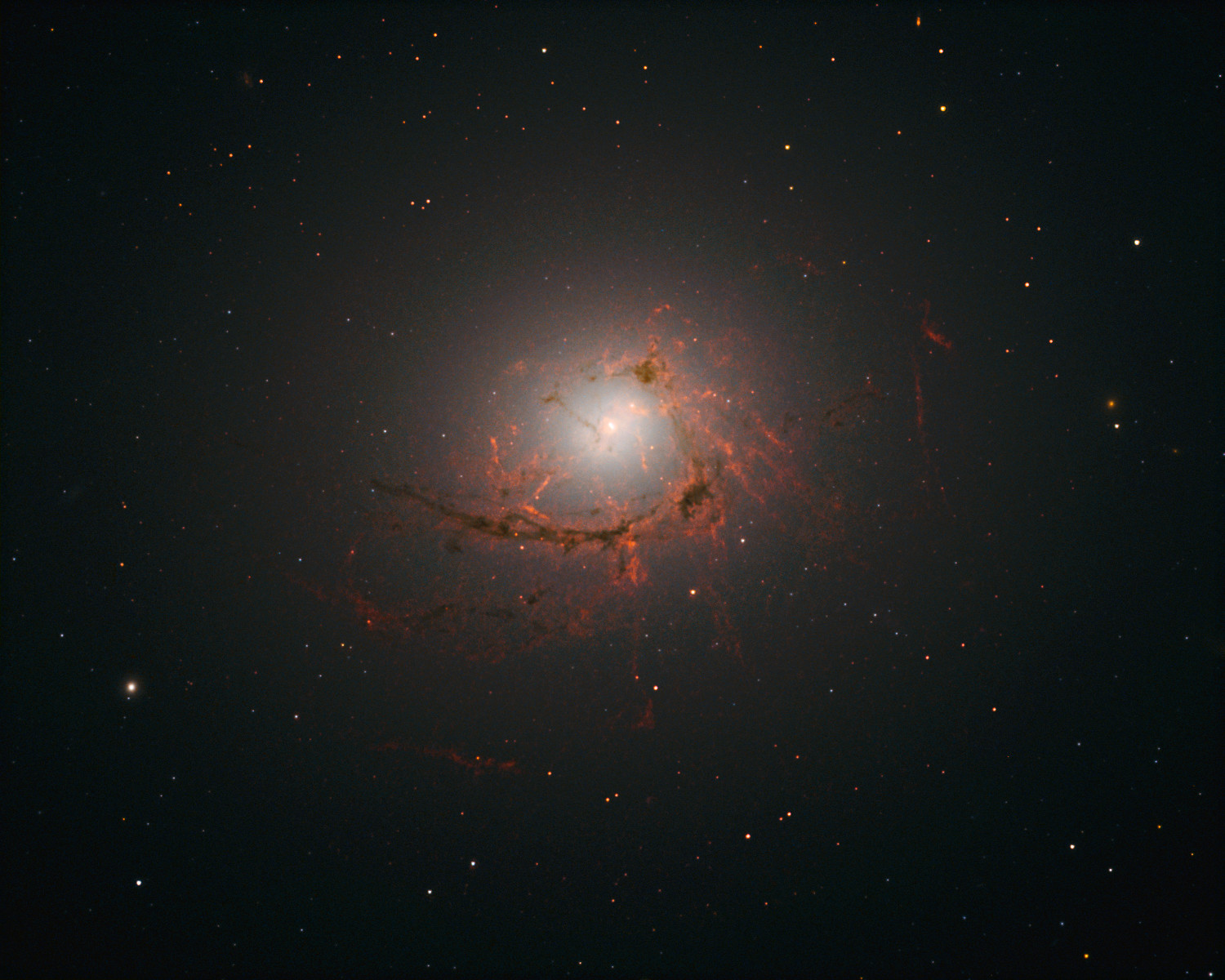
An international team using the JWST has found photographic evidence that brings astronomers closer to solving a long-standing mystery about black holes.
For decades, astronomers have faced a puzzle at the centers of massive galaxies: how can a supermassive black hole keep feeding when its own powerful jets heat the surrounding gas that supplies it? New observations from the James Webb Space Telescope, or JWST, are bringing that process into much sharper view.
The images provide the clearest look yet at gaseous filaments linking a galaxy’s hot atmosphere to the rotating disk that supplies material to its central supermassive black hole.
An international collaboration led by the Université de Montréal, with contributions from Michigan State University, carried out the observations and analyzed the data. The results, reported in the July 14 issue of The Astrophysical Journal Letters, address a question astronomers have wrestled with for decades.
“JWST observations are offering us thousands of new facts and measurements, and I can report it’s a lot to absorb,” said Megan Donahue, MSU University Distinguished Professor of physics and astronomy. “We are all working together to solve the astrophysics questions about how these black holes get their fuel and how they interact with their host galaxy.”
Black hole jets create a feeding paradox
Nearly every large galaxy contains a supermassive black hole, or SMBH, at its center, with a mass millions or even billions of times greater than the sun. When one of these black holes actively consumes surrounding material, it becomes what astronomers call an active galactic nucleus, or AGN.
An active black hole can launch powerful jets of energy into its surroundings. Those jets can reshape the host galaxy, suppress the formation of new stars, and influence how the galaxy evolves.
But that creates an apparent contradiction. If the jets heat the gas surrounding the black hole, they should eventually cut off the very material the black hole needs to continue feeding and growing.
The leading explanation is that some of the heated gas eventually cools, condenses into long, narrow filaments, and falls back toward the center of the galaxy. This would create a self regulating cycle in which the black hole both disrupts and ultimately replenishes its own fuel supply.
To investigate that idea, the researchers turned JWST toward NGC 4696, the central galaxy of the Centaurus Cluster. Located about 145 million light-years from Earth, the dense galaxy cluster is considered one of the best places to study how AGN operate.
JWST traced gas into the feeding disk
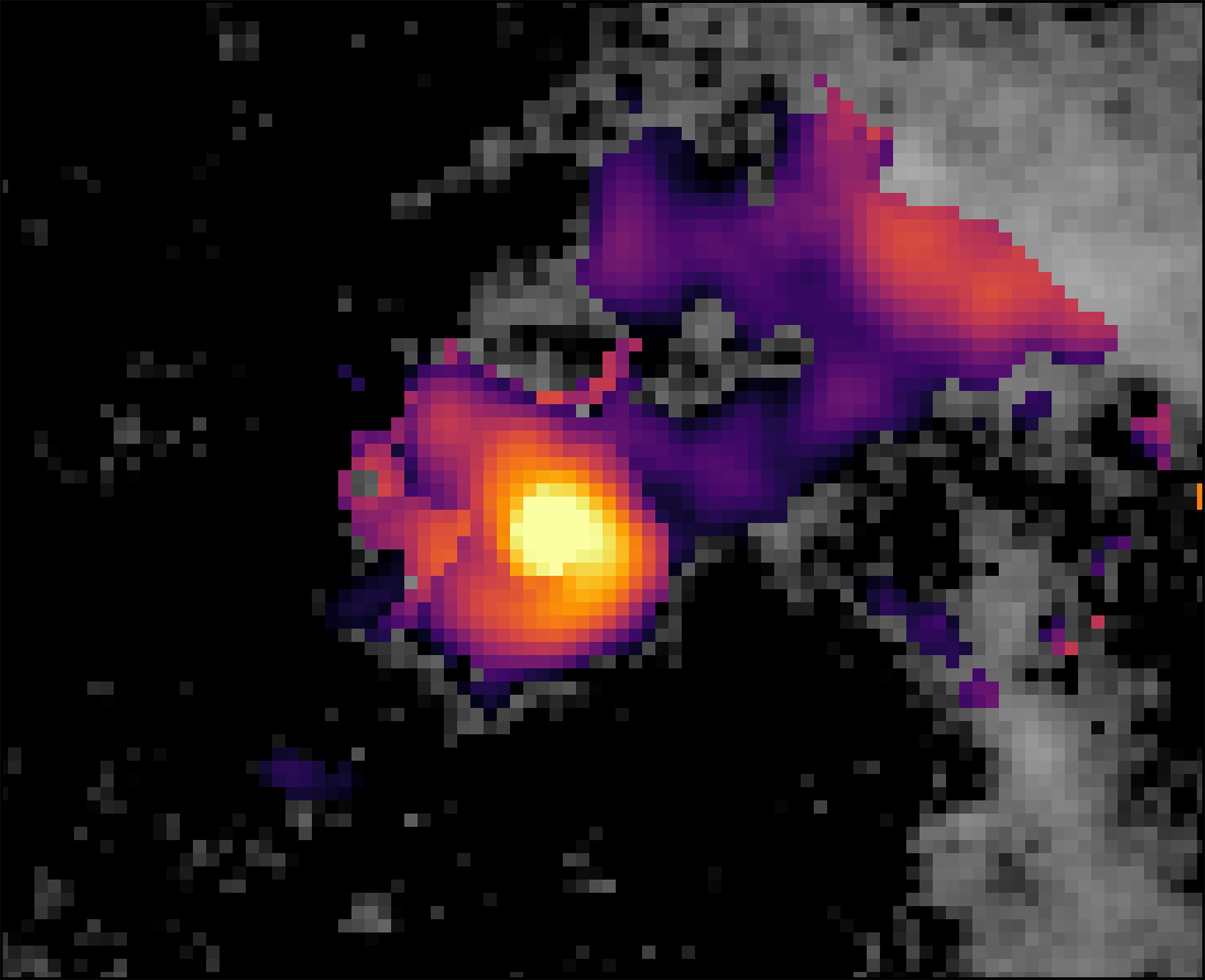
Using nearly eight hours of observations from JWST’s NIRSpec instrument, the researchers mapped the movement of gas deep within the black hole’s sphere of influence. The observations resolved features about 30 light-years across — extremely small compared with a galaxy spanning hundreds of thousands of light-years.
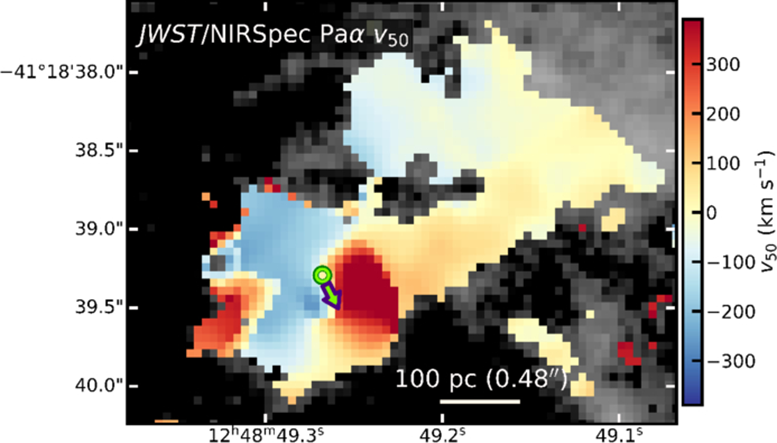
The maps revealed that an S-shaped swirl near the center is actually a rotating disk of gas surrounding the SMBH. The disk stretches nearly 800 light-years across, with material moving at speeds of up to 600 kilometers per second.
Most importantly, the disk appears to connect directly with one of the large filaments extending into the galaxy. The observations show gas traveling along that filament and entering the rotating disk that supplies material to the black hole.
Together, the observations help fill in the broader feeding cycle. Jets released by the black hole inject energy into the surrounding gas. Over time, some of that gas cools, becomes unstable, and condenses into filaments that may be only a few hundred light-years wide while extending for thousands of light-years.
Magnetic forces then slow the rotation of the falling gas and guide it inward. The material collects in a spinning disk around the black hole, the disk supplies the black hole with fuel, and the black hole launches new jets, beginning the cycle again.
Simulations support the feeding cycle
The researchers also tested this interpretation with state-of-the-art computer simulations. Gas in the simulations behaved much like the material observed by JWST, providing independent support for the proposed feeding process.
“It’s been really exciting to participate in this project,” MSU Physics and Astronomy Professor Mark Voit said. “Calculations done by our Michigan State group predict that magnetic fields should help feed the universe’s biggest black holes by channeling cool gas toward them, and it’s amazing to see that happening in these JWST images.”
Reference: “JWST Reveals How Black Holes are Fed: Kiloparsec-scale Multiphase Filaments Feed Subkiloparsec Circumnuclear Disks” by Julie Hlavacek-Larrondo, Hyunseop Choi, 현섭 최, Minghao Guo, 明浩 郭, Mathieu Marquis, Olivia Pereira, G. Mark Voit, Loïc Albert, Jorge Barrera-Ballesteros, Rebecca E. A. Canning, Francesco D’Eugenio, Megan Donahue, Andrew C. Fabian, Gary J. Ferland, John S. Gallagher, Marie-Lou Gendron-Marsolais, Pierre Guillard, Nina Hatch, Ralf Kotulla, Yuan Li, Roberto Maiolino, Allison Man, Michael A. McDonald, B. R. McNamara, Valeria Olivares, Marine Prunier, Michael Reefe, Christopher S. Reynolds, Carter Rhea, Annabelle Richard-Laferrière, Helen R. Russell, Philippe Salomé, Ming Sun, Prathamesh Tamhane, Gregory Taylor, Auriane Thilloy, Grant R. Tremblay, Benjamin Vigneron and Stephen A. Walker, 14 July 2026, The Astrophysical Journal Letters.
DOI: 10.3847/2041-8213/ae81ae
Funding: Canadian Space Agency
Never miss a breakthrough: Join the SciTechDaily newsletter.
Follow us on Google and Google News.