
The Webb Space Telescope team continues to work on commissioning the science instruments, the final step before starting science operations in the summer. We recently saw the spectacular image of the black hole in the center of our Milky Way galaxy, taken by the Event Horizon Telescope. One of the puzzles of modern astronomy is how every large galaxy came to have a gargantuan central black hole, and how some of these black holes are surprisingly large even at very early times of the universe. We asked Roberto Maiolino, a member of Webb’s Near-Infrared Spectrometer (NIRSpec) instrument science team, to tell us how Webb will help to answer some of these questions.
“One of the most exciting areas of discovery that Webb is about to open is the search for primeval black holes in the early universe. These are the seeds of the much more massive black holes that astronomers have found in galactic nuclei. Most (probably all) galaxies host black holes at their centers, with masses ranging from millions to billions of times the mass of our Sun. These supermassive black holes have grown to be so large both by gobbling matter around them and also through the merging of smaller black holes.
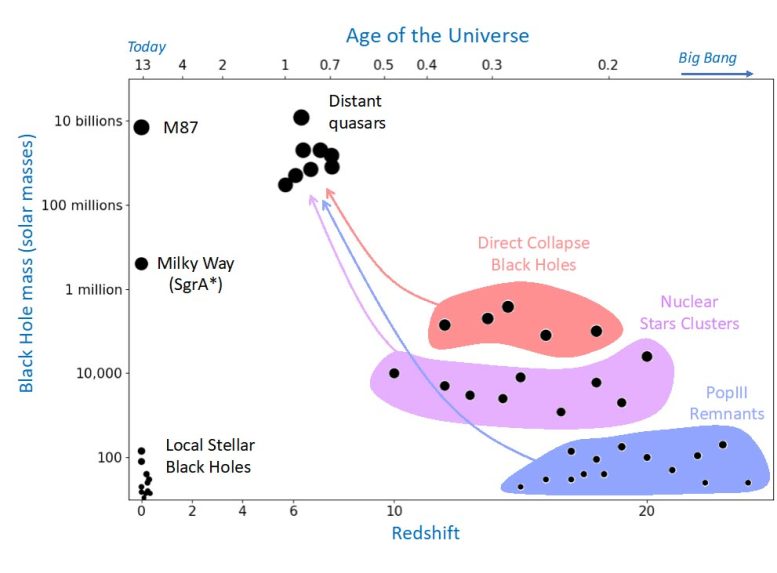
“An intriguing recent finding has been the discovery of hyper-massive black holes, with masses of several billion solar masses, already in place when the universe was only about 700 million years old, a small fraction of its current age of 13.8 billion years. This is a puzzling result, as at such early epochs there is not enough time to grow such hyper-massive black holes, according to standard theories. Some scenarios have been proposed to solve this conundrum.
“One possibility is that black holes, resulting from the death of the very first generation of stars in the early universe, have accreted material at exceptionally high rates. Another scenario is that primeval, pristine gas clouds, not yet enriched by chemical elements heavier than helium, could directly collapse to form a black hole with a mass of a few hundred thousand solar masses, and subsequently accrete matter to evolve into the hyper-massive black holes observed at later epochs. Finally, dense, nuclear star clusters at the centers of baby galaxies may have produced intermediate mass black hole seeds, via stellar collisions or merging of stellar-mass black holes, and then become much more massive via accretion.”
“Webb is about to open a completely new discovery space in this area. It is possible that the first black hole seeds originally formed in the ‘baby universe,’ within just a few million years after the Big Bang. Webb is the perfect ‘time machine’ to learn about these primeval objects. Its exceptional sensitivity makes Webb capable of detecting extremely distant galaxies, and because of the time required for the light emitted by the galaxies to travel to us, we will see them as they were in the remote past.
“Webb’s NIRSpec instrument is particularly well suited to identify primeval black hole seeds. My colleagues in the NIRSpec Instrument Science Team and I will be searching for their signatures during ‘active’ phases, when they are voraciously gobbling matter and growing rapidly. In these phases the material surrounding them becomes extremely hot and luminous and ionizes the atoms in their surroundings and in their host galaxies.
“NIRSpec will disperse the light from these systems into spectra, or ‘rainbows.’ The rainbow of active black hole seeds will be characterised by specific ‘fingerprints,’ features of highly ionized atoms. NIRSpec will also measure the velocity of the gas orbiting in the vicinity of these primeval black holes. Smaller black holes will be characterized by lower orbital velocities. Black hole seeds formed in pristine clouds will be identified by the absence of features associated with any element heavier than helium.
“I look forward to using Webb’s unprecedented capabilities to search for these black hole progenitors, with the ultimate goal of understanding their nature and origin. The early universe and the realm of black holes seeds is a completely uncharted territory that my colleagues and I are very excited to explore with Webb.”
Roberto Maiolino, professor of experimental astrophysics and director of the Kavli Institute for Cosmology, University of Cambridge
Written by:
- Jonathan Gardner, Webb deputy senior project scientist, NASA’s Goddard Space Flight Center
- Stefanie Milam, Webb deputy project scientist for planetary science, NASA’s Goddard Space Flight Center
Never miss a breakthrough: Join the SciTechDaily newsletter.
Follow us on Google and Google News.
3 Comments
According to the theory of coevolution of galaxy,super massive black hole at the center of galaxy evolved as a seed in the cool hydrogen gas cloud.This has growth in the invisible state upto .5 billion years but less,without any significant evolution of stars.Theory is based on rotation.
There are some theories about the evolution of early galaxies.One is theory of coevolution of stars and super massive black hole at the center of galaxy based on the effects of rotation in gaĺaxies.
Primordial*