
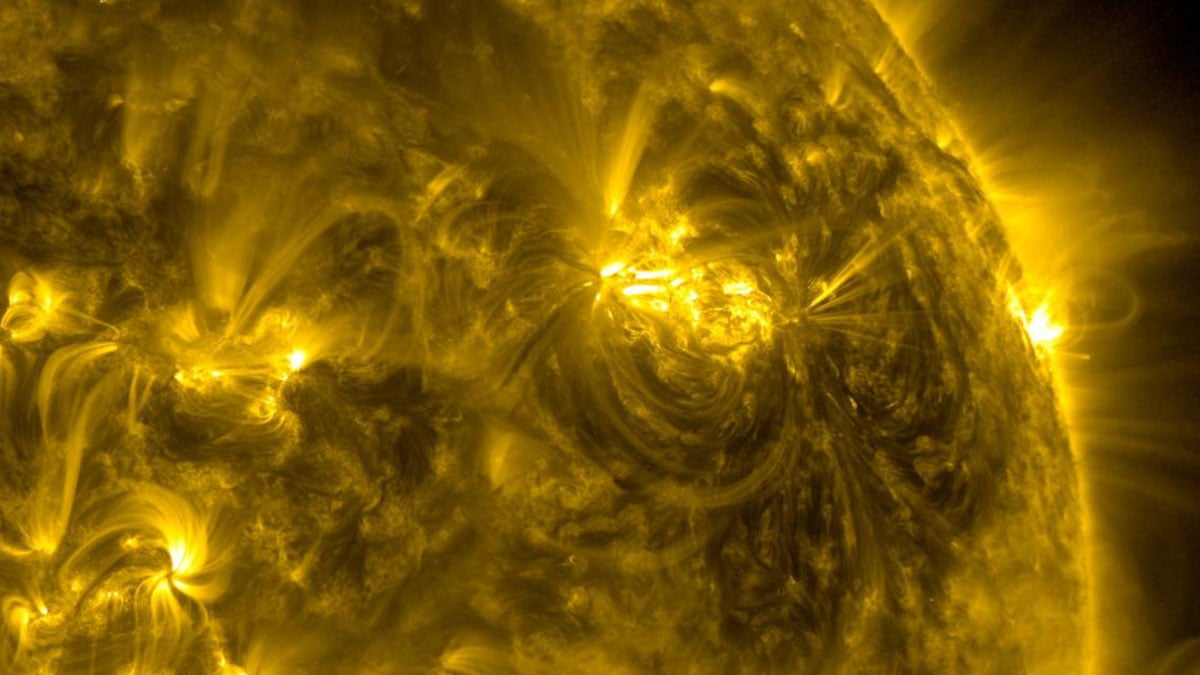
AI detected faint signs of emerging solar active regions about nine hours before they became visible on average.
Before a sunspot darkens the Sun’s visible surface, the magnetic activity that creates it is already developing out of sight. Those early changes are faint, but researchers say artificial intelligence can now recognize them hours before a new solar active region becomes visible.
A model called EarlyDetect detected signs of emerging active regions an average of nearly nine hours ahead of their appearance. The system was developed by a New Jersey Institute of Technology (NJIT) led research team and described Aug. 14 in the Journal of Geophysical Research: Machine Learning and Computation.
EarlyDetect searches for precursor patterns in both the Sun’s acoustic activity and magnetic field, signals that scientists have previously struggled to identify reliably.
NJIT undergraduate researcher Jonas Tirona, the study’s corresponding author, developed the model with computer scientists and solar physicists at NJIT and collaborators from Princeton University and NASA’s Ames Research Center. The work used observations collected by NASA’s Solar Dynamics Observatory (SDO).
“The most valuable thing this work shows is that we can use machine learning to predict when solar active regions will emerge in advance,” said Tirona, an incoming senior computer science major and Albert Dorman Honors College scholar. “That early warning could allow satellite communications companies or power grid companies to prepare and potentially mitigate damage from solar storms.”
This visualization shows the emergence of solar active region AR11158 using magnetic-field, continuum-intensity, and acoustic-power observations. A drop in acoustic power appears first, providing an early sign of emergence, followed by changes in intensity and magnetic field. The visualization demonstrates the data-analysis pipeline behind EarlyDetect, a machine-learning model being developed to forecast active-region emergence. The model is not yet operational. Credit: Irina N. Kitiashvili (NASA Ames Research Center) and Spiridon Kasapis (Princeton University).
Faint solar vibrations reveal hidden activity
Active regions are areas of intense magnetic activity where sunspots develop. Their emergence unfolds over several hours, while complete development can require anywhere from one to several days.
Before those regions reach the surface, rising magnetic fields subtly alter acoustic waves moving through the Sun. Scientists can study these vibrations using helioseismology, which examines waves inside the Sun to learn about processes that cannot be observed directly.
EarlyDetect searches for these signals by analyzing hourly maps of acoustic power together with measurements of the solar magnetic field from NASA’s Solar Dynamics Observatory.
The acoustic maps come from sound wave measurements recorded every 45 seconds by the Helioseismic and Magnetic Imager (HMI) aboard SDO.
“The main difficulty is that an active region begins developing beneath the Sun’s visible surface, where we cannot directly observe the magnetic structure,” said Alexander Kosovichev, distinguished professor of physics at NJIT and co-principal investigator of the project. “Instead, we’re looking for very small changes in the magnetic field and in the pattern of acoustic waves continually traveling through the Sun. It’s more like detecting a slight change in rhythm within a very noisy orchestra.”
Removing noise made forecasts worse
EarlyDetect is built around a Transformer architecture, the same broad type of AI technology used by large language models such as ChatGPT. Instead of learning statistical patterns in language, however, this model searches solar measurements for patterns that precede changes in the Sun’s activity.
When Tirona joined the project last year, the researchers were using a filtering method intended to make important solar patterns easier for the model to recognize. Testing revealed the opposite. Filtering the observations actually reduced the quality of the forecasts.
“That surprised us most,” Kosovichev said. “We initially expected it to help isolate useful short-timescale patterns. Instead, it averaged away the very faint fluctuations that provided the earliest warning.”
“It’s kind of like noise canceling … it normally removes the loud noises so you can see the overall trend better,” Tirona said. “But we found it was detrimental in almost every case. The signals that the filter removed turned out to be really important in helping the model predict when an active region would emerge.”
This video condenses nine days of solar activity into just four minutes, playing 3,240 times faster than real time. Credit: NASA’s Goddard Space Flight Center/SDO Producer: Scott Wiessinger (eMITS) Editor: Scott Wiessinger (eMITS) Visualizer: AJ Christensen (ADNET Systems, Inc.) Science writer: Miles S. Hatfield (Telophase) Music Credit: “Atomic Drift” from the album Molecular Echoes. Written and produced by Lars Leonhard.
EarlyDetect spots signals about nine hours early
After training EarlyDetect with measurements from NASA’s SDO/HMI, the researchers challenged it with active regions that were not included in its training data.
The strongest version of the model detected precursor patterns an average of 9.24 hours before the active regions became visible. Its performance exceeded both a standard Transformer model and an earlier benchmark method.
“Machine learning hasn’t been widely applied to solar activity forecasting yet,” said Mengjia Xu, assistant professor of data science at NJIT and principal investigator of the project. “Our work shows that advanced machine learning models can open new possibilities for future space weather prediction.”
The research was among the first projects supported by NJIT’s Grace Hopper AI Research Institute, which was established in 2025 to support interdisciplinary artificial intelligence research. The work also received support from NASA heliophysics and space weather research grants, including the NASA Science DRIVE Center, Consequences Of Fields and Flows in the Interior and Exterior of the Sun (COFFIES).
The researchers also made their data available for others to use. They released the Solar Active Region Emergence Dataset (SolARED), a public collection of active region observations assembled from SDO, as well as the Solar Active Region (SAR) Portal, an interactive platform for exploring the observations.
“This is the first public dataset for solar active region emergence,” Xu said. “It provides a shared resource for both the machine learning and heliophysics communities to develop and test new prediction approaches.”
Real-time forecasting remains out of reach
Despite its performance, EarlyDetect cannot yet serve as an operational real-time forecasting system, Tirona cautioned. It was trained using known emergence events and can still generate false alarms or predictions that arrive too late.
Detecting the emergence of an active region also does not mean that a solar flare or coronal mass ejection is about to happen. Many active regions never generate major eruptions, and the researchers still need to test the model across a much larger number of solar events.
“I hope this project brings more awareness to how machine learning can contribute to heliophysics,” Tirona said. “It would be really cool if a model like this could someday help predict solar weather events. We’re not there yet — but this is an exciting step.”
Reference: “Forecasting Continuum Intensity for Solar Active Region Emergence Prediction Using Transformers” by Jonas Tirona, Sarang Patil, Spiridon Kasapis, Eren Dogan, John Stefan, Irina N. Kitiashvili, Alexander G. Kosovichev and Mengjia Xu, 14 August 2026, Journal of Geophysical Research: Machine Learning and Computation.
DOI: 10.1029/2025JH001207
This work was supported by the New Jersey Institute of Technology (NJIT) Grace Hopper AI Research Institute (GHAIRI) Seed Grant (Grant 179025). This work is supported by the NASA AI/ML HECC Expansion Program, and the NASA Grants 24-HGIO24_2-0101, 23-HGIO23_2-0077, 20-HSR20_2-0037, 80NSSC19K0630, 80NSSC19K0268, 80NSSC20K1870, and 80NSSC22M0162. Xu and Patil were partially supported by the DOE SEA-CROGS project (DE-SC0023191) and the AFOSR project (FA9550-24-1-0231).
Never miss a breakthrough: Join the SciTechDaily newsletter.
Follow us on Google and Google News.
1 Comment
While NJIT’s Early Detect Transformer represents a massive step forward in detecting solar flare precursors, its creators rightly note its operational limits: high false-alarm rates and unpredictable prediction lag when processing real-time data.This limitation occurs because pure machine learning models treat solar acoustic waves as statistical patterns rather than physical mechanics. When background convection mimics precursor patterns, the AI generates false positives; when signature acoustic drops are delayed, the warning arrives too late.By integrating continuous 3D field mechanics into Early Detect processing pipeline, these operational barriers vanish:Noise vs. Signal: Applying Temporal Gradient Impedance ($Z_T$) boundary conditions allows the algorithm to instantly filter out chaotic convective noise, isolating the true geometric impedance collapse that precedes an eruption.Zero-Lag Early Warning: Modeling subsurface magnetic twist via Vector Helical Paths ($V_h$) and full rotational geometry ($E = mc^2 \cdot \pi$) tracks energy build-up at its source—predicting Torsional Release Inception (TRI) hours before acoustic waves reach the surface.Combining predictive AI with deterministic 3D helical physics transforms Early Detect from an experimental pattern-recognition tool into a precise, real-time solar defense system. The Link , take a look , https://docs.google.com/document/d/1iHSMitywAsr2YbvXBW65bAR9g5bELPSy1meMg_ik7f8/edit?usp=drive_link