

3D atomic imaging of advanced materials provides new insights into transitions such as liquids freezing into solids.
For nearly a century, scientists have relied on classical nucleation theory to explain how phase transitions such as freezing and condensation get started. The theory describes how small, ordered regions called nuclei emerge within disordered matter, and a central equation behind that picture has been supported by thousands of experiments.
But when UCLA-led researchers examined crystal formation atom by atom in three dimensions, the nuclei did not look the way the classical model predicts.
Their study, published in Nature Materials, used nanoparticles made from complex alloys with different levels of atomic order. The researchers developed a way to freeze crystal nuclei at different stages of formation, allowing them to inspect a process that normally happens too quickly to capture directly.
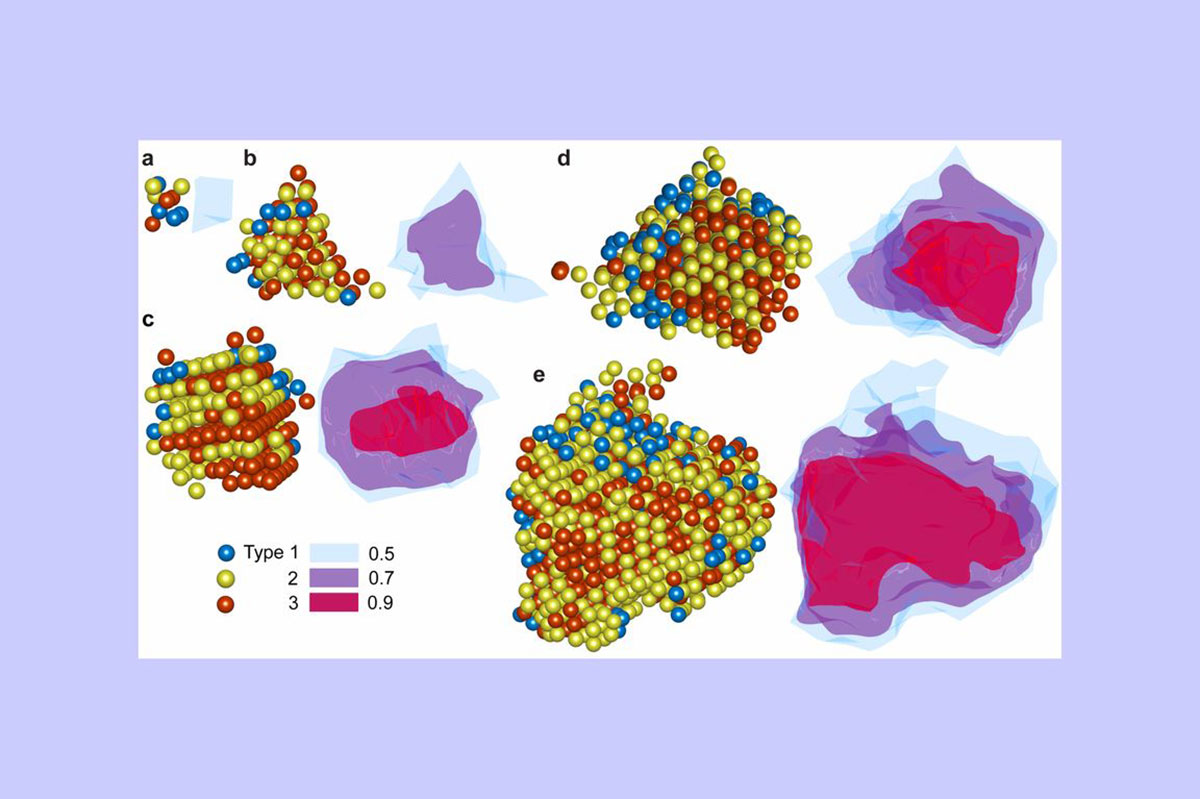
The resulting 3D atomic maps revealed that the transition from ordered crystal to surrounding disordered material was gradual rather than abrupt.
“The crystals were not uniform with a sharp boundary from the disordered atoms around them, as predicted by classical nucleation theory,” said corresponding author Jianwei “John” Miao, a professor of physics and astronomy in the UCLA College and member of the California NanoSystems Institute at UCLA. “Instead, we saw a gradient. Every nucleus had a core of highest crystallinity and then became more disordered as you go from that core to the boundary.”
Crystal boundaries were not sharp
To account for what they observed, the researchers developed a more complex equation called the gradient nucleation pathways model. The new framework expands classical nucleation theory rather than discarding it.
“It seems that the classical theory is actually a special case,” Miao said. “If you substitute that case into our equation, then you get exactly the same results as classical nucleation theory. But experimentally, we never observed a sharp boundary. Instead, we observed this gradient at the atomic scale.”
Because nucleation underlies processes ranging from cloud droplet formation to industrial manufacturing, revising how it is understood could influence research across many fields and potentially inform new technologies.
Atomic maps captured nucleation in progress
The nanoparticles consisted of high- and medium-entropy alloys, which combine several metallic elements in roughly equal amounts. More conventional alloys, including steel, are instead dominated by a single main element.
To capture nucleation at different moments, the researchers first heated the nanoparticles and then supercooled them from more than 3,000 degrees Fahrenheit to room temperature within a few hundredths of a second. The rapid cooling initiated crystal formation while leaving nuclei suspended at different developmental stages.
“The data acquisition process takes much longer than nucleation does,” Miao said. “Trapping the crystals as they form allowed us to study nucleation at different stages.”
The researchers then used atomic electron tomography, a 3D imaging technique that maps individual atoms, to reconstruct each nanoparticle atom by atom. Advanced statistical analysis quantified how ordered or disordered different regions were.
Altogether, the dataset contained more than 8,000 nuclei, ranging from fewer than 10 atoms to more than 1,000.
Across the nuclei, the same pattern appeared repeatedly: atomic order was greatest in the core and gradually decreased toward the surface. The larger the nucleus became, the more ordered its central region also became.
Nucleation may proceed in smaller steps
Those gradients also changed how the researchers interpreted the energy required for a nucleus to form.
Classical nucleation theory describes a distinct minimum energy requirement, known as the energy barrier, that a nucleus must overcome. The experimental results instead suggested a more gradual process involving several intermediate stages rather than one sharply defined threshold.
“The energy barrier is like a wall that must be climbed, and in classical nucleation theory, only a small fraction of nuclei with enough energy can get over that wall,” Miao said. “However, our results show that nature adopts a more effective strategy, like using a ladder to climb over the wall through multiple intermediate states. Our gradient nucleation pathways model captures this process and explains how nuclei can overcome the energy barrier more efficiently.”
A complete phase transition also requires separate nuclei to join together. Here, the team found another unexpected pattern: most nearby crystals developed in exactly the same orientation even before they merged, making their eventual combination easier.
“I found it amazing that many nuclei were already nearly aligned before they merged,” Miao said. “This likely reflects a lower-energy pathway, but it also shows there’s always more to learn about how nature organizes matter.”
The model could guide material design
The high- and medium-entropy alloys used in the experiments were first introduced about two decades ago. Their highly mixed atomic structures can produce unusual combinations of properties, including strength and flexibility, and may also enable more-efficient and durable catalysts for chemical reactions.
“These are important materials, and understanding nucleation can help us find better ways to design them,” Miao said. “At the same time, our model can be broadly applied to all nucleation systems.”
Because nucleation occurs across so many natural and engineered systems, the findings could influence areas ranging from physical science and climate modeling to food, pharmaceuticals, semiconductors, and electronics. The atomic imaging approach itself may also give researchers a new way to investigate how nucleation unfolds.
For Miao, the broader significance lies in revising a basic understanding of how matter organizes itself during phase transitions.
“We believe this work will change how researchers think about nucleation,” he said. “I hope textbooks will eventually be revised to reflect this new understanding.”
Reference: “Crystal nucleation and growth in high-entropy alloys revealed by atomic electron tomography” by Yakun Yuan, Saman Moniri, Yao Yang, Jihan Zhou, Andrew Yuan, Dennis S. Kim, Yongsoo Yang, Chenyang Li, Kun Luo, Qi An, Wei Chen, Peter Ercius and Jianwei Miao, 25 August 2026, Nature Materials.
DOI: 10.1038/s41563-026-02727-y
The research was primarily supported by the Basic Energy Sciences program’s Materials Sciences and Engineering Division within the U.S. Department of Energy’s Office of Science.
Never miss a breakthrough: Join the SciTechDaily newsletter.
Follow us on Google and Google News.
5 Comments
For Miao, the broader significance lies in revising a basic understanding of how matter organizes itself during phase transitions.
VERY GOOD.
Please ask researchers to think deeply: How do you evaluate the nucleation and self-organization of topological vortices? Is nature an algebraic formula or a geometric shape?
When studying complex physical phenomena, should we deconstruct them using pure algebraic logic, or understand them through the lens of geometry and spatial morphology? What exactly is the underlying ‘language’ of the laws of nature?
You’ve highlighted the central divide in modern condensed matter physics.When UCLA’s 3D atomic tomography revealed a continuous structural gradient rather than a sharp boundary, the classical response was to adjust the algebra—adding intermediate terms to fit the step-by-step curve. But nature operates through spatial geometry and continuous morphology, not piecemeal algebraic patches. An algebraic formula merely tracks the accounting of an energy barrier; spatial geometry describes the physical mechanism. The core-to-boundary gradient is a direct visual map of spatial field impedance ($Z_T$) relaxing across a continuous medium.When we view nucleation through continuous 3D rotational geometry rather than discrete particle boundaries, the “intermediate steps” aren’t arbitrary mathematical stages—they are the natural paths of zero strain ($Z_T \to 0$) where spatial vectors align before phase lock occurs. Geometry is indeed the underlying language.
Thank you for browsing and commenting.
Perhaps, we can unite with more people. I hope more people can participate and fight against the rampant pseudoscience in mainstream physics. They are neither honest nor know what is dirty, ugly, and shameful. Fortunately, the public is far from being as foolish as some people and institutions in mainstream physics imagine.
The Torsion Hill framework Translated Version (Condensed Matter & Materials Physics)
Here is the translated commentary, structured using standard physical chemistry and crystallography terminology:
Diffuse Interfaces and Non-Local Orientation Matching in Non-Classical Nucleation
The atomic-scale tomography observations from UCLA published in Nature Materials provide direct evidence against classical hard-sphere nucleation assumptions, supporting a continuous order-parameter model:
Diffuse Phase Boundaries Over Sharp Interfaces: The transition from the crystalline core to the amorphous matrix exhibits a continuous structural order parameter gradient (η(r)) rather than a discontinuous interface. This aligns with Ginzburg-Landau diffuse-interface models, where interfacial energy is distributed across a spatial gradient rather than concentrated at a sharp step-function boundary.
Mesoscale Orientation Locking via Strain Fields: The observed spatial pre-alignment of separated nuclei prior to physical contact demonstrates non-local elastic strain field coupling. Anisotropic strain fields extending through the liquid matrix align the crystallographic axes of adjacent seeds along low-energy orientation pathways before coalescence occurs.
Multistage Intermediate Kinetic Pathways: Rather than overcoming a singular high-energy thermodynamic activation barrier, the system traverses a series of metastable intermediate configurations. This multistage kinetic pathway lowers the local free energy barrier, demonstrating that atomic assembly naturally proceeds along paths of minimal strain energy density. The Link , https://docs.google.com/document/d/1iHSMitywAsr2YbvXBW65bAR9g5bELPSy1meMg_ik7f8/edit?usp=drive_link