
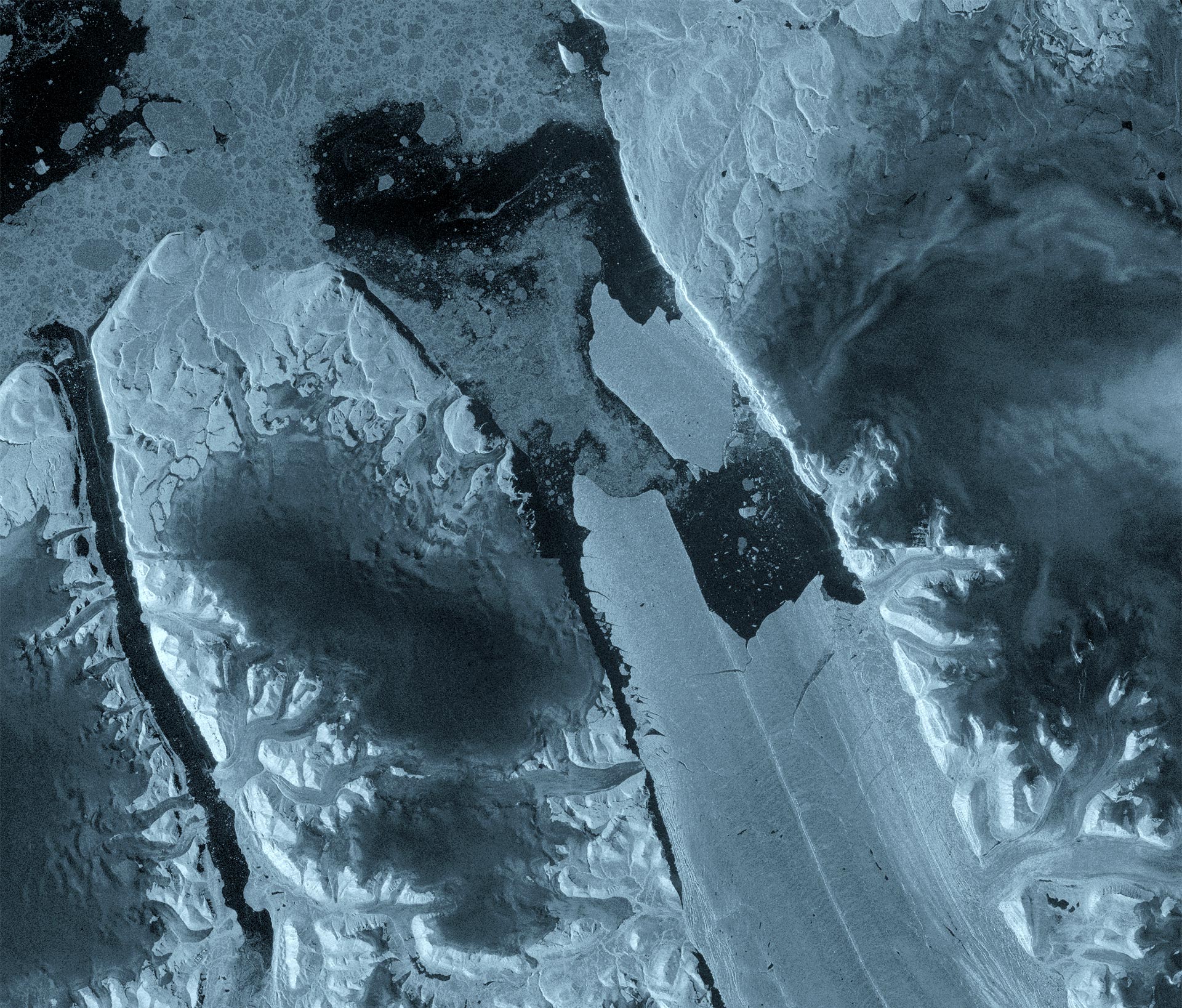
A Manhattan-sized ice island has broken free from Greenland’s Petermann Glacier, and scientists say even bigger breaks may be coming.
Europe’s Copernicus Sentinel-1 mission has documented a major breakup at Petermann Glacier in northwest Greenland, where a 76 sq km portion of the glacier’s floating ice tongue separated on August 4, 2026.
The loss is Petermann Glacier’s largest since 2012 and represents the most significant Arctic calving event since 2020 – another striking example of how quickly conditions can shift in Earth’s polar regions.
The newly created tabular iceberg, also known as an ‘ice island’, is roughly comparable in area to Manhattan and may be as much as 150 meters thick.
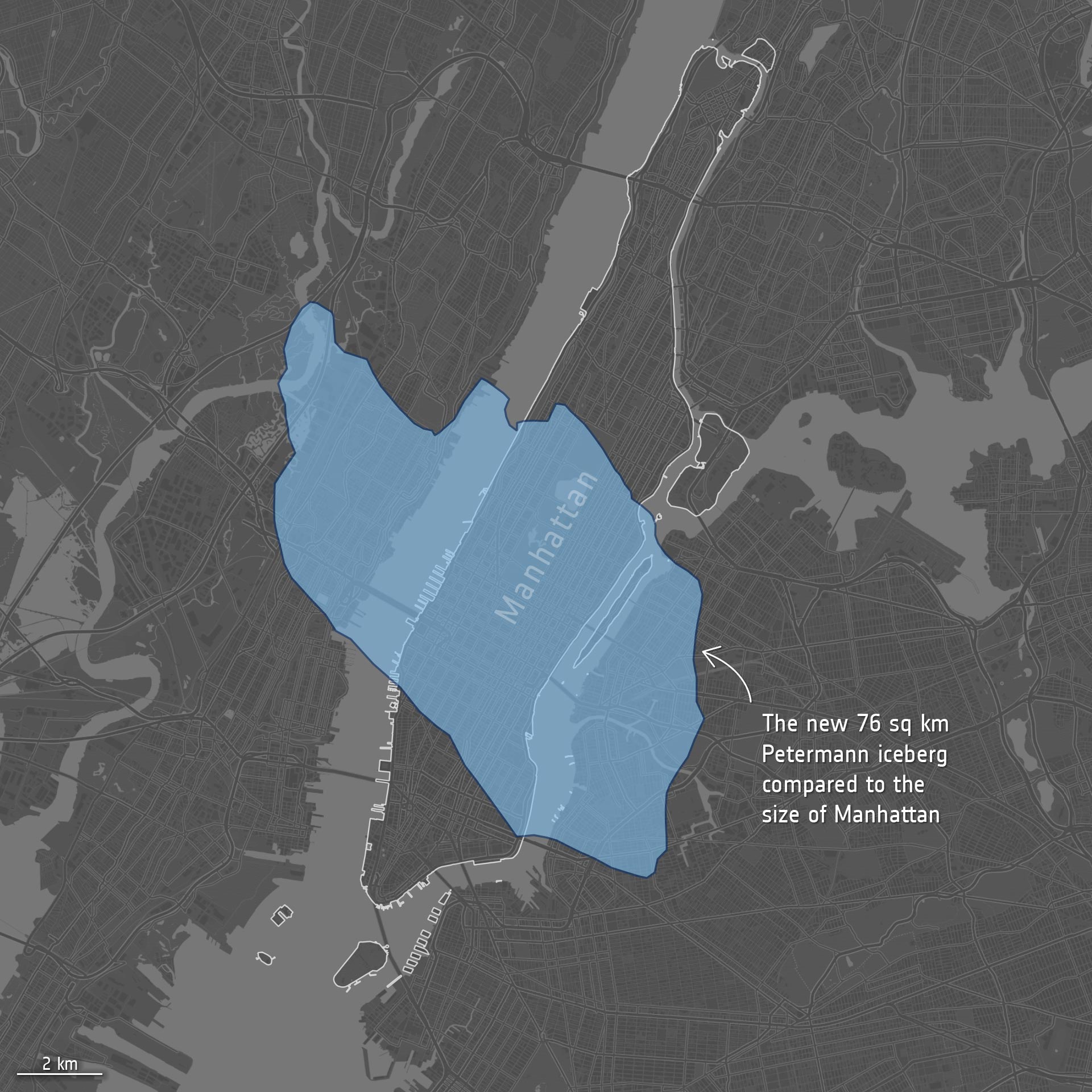
Sentinel-1 Captures the Breakup
Radar images from Sentinel-1 showed clear signs of worsening damage along the middle of the ice tongue on August 3. Just one day later, the enormous ice island had broken away from the glacier’s eastern side.
Sentinel-1 is especially useful for observing glaciers in remote Arctic regions because its radar instruments can collect data both day and night and can see through cloud cover.
An international group of researchers has been using Sentinel-1 observations to follow changes at Petermann Glacier since 2019. The work is partially funded through ESA’s FutureEO ARCTEX project.
The research effort includes scientists from the University of Ottawa in Canada, the Universities of Stirling, Lancaster and Leeds in the UK, and the Canadian Ice Service of Environment and Climate Change Canada. Over several years, the team has documented expanding fractures and growing instability within the glacier’s floating ice tongue.
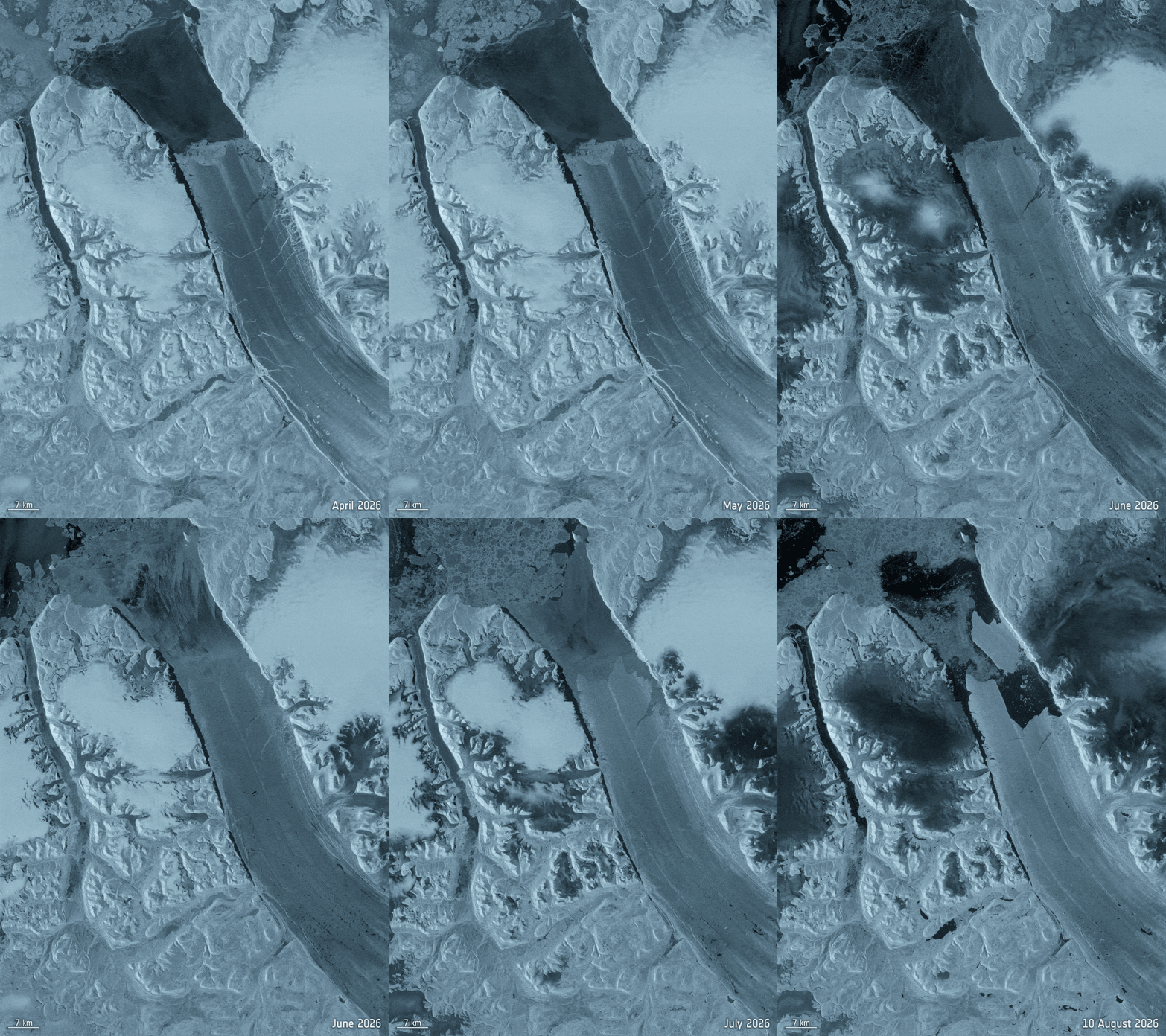
Cracks Had Been Growing for Months
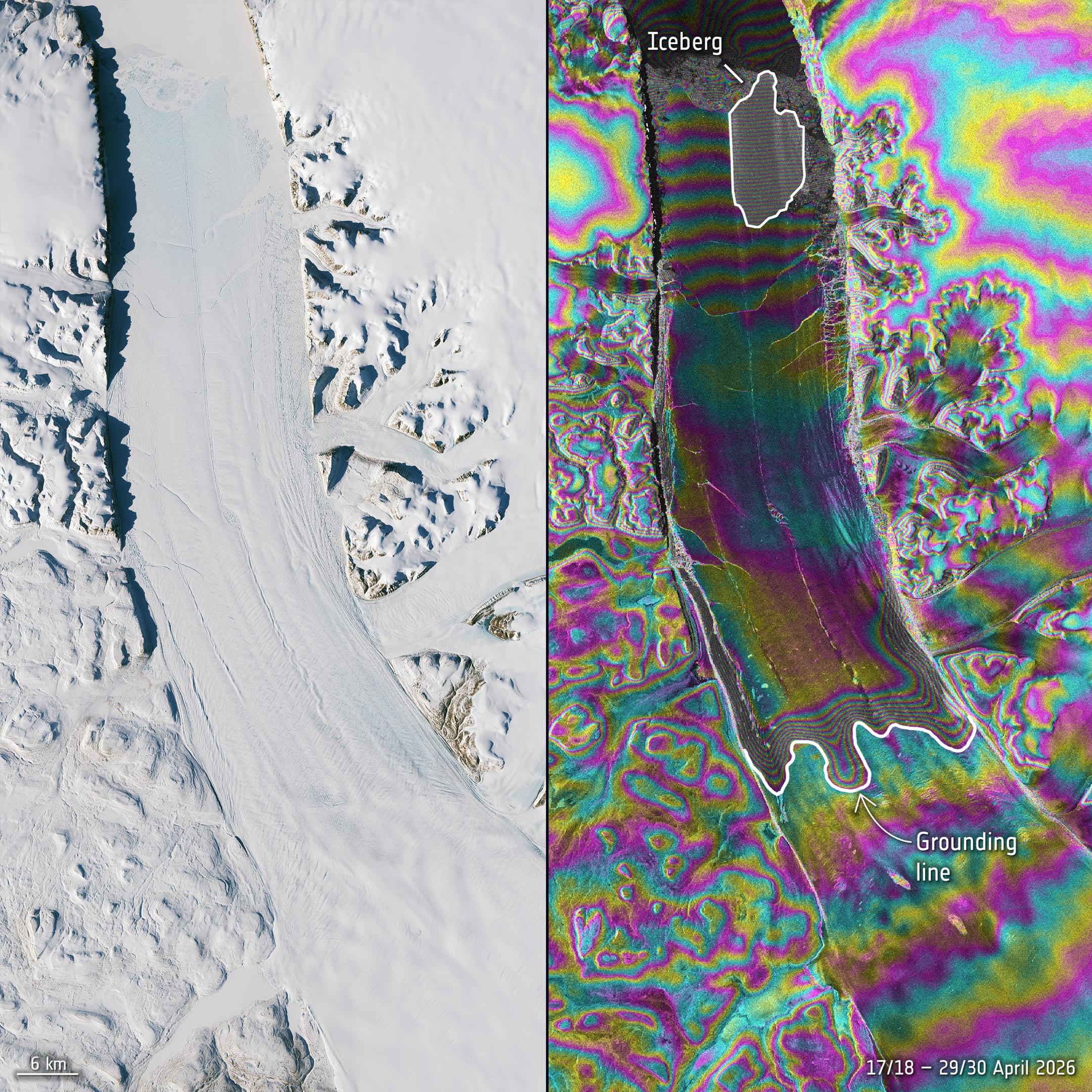
Interferometric measurements collected over Petermann in April had already revealed deformation and fractures within the ice tongue. Those observations gave researchers a detailed view of changes developing months before the eventual calving event.
Adam Garbo, a PhD student from the University of Ottawa, said, “Petermann Glacier has long been one of Greenland’s largest remaining ice tongues. We’ve anticipated this break for years, and seeing it finally happen is remarkable. It’s a powerful reminder of how quickly these systems can change.”
Petermann Glacier has produced several major ice islands in the past, including large calving events in 2008, 2010 and 2012. Since 2012, however, the floating ice tongue had remained comparatively stable, even though several smaller calving events occurred.
Researchers do not expect the latest breakup to be the final major change. Two additional large ice islands, with estimated areas of about 97 and 87 sq km, could eventually separate as existing rifts continue spreading across the floating ice tongue.
Anna Crawford, from the University of Stirling, commented, “While large, tabular icebergs are relatively common in the Southern Ocean around Antarctica, Arctic ice islands are far rarer.
“By studying Arctic ice islands, we will gain knowledge that can be transferred across polar regions. This is critical for understanding how the calving and deterioration of ice islands impact glacier dynamics, sea-level rise and the ocean environment.”
Satellites Tracked the Fractures in Fine Detail
Researchers were able to map the location and expansion of fractures across Petermann Glacier in exceptional detail using a Sentinel-1 interferogram. This was possible because one-day repeat Sentinel-1 synthetic aperture radar observations were collected during the Sentinel-1C and Sentinel-1D tandem phase while the newly launched Sentinel-1D satellite was being commissioned.
The data enabled scientists to closely measure how fractures were spreading across the ice shelf and how the surface of the ice tongue moved in response to ocean tides before the iceberg broke away.

Molly Hammond, a PhD student from the University of Leeds, who processed the Sentinel-1 data, said, “The changes we observed on Petermann Glacier were occurring very rapidly in the lead-up to the iceberg calving event, so it was incredibly exciting to monitor the crack propagation with interferometry in near-real time. This has demonstrated the incredible value of one-day repeat synthetic aperture data.”
ESA’s Martin Wearing noted, “This type of large tabular iceberg is relatively rare in the Arctic, making this calving event a unique opportunity to study how such a vast ice mass drifts, evolves and eventually breaks apart.
“Satellite missions such as Sentinel-1 provide the systematic, long-term observations needed to track these changes, helping scientists better understand the processes driving calving and the wider impacts on the polar environment, and ultimately the Earth system as a whole.
“Alongside Europe’s excellent Earth observation missions, we are pleased to see the ARCTEX project supporting this work and enabling further scientific investigation of the rapidly evolving Arctic.”
Scientists Will Follow the Ice Island’s Journey
The team plans to keep monitoring both Petermann Glacier and the newly formed iceberg using satellite images, aerial observations and tracking data. By following how the ice island moves and fragments, researchers hope to learn more about the behavior of unusually large Arctic ice masses and the processes controlling the future evolution of Petermann Glacier.
The event also matters beyond scientific research because large ice islands can affect Arctic navigation and offshore activities.
Environment and Climate Change Canada is tracking the iceberg’s path and evaluating possible threats to shipping routes and infrastructure. Ice masses of this size can survive in the ocean for years, slowly breaking into smaller pieces that may become more difficult to identify and follow.
Never miss a breakthrough: Join the SciTechDaily newsletter.
Follow us on Google and Google News.
1 Comment
“Radar images from Sentinel-1 showed clear signs of worsening damage along the middle of the ice tongue on August 3.”
Other than the above, there is nothing said about the cause of the calving, although laymen will probably assume it is the result of global warming — everything is!
The ice island is well forward of the grounding line, thus being susceptible not only to tidal flexing, but waves. Are those what were responsible for the calving? The article doesn’t really say. An inquiring mind would like to know.