
Close Menu
    Facebook X (Twitter) Instagram
    SciTechDaily
    • Biology
    • Chemistry
    • Earth
    • Health
    • Physics
    • Science
    • Space
    • Technology
    Facebook X (Twitter) Pinterest YouTube RSS
    SciTechDaily
    Home»Science»New Species: First Primate Relatives Discovered in the High Arctic of Ancient Canada
    Science

    New Species: First Primate Relatives Discovered in the High Arctic of Ancient Canada

    By PLOSJanuary 25, 2023No Comments3 Mins Read
    Facebook Twitter Pinterest Telegram LinkedIn WhatsApp Email Reddit
    Share
    Facebook Twitter LinkedIn Pinterest Telegram Email Reddit
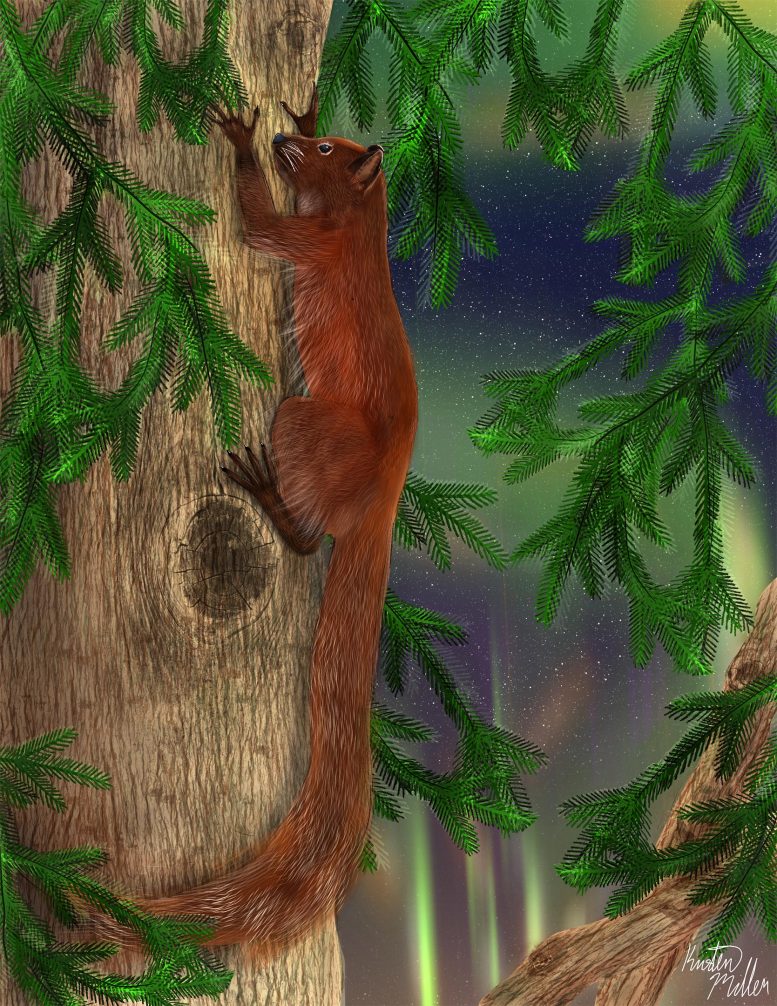
    Ignacius dawsonae Artist’s Reconstruction
    Artist’s reconstruction of Ignacius dawsonae surviving six months of winter darkness in the extinct warm temperate ecosystem of Ellesmere Island, Arctic Canada. Credit: Kristen Miller, Biodiversity Institute, University of Kansas

    Fossilized Mammals Reveal Patterns of Arctic Migration in Warming Climates

    In the warm climate of ancient Canada, early primate relatives adapted to life in the high Arctic, albeit with limited biodiversity, according to a study published today (January 25, 2023) in the open-access journal PLOS ONE by Kristen Miller of the University of Kansas and colleagues.

    The Eocene Epoch was a time of intense global warming, providing a crucial case study for examining how ecosystems react to changing climates. Fossils from Ellesmere Island, Canada provide evidence of a warm, swamp-like environment around 52 million years ago, despite half the year spent in Arctic winter darkness. In this study, Miller and colleagues identify two new species, the first primate relatives ever reported from this ancient Arctic ecosystem.

    Discovery of Two New Primate Species

    Based on fossil fragments of jaws and teeth, the researchers identified the new species as close relatives of early primates, here named Ignacius dawsonae and Ignacius mckennai. Compared to similar species from more southern localities, this pair features distinct adaptations for their unusual environment. Both species are relatively large, a common trait in northern mammals, and both exhibit dental features that suggest a diet of hard food items, possibly an adaptation for feeding on tougher foods during long, dark Arctic winters where softer meals were hard to come by.

    During the Eocene, the lower latitudes of North America were home to many early primate relatives, but only these two species are known from this Arctic community, adding to previous evidence that this ecosystem experienced limited biodiversity compared to more southern habitats. The researchers suggest that while warming climates allowed certain organisms to migrate northward, such movement might be limited by factors such as long periods of Arctic darkness. Such insights are crucial for predictions about how ecosystems might react to modern warming climates.

    The authors add: “Global warming is transforming Arctic ecosystems in ways that are difficult to predict, but ancient episodes of global warming show how future changes in the Arctic might unfold. The first primate-like fossils ever recovered north of Arctic Circle show that these tropically adapted mammals were able to colonize the Arctic during an ancient episode of global warming approximately 52 million years ago by adopting a new diet of nuts and seeds that enabled them to survive six months of winter darkness.”

    Reference: “Basal Primatomorpha colonized Ellesmere Island (Arctic Canada) during the hyperthermal conditions of the early Eocene climatic optimum” by Kristen Miller, Kristen Tietjen and K. Christopher Beard,  25 January 2023, PLOS ONE.
    DOI: 10.1371/journal.pone.0280114

    Never miss a breakthrough: Join the SciTechDaily newsletter.
    Follow us on Google and Google News.

    Arctic Ecology Environment Eocene Mammals New Species PLOS Primates
    Share. Facebook Twitter Pinterest LinkedIn Email Reddit

    Related Articles

    “Going Where No Primate Has Gone Before”: Scientists Identify New Species of Near-Primates

    Remote Community in Ireland Survived a Millennium of Environmental Change

    Primates’ Ancestors May Have Left Trees To Survive Asteroid That Wiped Out the Dinosaurs

    Neptune’s Vishnu Otter: A New Species Discovered in Germany

    Prolonged Exposure to Weedkiller Roundup Can Cause Significant Harm to Keystone Species

    Herbicide Overuse Costs UK Economy £400 Million per Year

    Deepwater Horizon Disaster Payout Announced by US Justice Department

    First Direct Observation of an Under-Ice Algal Bloom in the Arctic

    Experimental Validation on How Populations Collapse

    Leave A Reply Cancel Reply

    • Facebook
    • Twitter
    • Pinterest
    • YouTube

    Don't Miss a Discovery

    Subscribe for the Latest in Science & Tech!

    Trending News

    New Study Reveals Why Ozempic Works Better for Some People Than Others

    Climate Change Is Altering a Key Greenhouse Gas in a Way Scientists Didn’t Expect

    New Study Suggests Gravitational Waves May Have Created Dark Matter

    Scientists Discover Why the Brain Gets Stuck in Schizophrenia

    Scientists Engineer “Tumor-Eating” Bacteria That Devour Cancer From Within

    Even “Failed” Diets May Deliver Long-Term Health Gains, Study Finds

    NIH Scientists Discover Powerful New Opioid That Relieves Pain Without Dangerous Side Effects

    Collapsing Plasma May Hold the Key to Cosmic Magnetism

    Follow SciTechDaily
    • Facebook
    • Twitter
    • YouTube
    • Pinterest
    • Newsletter
    • RSS
    SciTech News
    • Biology News
    • Chemistry News
    • Earth News
    • Health News
    • Physics News
    • Science News
    • Space News
    • Technology News
    Recent Posts
    • This 15,000-Year-Old Discovery Changes What We Know About Early Human Creativity
    • 35-Million-Year-Old Mystery: Strange Arachnid Discovered Preserved in Amber
    • Revolutionary Gas Turbine Generates Power Without Air Compression
    • Is AI Really Just a Tool? It Could Be Altering How You See Reality
    • JWST Reveals a “Forbidden” Planet With a Baffling Composition
    Copyright © 1998 - 2026 SciTechDaily. All Rights Reserved.
    • Science News
    • About
    • Contact
    • Editorial Board
    • Privacy Policy
    • Terms of Use

    Type above and press Enter to search. Press Esc to cancel.