
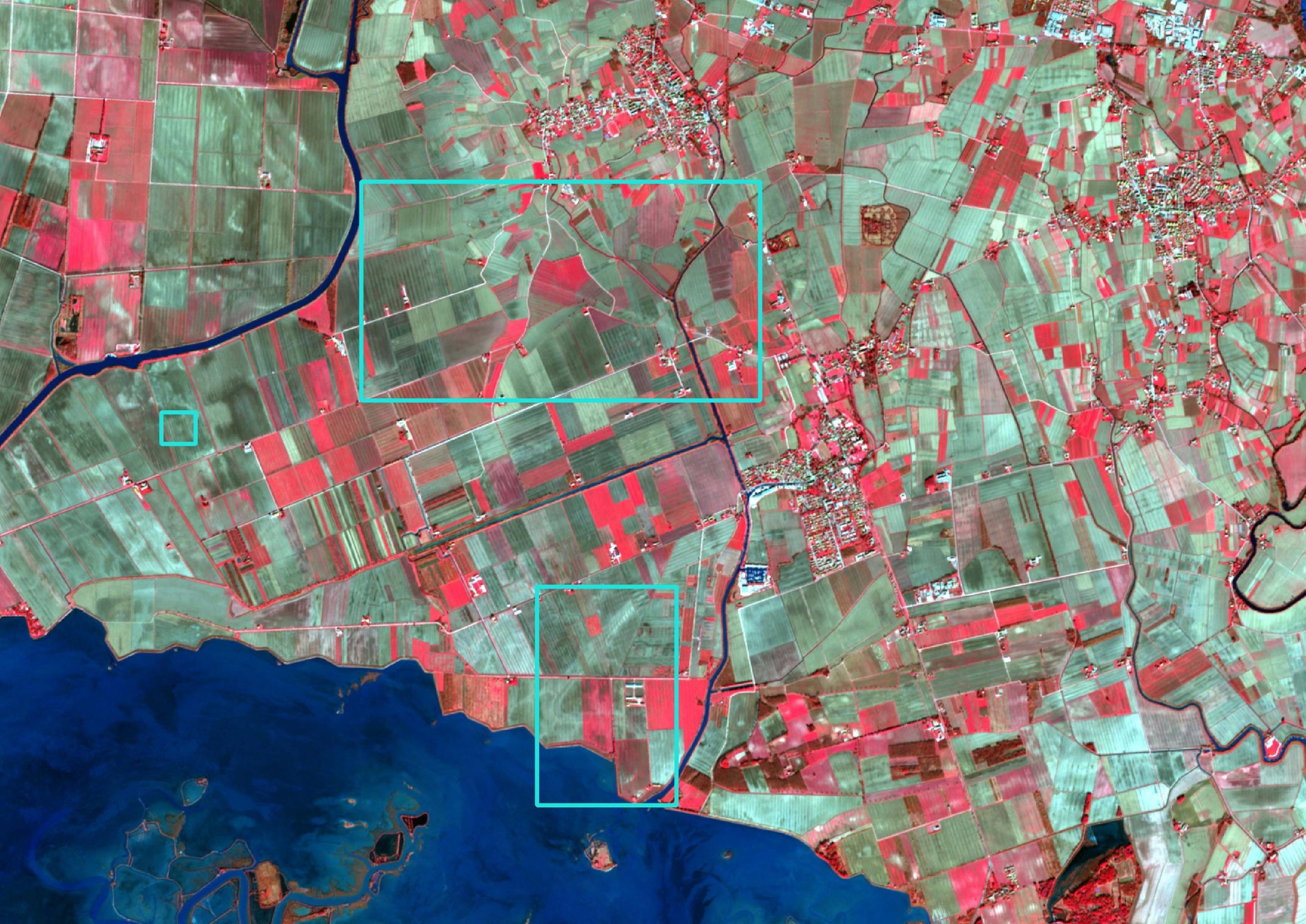
The Cultural Landscapes Scanner pilot project will exploit Artificial Intelligence to detect the archaeological heritage of the subsoil. The project will last three years and will be carried out by IIT in collaboration with the European Space Agency.
The “Cultural Landscapes Scanner” (CLS) project was born from the collaboration between Istituto Italiano di Tecnologia (IIT- Italian Institute of Technology) and the European Space Agency (ESA) in order to detect archaeological sites from above by analyzing satellite images through artificial intelligence (AI). IIT’s researchers of the Centre of Cultural Heritage Technology in Venice, led by Arianna Traviglia, will introduce AI to help archaeologists trace back the ancient presence of humans by revealing hidden traces in the soil. The AI will be able to recognize even minimal or imperceptible variations in vegetation or other particular signs of the surface that may indicate the presence of remains not yet discovered. The project, lasting three years, may result in an immediate improvement in the capacity to identify cultural heritage sites at risk of looting.
In the last decades, the identification of sub-surface cultural heritage sites has taken advantage of Remote Sensing data, a way of detecting that allows to find buried objects in the sub-soil through images in which is possible to recognize subsoil archaeological deposits from anomalies and traces in bare soils, crops or vegetation. Arianna Traviglia’s previous studies have already investigated the potential advantages of developing automated remote sensing, but they have also shown that the current technologies have some limits, being able to detect only very specific objects. In this scenario, web platforms providing free remote sensing datasets have experienced exponential growth and are extensively used by the Cultural Heritage community worldwide. Among them, there is Copernicus, the free and open satellite data platform for Earth observation coordinated by the European Commission in partnership with ESA.
However, the visual analysis of data coming from these platforms is extremely complex due to the large amount of data to be managed and because the images must be viewed and human-interpreted. For this reason, the real challenge for Traviglia’s research group is to add machine learning and computerized artificial vision in order to make this job much easier. The group is one of the few in the world that has designed algorithms for automatic detection of archaeological and cultural heritage sites.
The “Cultural Landscapes Scanner” (CLS) project will have, thus, an innovative approach aiming to overcome the current methods based on subjective observation, making possible a wider and more precise detection thanks to advanced computational methods.
A New Standard in Cultural Heritage Detection
Researchers will define a broad spectrum, adaptable, and robust automated recognition procedure, customized for cultural heritage sites using the tele data obtained from the Copernicus platform. Automated Remote Sensing, via machine learning, will produce a more accurate detection of cultural heritage objects through satellite imagery and a clearer identification of ancient land division systems.
Machine learning algorithms can improve automatically by gaining experience in an incremental self-learning process. Therefore, AI will be able to offer an increasingly precise identification of potential underground archaeological sites.
This AI approach will be able to see objects or irregularities that are usually impossible to see for the human eye. The combination of these elements will enable the observation of traces in vegetation, bare soils, hollows, and crop marks. Thus, AI will support current photo-interpretation practices, based on subjective observations, thanks to its accuracy in analyzing images and the possibility to explore wider spatial areas. Another aspect that will surely profit from the development of Automated Remote Sensing is the increased possibility of cultural heritage preservation. In fact, an immediate outcome will be the enhanced capacity to respond to cultural threats by identifying cultural heritage sites at risk of looting.
Further Information
The Cultural Landscapes Scanner pilot project is the result of a partnership between IIT’s Centre for Cultural Heritage Technology and the European Space Agency (ESA).
Arianna Traviglia is the coordinator of the IIT’s Centre for Cultural Heritage Technology (CCHT) in Venice (Italy). Her research field is placed at the intersection of information management and humanities and most of it focuses on mediating the inclusion of digital technology within the study and management of cultural heritage. Her expertise lies in multispectral/hyperspectral image processing and photointerpretation: with research interests in the areas of landscape archaeology and remote sensing, spanning over 15 years of academic career, she is an internationally renowned expert in her field.
Never miss a breakthrough: Join the SciTechDaily newsletter.
Follow us on Google and Google News.
2 Comments
…great advancement,but will that find all of the sites…
I have a site I would like for you to check