
Close Menu
    Facebook X (Twitter) Instagram
    SciTechDaily
    • Biology
    • Chemistry
    • Earth
    • Health
    • Physics
    • Science
    • Space
    • Technology
    Facebook X (Twitter) Pinterest YouTube RSS
    SciTechDaily
    Home»Space»Astronomers Reach an Important Milestone in the Study of Cluster Mergers
    Space

    Astronomers Reach an Important Milestone in the Study of Cluster Mergers

    By Harvard-Smithsonian Center for AstrophysicsSeptember 8, 2015No Comments3 Mins Read
    Facebook Twitter Pinterest Telegram LinkedIn WhatsApp Email Reddit
    Share
    Facebook Twitter LinkedIn Pinterest Telegram Email Reddit
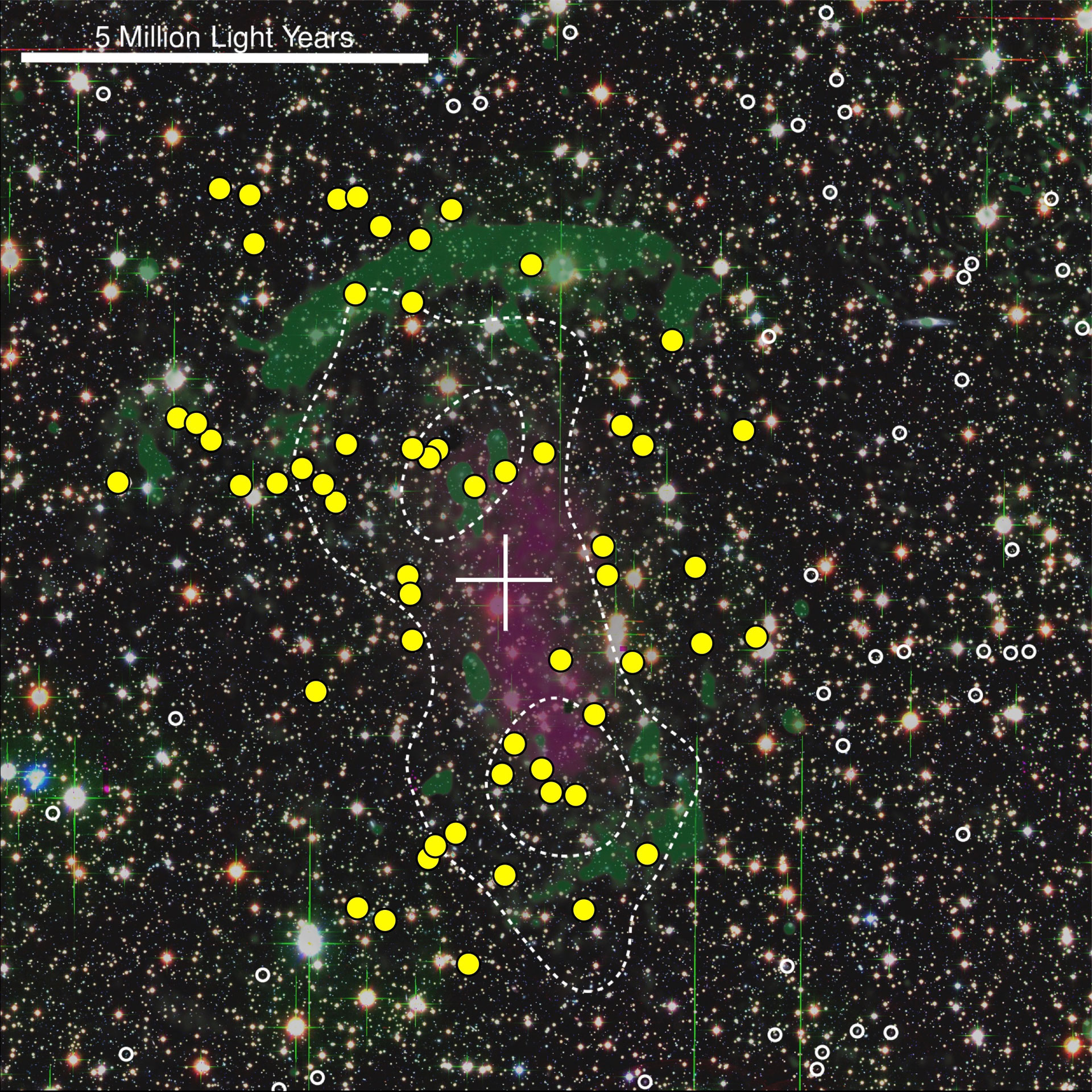
    Image of the Sausage Merging Cluster CIZA J2242.8+5310
    A composite image of the ‘Sausage’ merging cluster CIZA J2242.8+5310, made using data from the Subaru and Canada France Hawaii Telescopes. Yellow circles are cluster galaxies, where accelerated star formation is taking place; white circles indicate galaxies outside of the cluster; green marks regions of radio emission that traces shocks; purple marks the hot X-ray emitting gas. The cluster is one of the most massive in the Universe. Credit: Andra Stroe

    Astronomers reach an important milestone in the study of cluster mergers, showing that member galaxies are still gas-rich and thus can form stars and stimulate the nuclear engine for a long time.

    Most galaxies are members of a cluster, a grouping of several to thousands of galaxies. Our Milky Way, for example, is a member of the “Local Group,” a set of about fifty galaxies whose other large member is the Andromeda galaxy about 2.3 million light-years away. The closest large cluster of galaxies to us is the Virgo Cluster, with about 2000 members; its center is about 50 million light-years away. The clustering of galaxies influences how any particular member galaxy will evolve, but what happens and how it happens are not well understood. The cluster’s influences on the star-formation activity within its galaxies is a particularly interesting question because the star formation rate helps set the luminosity of a galaxy, its supernovae activity, and the processing of its hydrogen gas into heavier elements.

    Astronomers think that when clusters merge, whatever effects they have on star formation should be accentuated. Published results, however, have arrived at divergent conclusions on what these effects are. Most research finds that cluster mergers enhance the star formation activity, but a few studies have concluded that it quenches it, while at least one has argued there is little effect either way.

    Harvard-Smithsonian Center for Astrophysics (CfA) astronomer Reinout van Weeren and his five colleagues used the Westerbork Synthesis Radio Telescope for very deep studies of the atomic hydrogen gas in the cluster CIZAJ2242.8+5301, nicknamed the “Sausage.”

    Hydrogen gas is the fuel for star formation, and they find, contrary to previous results, that there are comparable amounts of it in star-forming cluster galaxies as in non-cluster galaxies, implying that the cluster merger does not reduce the amount of the gas. Moreover, the scientists find that supernova activity confirms that star formation has been underway in these galaxies for about one hundred million years (not an unusual span for a starburst) and that at the current rate of activity, the gas would not be depleted for about a billion years.

    The new results mark an important milestone in the study of cluster mergers because they show that member galaxies are still gas-rich and thus can form stars and stimulate the nuclear engine for a long time. The results also can exclude some previously viable models.

    Reference: “Neutral Hydrogen Gas, Past and Future Star Formation in Galaxies in and around the ‘Sausage’ Merging Galaxy Cluster” by Andra Stroe, Tom Oosterloo, Huub J. A. Rottgering, David Sobral, Reinout van Weeren and William Dawson, 25 July 2015, MNRAS.
    DOI: 10.1093/mnras/stv1462
    arXiv: 1506.08822

    Never miss a breakthrough: Join the SciTechDaily newsletter.
    Follow us on Google and Google News.

    Astronomy Astrophysics Globular Cluster Harvard-Smithsonian Center for Astrophysics Star Formation Stars
    Share. Facebook Twitter Pinterest LinkedIn Email Reddit

    Related Articles

    Astronomers Explore Cosmic Ray Influences on Star Formation in Galaxies

    Astronomers Observe a New Type of Binary Star – “Exciting, Missing Evolutionary Link”

    Astronomers Have Discovered a Gigantic Sphere-Shaped Cavity in Space

    Mystery Solved: Astronomers Unravel the Puzzle of Betelgeuse’s “Great Dimming”

    Mega-Flares From Stars: 10 Million Times More Energetic Than the Most Powerful Flare Ever Observed on the Sun

    The Give and Take of Stellar Mega-Flares: By Studying Thousands of Young Stars, New Information Has Emerged

    Growing up Stardust: Astronomers Discover That Stars and Planets May Be Siblings

    Massive Rotating Stars in the Pleiades Cluster

    Chandra Studies Extraordinary Magnetar: Fastest Spinning and Possibly the Youngest Magnetar Known

    Leave A Reply Cancel Reply

    • Facebook
    • Twitter
    • Pinterest
    • YouTube

    Don't Miss a Discovery

    Subscribe for the Latest in Science & Tech!

    Trending News

    One of the Universe’s Largest Stars May Be Getting Ready To Explode

    Scientists Discover Enzyme That Could Supercharge Ozempic-Like Weight Loss Drugs

    Popular Sweetener Linked to DNA Damage – “It’s Something You Should Not Be Eating”

    Ancient “Rock” Microbes May Reveal How Complex Life Began

    Researchers Capture Quantum Interference in One of Nature’s Rarest Atoms

    “A Plague Is Upon Us”: The Mass Death That Changed an Ancient City Forever

    Scientists Discover Game-Changing New Way To Treat High Cholesterol

    This Small Change to Your Exercise Routine Could Be the Secret to Living Longer

    Follow SciTechDaily
    • Facebook
    • Twitter
    • YouTube
    • Pinterest
    • Newsletter
    • RSS
    SciTech News
    • Biology News
    • Chemistry News
    • Earth News
    • Health News
    • Physics News
    • Science News
    • Space News
    • Technology News
    Recent Posts
    • Scientists Rethink Extreme Warming After Surprising Ocean Discovery
    • The Surprising Role of Asteroids in the Origin of Life
    • Scientists Raise Concerns Over Newly Recognized Pollutant Found Everywhere in the Air
    • New Study Challenges 40-Year Puzzle About Childhood Body Fat
    • 20-Year Study Finds Daily Multivitamins Don’t Extend Lifespan
    Copyright © 1998 - 2026 SciTechDaily. All Rights Reserved.
    • Science News
    • About
    • Contact
    • Editorial Board
    • Privacy Policy
    • Terms of Use

    Type above and press Enter to search. Press Esc to cancel.