
Close Menu
    Facebook X (Twitter) Instagram
    SciTechDaily
    • Biology
    • Chemistry
    • Earth
    • Health
    • Physics
    • Science
    • Space
    • Technology
    Facebook X (Twitter) Pinterest YouTube RSS
    SciTechDaily
    Home»Science»How Do We Find Exoplanets? [Video]
    Science

    How Do We Find Exoplanets? [Video]

    By Space Telescope Science InstituteMarch 22, 2022No Comments2 Mins Read
    Facebook Twitter Pinterest Telegram LinkedIn WhatsApp Email Reddit
    Share
    Facebook Twitter LinkedIn Pinterest Telegram Email Reddit
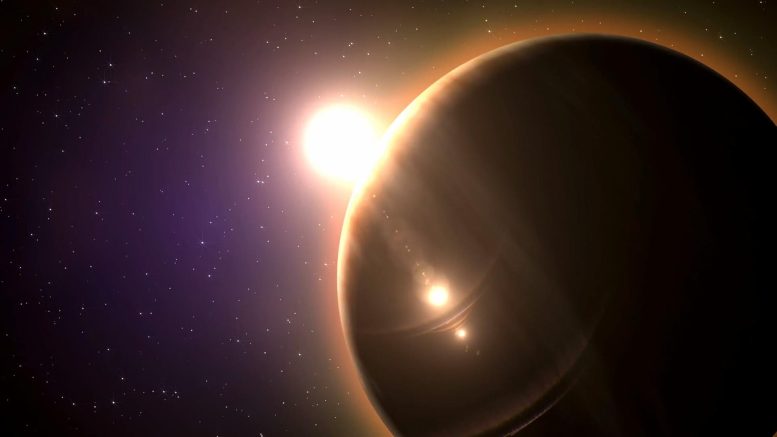
    Exoplanet and Star in Space
    Exoplanet and Star in Space

    How can we detect exoplanets (planets around other stars)? Planets are very faint and small compared to the stars they orbit. To overcome this challenge, scientists use a variety of techniques to find and characterize them.

    For more information on the different techniques used to detect exoplanets, see How To Find an Exoplanet.

    Video Transcript:

    How do we find exoplanets?

    Since planets are close to much brighter stars, how do we actually find them?

    Some planets are found by a technique that uses Einstein’s theory of general relativity, observing the bending effect of gravity from a hidden planet as it warps the light around its host star.

    The most common method is to look for an eclipse or transit as a planet passes in front of its host star. This is how the Kepler observatory found planets, by staring at a large region of the sky and waiting for planets to pass in front of their stars, taking snapshots every second.

    The Transiting Exoplanet Survey Satellite uses the same technique on our nearest neighbor stars.

    Another technique observes very small changes in the star’s position in the sky — the wobble that occurs when an unseen planet’s gravity tugs on its host star.

    If the planet and star are oriented so that the star is moving toward or away from us, instead of side to side, we can detect the planet as a shift in the star’s light.

    As far as getting pictures of the actual exoplanets themselves, it’s possible, but very difficult. The telescope has to block the bright star’s light to reveal the faint planet nearby.

    Never miss a breakthrough: Join the SciTechDaily newsletter.
    Follow us on Google and Google News.

    Astronomy Exoplanet Space Telescope Science Institute
    Share. Facebook Twitter Pinterest LinkedIn Email Reddit

    Related Articles

    Hubble’s Big Reveal: Unearthing the Secrets of a Nearby Earth-Sized World

    Hubble Finds Earth-Sized Planet That May Be on Its Second Atmosphere

    Astronomers Unlock the Mysteries of Super-Earths

    Hubble Comparison of Two “Hot Jupiter” Exoplanets

    Astronomers Believe There May Be a New Population of Circumbinary Planets

    New Exoplanet-Hunting Facility (NGTS) Achieves First Light

    New Guidelines for the Search for Alien Life on Other Planets

    SETI Scientist Believes We Will Find Life in Space This Century

    How NASA Engineers Revamped Spitzer to Probe Exoplanets

    Leave A Reply Cancel Reply

    • Facebook
    • Twitter
    • Pinterest
    • YouTube

    Don't Miss a Discovery

    Subscribe for the Latest in Science & Tech!

    Trending News

    Scientists Recreate a Nuclear Fireball and Uncover Fallout’s Hidden Chemistry

    These Tiny Gut Particles Could Be Accelerating Aging Throughout the Body

    Doctors Changed One Thing and Weight Gain Stopped

    Magnetic Fields May Solve a Longstanding Binary Star Mystery

    The Probiotic Breakthrough for Natural Anxiety Relief and Better Mental Health

    Animal vs. Plant Protein: Scientists Found a Surprising Nutritional Difference

    According to Scientists, This Simple Dietary Change Is Linked to Lower Depression Scores

    Researchers Discover a Hidden Vitamin D Problem That Persists Year-Round

    Follow SciTechDaily
    • Facebook
    • Twitter
    • YouTube
    • Pinterest
    • Newsletter
    • RSS
    SciTech News
    • Biology News
    • Chemistry News
    • Earth News
    • Health News
    • Physics News
    • Science News
    • Space News
    • Technology News
    Recent Posts
    • Mini Brain Organoids Expose Hidden Biological Differences in Alzheimer’s Disease
    • Scientists Recommend Doing This To Reduce Anxiety During Pregnancy
    • Scientists Reveal What Happened When 12 People Were Trapped Together in Antarctica for 10 Months
    • Buried for 1.7 Billion Years: These Ancient Fossils May Rewrite the Story of Complex Life
    • NASA Spots Giant Ocean Swell Signaling a Potential El Niño Comeback
    Copyright © 1998 - 2026 SciTechDaily. All Rights Reserved.
    • Science News
    • About
    • Contact
    • Editorial Board
    • Privacy Policy
    • Terms of Use

    Type above and press Enter to search. Press Esc to cancel.