
Close Menu
    Facebook X (Twitter) Instagram
    SciTechDaily
    • Biology
    • Chemistry
    • Earth
    • Health
    • Physics
    • Science
    • Space
    • Technology
    Facebook X (Twitter) Pinterest YouTube RSS
    SciTechDaily
    Home»Science»Space Debris: Feel the Burn – Designing Satellites To Fall Apart
    Science

    Space Debris: Feel the Burn – Designing Satellites To Fall Apart

    By European Space AgencyOctober 30, 2021No Comments3 Mins Read
    Facebook Twitter Pinterest Telegram LinkedIn WhatsApp Email Reddit
    Share
    Facebook Twitter LinkedIn Pinterest Telegram Email Reddit
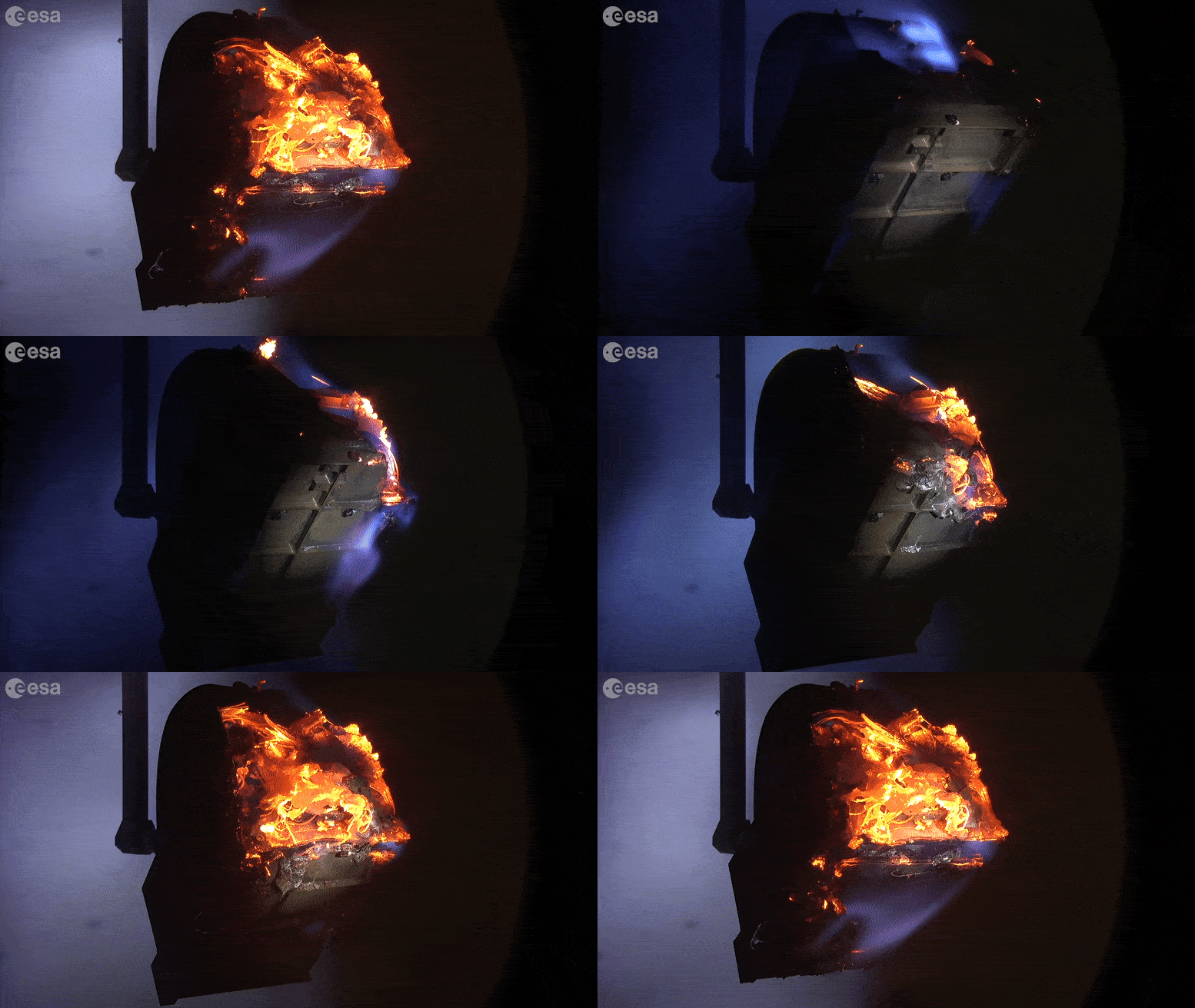
    Testing Fiery Satellite Reentry
    ESA’s Clean Space initiative performed simulated reentry testing inside a plasma wind tunnel at the DLR German Aerospace Center’s site in Cologne. Credit: ESA

    ESA’s “Design for Demise” strategy makes satellites easier to burn up during reentry, reducing space debris risks.

    It might be counter-intuitive, but designing satellites to better fall apart is one of the key strategies to combat space debris. Developed by ESA’s Clean Space initiative, the approach is called ‘Design for Demise’ and involves making sure that derelict satellites will break up and burn up fully as they reenter the atmosphere.

    Reentering space hardware should burn up entirely in the course of plunging through the atmosphere to be safe. In practice, some pieces can make it all the way down to Earth – some of them big enough to do serious damage.

    In 1997, for instance, Texans Steve and Verona Gutowski were woken by the impact of what looked like a “dead rhinoceros” just 50 m (160 ft) from their farmhouse. It turned out to be a 250 kg (550 lb) fuel tank from a rocket stage.

    Space Debris Texas
    The main propellant tank of the second stage of a Delta 2 rocket landed near Georgetown, Texas, USA, on January 22, 1997. This tank of about 250 kg is primarily a stainless steel structure and survived reentry relatively intact. Credit: NASA

    Modern space debris regulations demand that such incidents should not happen. Uncontrolled re-entries should have a less than 1 in 10,000 chance of injuring anyone on the ground.

    As part of a larger effort called cleansat, ESA is developing technologies and techniques to ensure future low-orbiting satellites are designed according to the concept of ‘D4D’ – design for demise.

    Some heavier satellite elements are more likely to survive the reentry process. These include magnetotorquers which use magnets to shift spacecraft orientation against Earth’s magnetic field, optical instruments, propellant, and pressure tanks, the drive mechanisms operating solar arrays, and reaction wheels – spinning gyroscopes used to change a satellite’s pointing direction.
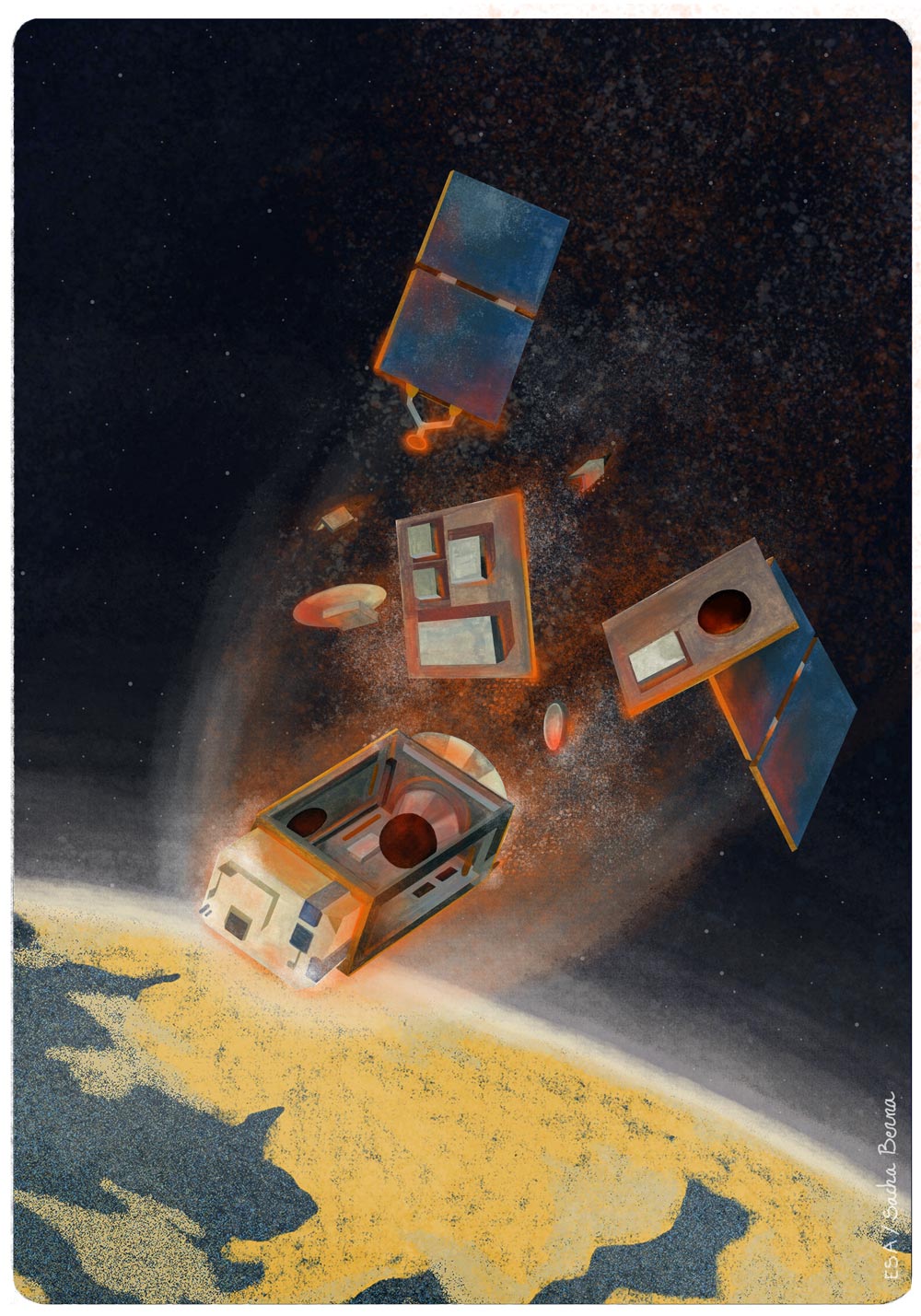
    Satellite Reentry
    Satellite reentry. Credit: ESA/ Sacha Berna

    One element of D4D research involves actually melting such bulky items within plasma wind tunnels capable of reproducing the fiery conditions involved. Another is to plan methods of ensuring an early breakup of reentering debris.

    During reentry, peak heat fluxes and mechanical loads usually result in a satellite’s break-up at around 75 km (47 mi). Only after this altitude will most of the internal equipment exposed to the heat flux start ‘demising’ as well.
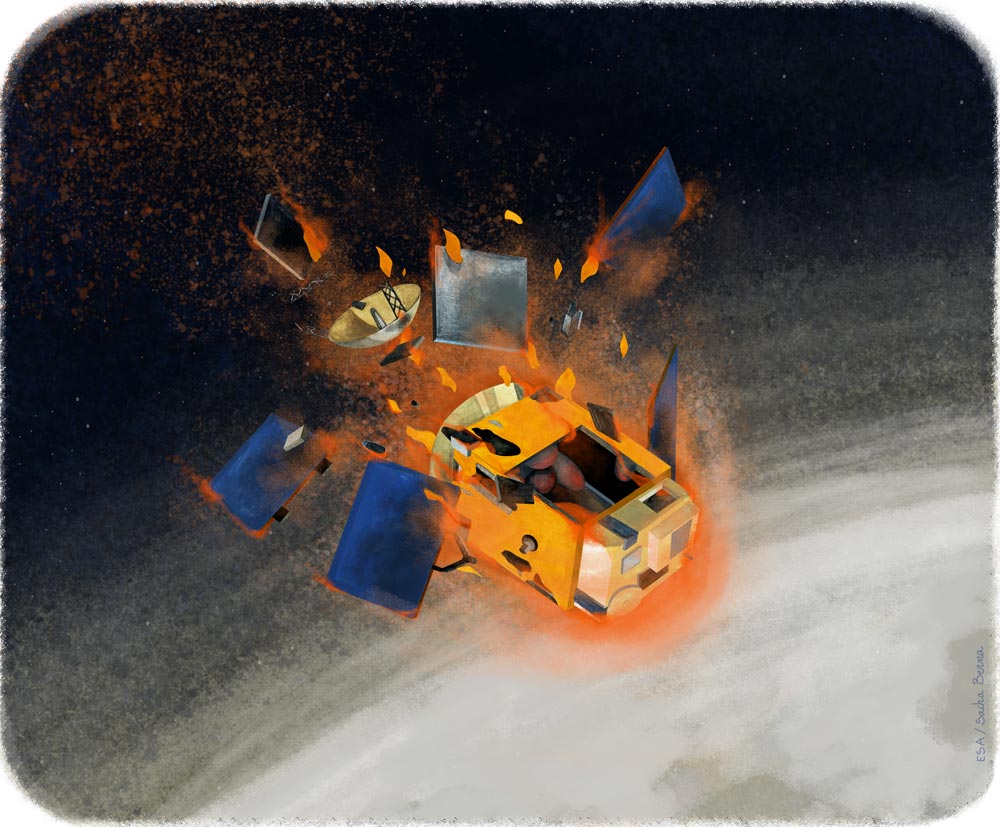
    Breaking Apart on Reentry
    Breaking apart on reentry. Credit: ESA/ Sacha Berna

    But engineering a higher break-up altitude would imply that the internal equipment would be exposed to the heat flux for a longer time, greatly enhancing its overall demisability. Possible ways to ensure this include more meltable joints holding satellite panels together or the use of ‘shape memory alloys’ which shift shape with temperature.

    Clean Space also uses the DRAMA (Debris Risk Assessment and Mitigation Analysis)  software to calculate the compliance of a given satellite design with space debris mitigation standards and to ensure that the latest research findings are accounted for, always aiming to reduce the risk of injury below that crucial 1 in 10,000 value.

    Never miss a breakthrough: Join the SciTechDaily newsletter.
    Follow us on Google and Google News.

    European Space Agency Popular Space Debris
    Share. Facebook Twitter Pinterest LinkedIn Email Reddit

    Related Articles

    The Final Orbit: Unraveling a Satellite’s Death Spiral

    ESA’s Aeolus: A Historic End to a Trailblazing Mission

    Swarm Spacecraft Dodges Collision With Space Junk During Climb To Escape Sun’s Wrath

    Incoming! SpaceX Falcon 9 Rocket on Collision Course With the Moon

    ESA’s Solar Orbiter Spacecraft Is Skimming Earth for a Gravity Assist – And It’s One of the Riskiest Planetary Flybys Ever

    Drive to Destruction: Simulating Burn-Up During Atmospheric Reentry

    Genesis of Bizarre Blue Lightning Jetting Into the Stratosphere Detected From International Space Station

    Parking in a Pandemic: Where Are All the Airplanes and Cruise Ships During COVID-19?

    New Spray Lights Up Cancer Cells

    Leave A Reply Cancel Reply

    • Facebook
    • Twitter
    • Pinterest
    • YouTube

    Don't Miss a Discovery

    Subscribe for the Latest in Science & Tech!

    Trending News

    The Universe Is Expanding Too Fast and Scientists Can’t Explain Why

    “Like Liquid Metal”: Scientists Create Strange Shape-Shifting Material

    Early Warning Signals of Esophageal Cancer May Be Hiding in Plain Sight

    Common Blood Pressure Drug Shows Surprising Power Against Deadly Antibiotic-Resistant Superbug

    Scientists Uncover Dangerous Connection Between Serotonin and Heart Valve Disease

    Scientists Discover a “Protector” Protein That Could Help Reverse Hair Loss

    Bone-Strengthening Discovery Could Reverse Osteoporosis

    Scientists Uncover Hidden Trigger Behind Stem Cell Aging

    Follow SciTechDaily
    • Facebook
    • Twitter
    • YouTube
    • Pinterest
    • Newsletter
    • RSS
    SciTech News
    • Biology News
    • Chemistry News
    • Earth News
    • Health News
    • Physics News
    • Science News
    • Space News
    • Technology News
    Recent Posts
    • Scientists Crack Alfalfa’s Chromosome Mystery After Decades of Debate
    • Ancient Ant-Plant Alliance Collapses As Predatory Wasps Move In
    • Scientists Discover Tiny New Spider That Hunts Prey 6x Its Size
    • Natural Component From Licorice Shows Promise for Treating Inflammatory Bowel Disease
    • New Research Finds Shocking Link Between Chili Peppers and Cancer
    Copyright © 1998 - 2026 SciTechDaily. All Rights Reserved.
    • Science News
    • About
    • Contact
    • Editorial Board
    • Privacy Policy
    • Terms of Use

    Type above and press Enter to search. Press Esc to cancel.