
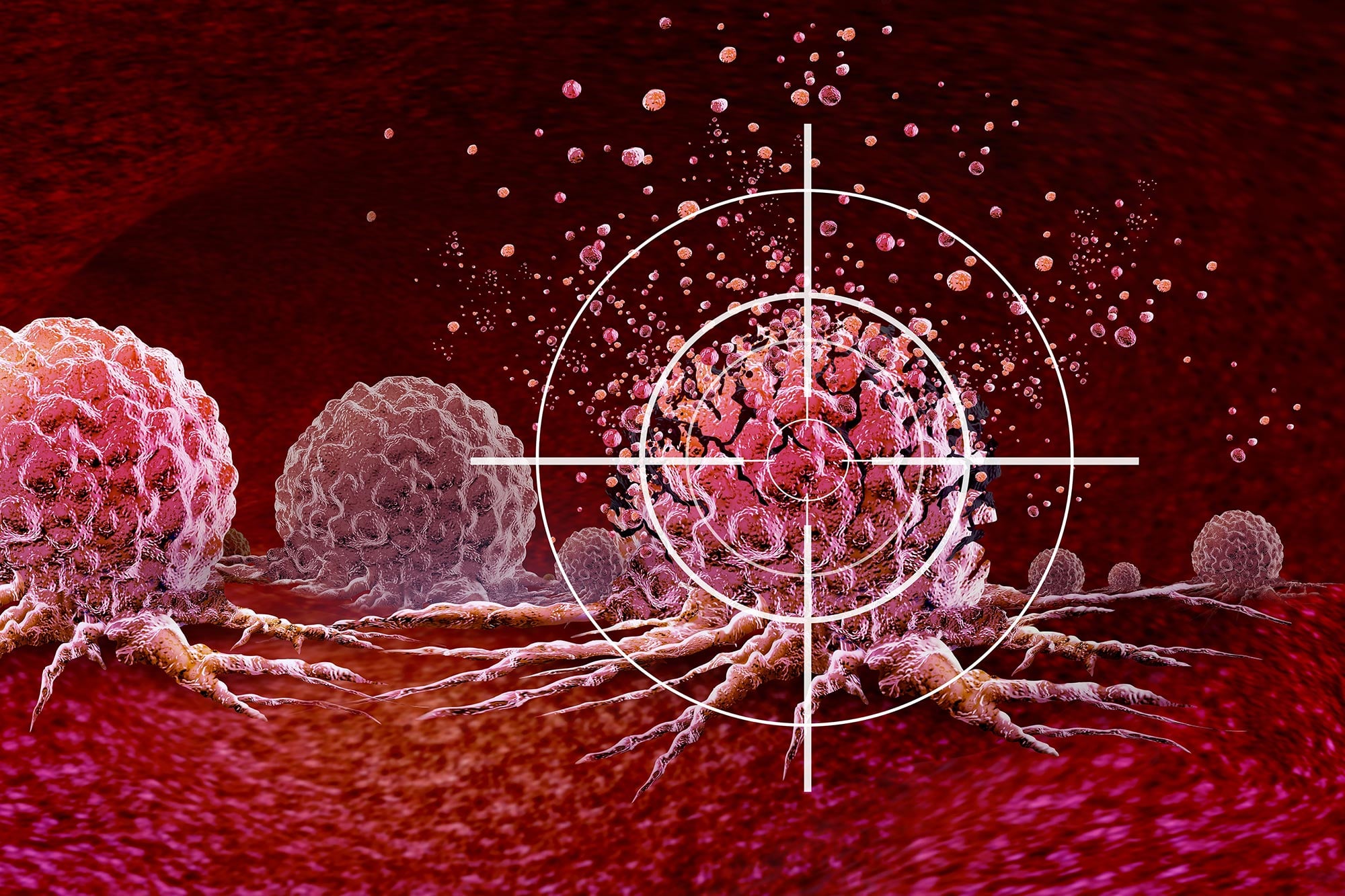
BCL6, a driver of lymphoma, suppresses genes involved in cell death. A new molecule designed at Stanford Medicine blocks BCL6 activity and activates downstream genes that trigger cell death.
A protein that helps keep lymphoma cells growing can be turned against the cancer itself. Stanford Medicine researchers designed a molecule that redirects one of the most common protein drivers of B-cell lymphoma toward activating cell death, and twice-a-day treatment eliminated aggressive lymphoma tumors in mice within 11 days.
The work extends a strategy the researchers have developed over several years. Instead of simply blocking a cancer-causing protein, they create a small molecule that physically connects it to another protein capable of activating the cell’s own self-destruct program. The researchers believe the same general strategy could potentially be adapted for other cancers and autoimmune diseases.
“We’re trying to essentially fight cancer with its cause — taking the driving force of the cancer and then rewiring it to activate cell death mechanisms,” said Gerald Crabtree, MD, the David Korn, MD, Professor in Pathology and a professor of developmental biology.
Crabtree shares senior authorship of the study, published in Cell, with Nathanael Gray, PhD, the Krishnan-Shah Family Professor and a professor of chemical and systems biology; Stephen Hinshaw, PhD, assistant professor of molecular and cellular physiology; and Michael Green, PhD, director of translational and laboratory research, lymphoma/myeloma at the MD Anderson Cancer Center. Graduate student Meredith Nix and postdoctoral scholar Sai Gourisankar, PhD, are the study’s lead authors.
BCL6 keeps lymphoma cells alive
Diffuse large B-cell lymphoma, the most common type of the blood cancer non-Hodgkin lymphoma, is frequently driven by a protein called BCL6. In healthy immune cells, BCL6 binds to DNA and temporarily shuts down genes that would normally stop growth or trigger cell death, giving the cells time to multiply during an immune response.
Once the threat has passed, other proteins modify BCL6 and disable its ability to silence those genes. The immune cells that are no longer needed can then undergo apoptosis, a programmed form of cell death that allows the body to remove excess, damaged, or cancerous cells without causing inflammation or tissue injury.

In lymphoma, BCL6 can remain stuck in the “on” position, continually suppressing death genes and allowing malignant cells to multiply without restraint. Crabtree, Gray, and their colleagues wanted not only to remove that suppression, but also to actively increase expression of the genes that kill the cell. They turned to chemically induced proximity, a technique that uses chemical bonds to force molecules together that would otherwise interact rarely or not at all.
TCIP3 activates silenced death genes
Their resulting molecule, TCIP3, brings BCL6 together with proteins that can reverse its cancer-promoting activity. “One side binds to BCL6,” Nix explained. “The other side binds either of two proteins called P300 and CBP that add chemical tags called acetyl marks onto nearby proteins.” When BCL6 receives an acetyl tag, it can no longer suppress downstream genes involved in cell death. P300 and CBP also add acetyl tags to histones, the proteins around which DNA is packaged. Those changes loosen the DNA and make it accessible to transcription factors, proteins needed to switch genes on.
That mechanism goes beyond existing BCL6-targeted drugs, which generally block the protein or cause it to be degraded. “We’re not just relieving the repression conferred by BCL6; we’re also actively driving the expression of these cell death genes, which is why we’re able to get really potent compounds,” Nix said, comparing the difference to easing off a car’s brake versus flooring the accelerator.
Molecular glue strengthened the effect
To determine why the molecule was so effective, the researchers used X-rays to examine the atomic-level structure of its crystallized form and see precisely how it joined the proteins. The resulting structure exposed an unexpected feature: Once TCIP3 pulled the proteins together, they formed several additional chemical contacts with each other that helped hold the entire complex in place. Those extra interactions made the hybrid molecule more powerful than the researchers had anticipated.
“We used structural studies and biophysical measurements to determine that TCIP3 acts as a kind of molecular glue, anchoring these proteins together,” Gourisankar said. The structural findings allowed the chemists to make the link between the molecule’s two halves more rigid, preserving useful contacts instead of allowing the molecule to flex and lose energy. The resulting TCIP3 compound killed lab-grown lymphoma cells at very low concentrations.
Tumors disappeared in treated mice
The researchers then implanted human lymphoma cells into mice and allowed tumors to develop before giving the animals TCIP3 twice each day. “By 11 days, the tumors that had been treated with TCIP3 were completely gone, whereas the tumors in the control animals remained,” Nix said. The treated animals showed no obvious signs of toxicity, and blood tests did not detect an increase in inflammatory signals, even though TCIP3 also eliminated germinal centers — clusters of rapidly dividing immune cells that depend strongly on BCL6 and are the same type of cells that become abnormal in lymphoma.
That effect also pointed toward another possible application. Germinal center cells contribute to certain autoimmune diseases, including rheumatoid arthritis and myasthenia gravis, leading the researchers to suggest that molecules similar to TCIP3 might eventually be useful against those conditions.
TCIP3 and related compounds still require substantial work before they could be tested clinically. The molecule needs additional chemical refinement and evaluation in other animal species before human trials could be considered. Even so, the broader strategy — using bivalent, or two-headed, molecules to redirect rather than simply inhibit a cancer-driving protein — may be adaptable to additional targets. The researchers are now looking for other cancer-driving proteins that could be manipulated in a similar way.
“This could be a powerful approach to tackling other cell death repressors or transcription factors that control genes we want to activate in cancer,” Nix said.
Reference: “A bivalent molecular glue linking lysine acetyltransferases to oncogene-induced cell death” by Meredith N. Nix, Sai Gourisankar, Kevin J. Bowman, Sabin A. Nettles, Haopeng Yang, Brendan G. Dwyer, Roman C. Sarott, Hind Abuzaid, Michael M. Martinez, Nick Phillips, Vincent Cabaud, Artur Hakobyan, Vahram Arakelov, Garik Petrosyan, Aram Davtyan, Yanlan Wang, Juste M. Simanauskaite, Bryan A. Romero, Hannah M. Jones, Andrey Krokhotin and Gerald R. Crabtree, 20 July 2026, Cell.
DOI: 10.1016/j.cell.2026.06.037
The study was funded by the National Institutes of Health (grants CA276167, CA163915, R01CA3044298, MH126720-01, S10OD028697-01, R01CA201380 and 1K99CA296700-01), the Howard Hughes Medical Institute, the Mary Kay Foundation, the Williams Foundation, the Victor Family Fund, Ed and Beatriz Schweitzer, the David L. Sze and Kathleen Donahue Interdisciplinary Fellowship, and a PhRMA Foundation Predoctoral Fellowship in Drug Discovery.
Never miss a breakthrough: Join the SciTechDaily newsletter.
Follow us on Google and Google News.