
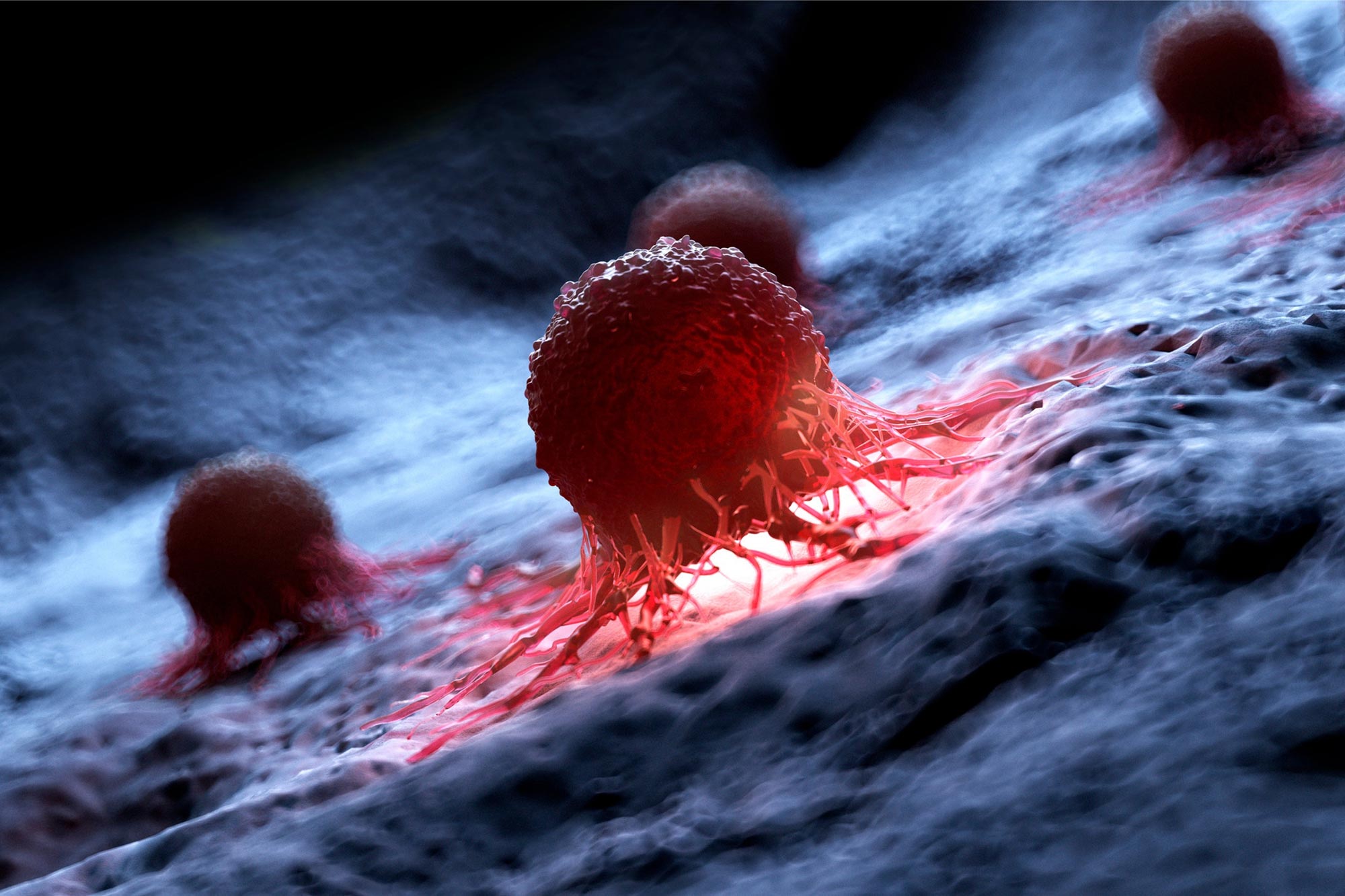
Scientists have developed compounds that selectively block a crucial interaction between RAS and the enzyme PI3K, a driver of tumor growth.
Scientists from the Francis Crick Institute and Vividion Therapeutics have discovered a group of chemical compounds capable of selectively stopping the interaction between the cancer-linked gene RAS and a key signaling pathway that drives tumor growth.
These potential drugs have now advanced to their first human clinical trial. If proven safe and effective, they could provide a new way to treat a wide range of cancers while minimizing harm to healthy cells.
The RAS gene plays a central role in triggering cell growth pathways and is mutated in roughly one out of every five cancers. When this gene mutates, it locks the RAS protein into a permanently active state, continuously signaling cancer cells to grow and divide.
Normally, the RAS protein sits on the cell membrane and acts as the first “runner” in a chain reaction that controls cell growth. However, shutting down RAS or the enzymes it influences entirely can produce unwanted side effects, since these same pathways are essential for normal cell function. One such enzyme, known as PI3K, also works with insulin to regulate blood sugar, so blocking it too strongly can lead to hyperglycemia.
A Precise Way to Interrupt the RAS–PI3K Connection
But in their work, published in Science, the research team used a combination of chemical screening and biological experiments to find and test compounds that can block the interaction between RAS and PI3K without causing side effects on healthy cells.
Scientists at Vividion Therapeutics identified a series of small compounds that irreversibly stick to the surface of PI3K near the RAS binding site, and then, using an assay developed by the Crick researchers, discovered that they prevented PI3K and RAS from binding, but still allowed PI3K to interact with other molecules, such as those in the insulin pathway.
Researchers in the Oncogene Biology Laboratory at the Crick and the team at Vividion then tested one of these compounds in mice with RAS-mutated lung tumors, finding that the treatment halted tumor growth. Importantly, they also checked for and observed no evidence of hyperglycemia.
They then tested the new drug candidate in combination with one or two other drugs that also target enzymes in the RAS pathway. This combination resulted in stronger and longer-lasting tumor suppression compared to the individual treatments alone.
Extending the Approach to Other Cancer Types
Finally, the team also tested the drug candidate in mice with tumors containing mutations in another cancer-driving gene, HER2. This gene is often overexpressed in breast cancer, and the HER2 protein also interacts with PI3K. The researchers observed similar suppression of tumor growth, and surprisingly, this effect was independent of RAS, suggesting that the drug candidate may work to block the growth of even more types of tumors.
The drug has now entered the first clinical trial in humans to test for safety and side effects in people with both RAS and HER2 mutations. The trial will also assess if the potential treatment is more effective in combination with other drugs targeting RAS.
Julian Downward, Principal Group Leader of the Oncogene Biology Laboratory at the Crick, said: “Given the RAS gene is mutated across a wide range of cancers, we’ve been exploring how to stop it interacting with cell growth pathways for many years, but side effects have held back the development of treatments.
“Our collaborative effort has overcome this challenge by targeting the PI3K and RAS interaction specifically, leaving PI3K free to bind with its other targets. It’s exciting to see these clinical trials starting, highlighting the power of understanding chemistry and fundamental biology to get to something with potential to help people with cancer.”
“This discovery is a great example of how new discovery approaches can open up completely novel ways to tackle cancer,” said Matt Patricelli, Ph.D., Chief Scientific Officer of Vividion. “By designing molecules that stop RAS and PI3K from connecting, while still allowing healthy cell processes to continue, we’ve found a way to selectively block a key cancer growth signal. It’s incredibly rewarding to see this science now progressing in the clinic, where it has the potential to make a real difference for patients.”
Reference: “Covalent inhibitors of the PI3Kα RAS binding domain impair tumor growth driven by RAS and HER2” by Joseph E. Klebba, Nilotpal Roy, Steffen M. Bernard, Stephanie Grabow, Melissa A. Hoffman, Hui Miao, Junko Tamiya, Jinwei Wang, Cynthia Berry, Antonio Esparza-Oros, Richard Lin, Yongsheng Liu, Marie Pariollaud, Holly Parker, Igor Mochalkin, Sareena Rana, Aaron N. Snead, Eric J. Walton, Taylor E. Wyrick, Erick Aitchison, Karl Bedke, Jacyln C. Brannon, Joel M. Chick, Kenneth Hee, Benjamin D. Horning, Mohamed Ismail, Kelsey N. Lamb, Wei Lin, Justine Metzger, Martha K. Pastuszka, Jonathan Pollock, John J. Sigler, Mona Tomaschko, Eileen Tran, Chanyu Yue, Todd M. Kinsella, Miriam Molina-Arcas, Brian N. Cook, Gabriel M. Simon, David S. Weinstein, Julian Downward and Matthew P. Patricelli, 9 October 2025, Science.
DOI: 10.1126/science.adv2684
Never miss a breakthrough: Join the SciTechDaily newsletter.
Follow us on Google and Google News.
3 Comments
What is the name or identifying factors of this new drug?
Have you and are you going to see how it goes with colon cancer due to the gene 14
(MLH1 = Lynch Syndrome, as a few more the other main other one I (MMR).
If you would like to talk more ,etc. Please don’t hesitate to send an email.
Thank you
Where are your studies being held? Any in Florida?