

Scripps Research scientists have discovered how some tumors endure DNA damage, revealing a potential new way to target them.
The DNA inside our cells is constantly exposed to damage, and one of the most severe forms occurs when both strands of the double helix are cut at the same time. Under normal conditions, cells use highly accurate repair systems to fix these breaks. When those systems fail, however, cells may fall back on a less reliable repair method. Researchers at Scripps Research have now identified the circumstances that trigger this backup pathway and have uncovered how it might be used to target cancer cells that depend on it for survival.
The study, published in Cell Reports, examined a protein responsible for untangling strands of genetic material, including RNA-DNA structures known as R-loops. These temporary and potentially harmful “knots” appear when newly formed RNA remains attached to its DNA template rather than separating, which leaves one strand of DNA exposed.
“R-loops are important for many different cell functions, but they must be tightly controlled,” says senior author Xiaohua Wu, a professor at Scripps Research. “If they aren’t properly regulated, they can accumulate to harmful levels and cause genome instability.”
The Role of Senataxin (SETX) in Preventing Genomic Stress
The researchers focused on senataxin (SETX), a helicase protein that belongs to a group of molecular machines responsible for unwinding tangled genetic material. Mutations in SETX are linked to several rare neurological diseases, including ataxia and a form of amyotrophic lateral sclerosis (ALS). These mutations also occur in certain uterine, skin, and breast cancers. This pattern raises an important question about how cancer cells continue to function despite the stress created by excess R-loops.
To explore this, Wu’s team worked with SETX-deficient cells that accumulate high amounts of R-loops and observed how they reacted when double-strand breaks formed at these sites. As expected, the cells experienced a sharp increase in DNA damage. They also shifted into an intense repair mode, attempting to cope with the ongoing stress.
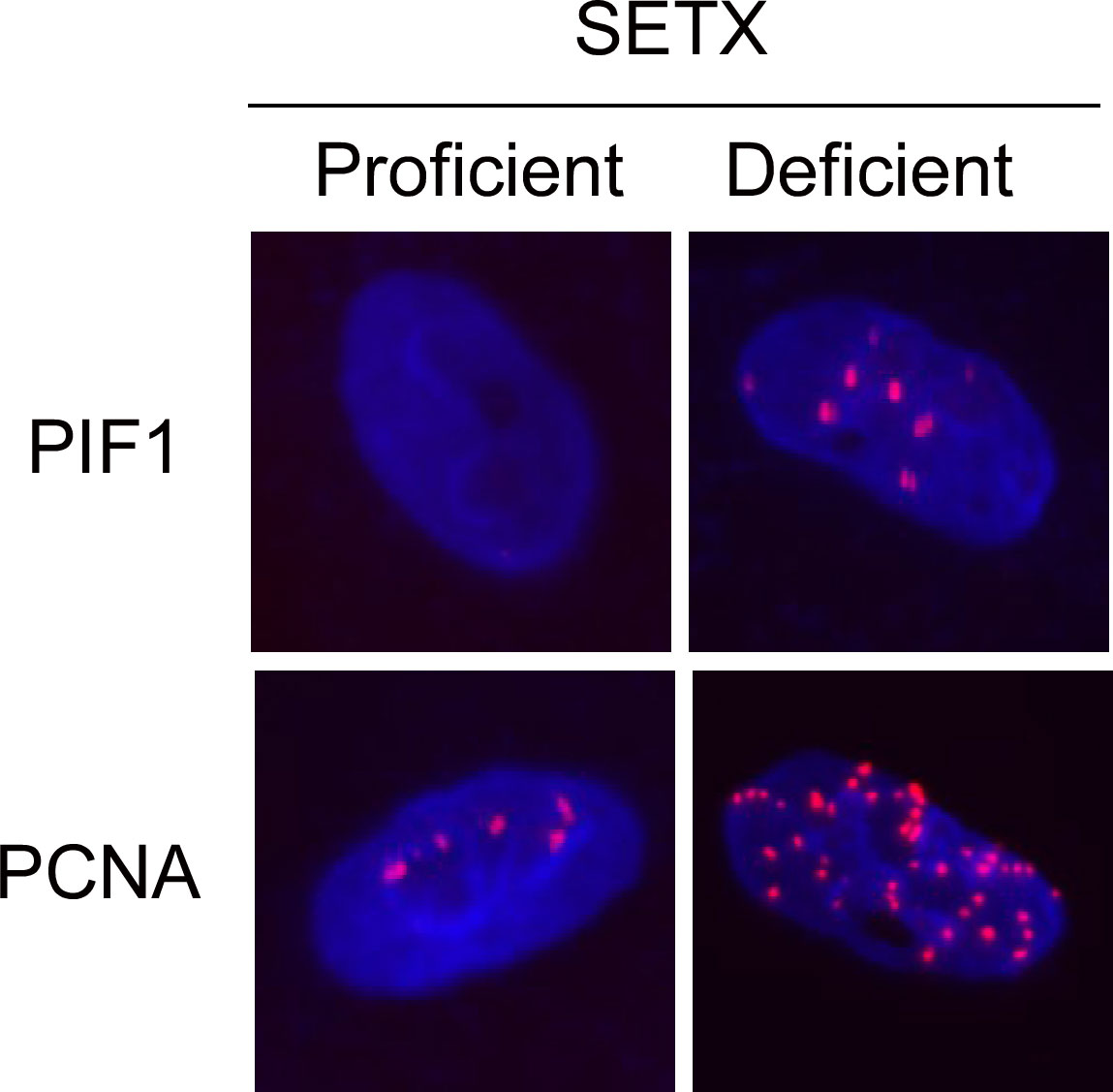
“We were surprised but excited to find that the cell turns on an emergency DNA repair mechanism called break-induced replication (BIR),” says Wu.
This BIR mechanism normally rescues damaged DNA forks during replication, but it can also act as a backup system for double-strand breaks. The process involves proteins that rapidly copy large sections of DNA to patch up broken strands—unlike the smaller, more precise fixes of the usual repair pathway. But because BIR copies the DNA so extensively and quickly, it often introduces errors.
“It’s like an emergency repair team that works intensively but makes more mistakes,” says Wu.
How SETX Loss Pushes Cells Into Error-Prone Repair
The researchers found that when SETX is missing, R-loops build up at the break sites, scrambling the cell’s normal repair signals. The broken DNA ends are trimmed too far, exposing long stretches of single-stranded DNA, which in turn attracts the BIR machinery, including PIF1, an essential helicase for the BIR process. The combination of exposed DNA strands and PIF1 kick-starts BIR for damage repair.
Despite its error-prone nature, BIR can keep SETX-deficient cells alive, but it also creates a critical weakness. The cells become dependent on BIR for survival, meaning that if BIR is blocked, the cells have no way to repair the breaks, and they die. This concept, known as synthetic lethality, is the basis of several modern targeted cancer therapies.
Wu’s team found that SETX-deficient cells rely heavily on three BIR-related proteins: PIF1, RAD52, and XPF.
“What’s important is that these aren’t essential in normal cells, which means we could selectively kill SETX-deficient tumors,” says Wu.
Toward Targeted Therapies
The findings are promising, but Wu notes that translating them into treatment will take time.
“We’re now exploring ways to inhibit these BIR factors, trying to find ones with the right activity and low toxicity,” she adds.
Her lab is also studying which types of tumors accumulate the highest levels of R-loops and under what conditions. Identifying the best cancer candidates for BIR-targeted therapy will be an important next step.
Although SETX deficiency isn’t the most common cancer mutation, many tumors accumulate R-loops through other mechanisms, such as oncogene activation or hormone signaling like estrogen in certain breast cancers. That means the therapeutic opportunities could apply to a broader set of cancers, not just those with SETX mutations.
Reference: “Break-induced replication is activated to repair R-loop-associated double-strand breaks in SETX-deficient cells” by Tong Wu, Youhang Li, Yuqin Zhao, Sameer Bikram Shah, Linda Z. Shi and Xiaohua Wu, 1 October 2025, Cell Reports.
DOI: 10.1016/j.celrep.2025.116386
This work was supported by the National Institutes of Health (grants GM141868, CA294646, CA244912 and CA187052).
Never miss a breakthrough: Join the SciTechDaily newsletter.
Follow us on Google and Google News.