
Close Menu
    Facebook X (Twitter) Instagram
    SciTechDaily
    • Biology
    • Chemistry
    • Earth
    • Health
    • Physics
    • Science
    • Space
    • Technology
    Facebook X (Twitter) Pinterest YouTube RSS
    SciTechDaily
    Home»Health»Gene Identified That Could Explain Why COVID-19 Causes No Symptoms in Some and Serious Illness or Death in Others
    Health

    Gene Identified That Could Explain Why COVID-19 Causes No Symptoms in Some and Serious Illness or Death in Others

    By The Translational Genomics Research InstituteDecember 16, 2020No Comments3 Mins Read
    Facebook Twitter Pinterest Telegram LinkedIn WhatsApp Email Reddit
    Share
    Facebook Twitter LinkedIn Pinterest Telegram Email Reddit
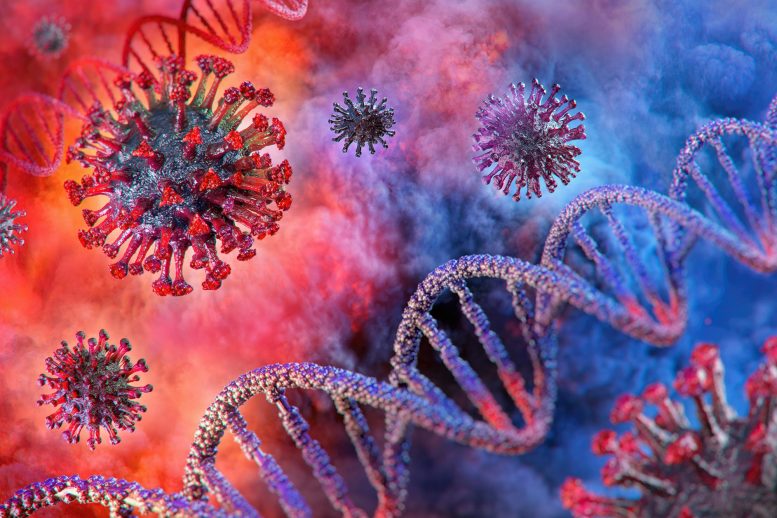
    SARS-CoV-2 Virus DNA Concept
    Researchers pinpoint a genetic target, miR1307, which may explain the wide range of COVID-19 severity. This DNA-based molecule could act as a dimmer switch, influencing why some have mild or no symptoms while others become seriously ill or fatal.

    The Translational Genomics Research Institute (TGen), an affiliate of City of Hope, has identified a specific genetic target that could help explain the tremendous variation in how sick those infected with COVID-19 become.

    The study results, recently published in the journal mSphere, describe a molecule made from DNA — miR1307 — as a potential dimmer switch that may influence the severity of the disease; why some infected with SARS-CoV-2, the virus that causes COVID-19, have mild or even no symptoms, while others become seriously ill or die.

    Led by Nicholas Schork, Ph.D., a Distinguished Professor and Director of TGen’s Quantitative Medicine and Systems Biology Division, researchers identified miR1307 by comparing the genetic elements of SARS-Cov-2 with seven other human coronaviruses, some of which merely cause common colds. In addition, they examined the genomes of coronavirus strains known to infect bats, pigs, pangolins, ferrets, civets, and chickens.

    “We pursued a systematic gene-by-gene comparative analysis, investigating how and to what extent the SARS-CoV-2 genome sequence differs from other well-characterized human and animal coronavirus genomes,” Dr. Schork said. “Our study results will allow the development of models of how the virus and its hosts interact, enhancing our understanding of the disease-causing mechanisms of SARS-CoV-2 and how to exploit both viral and host therapeutic targets.”

    Study results suggest that miR1307 serves as a switch that turns various genes within the virus on or off, potentially making the disease more or less harmful to patients by regulating, for example, how fast or slow the virus replicates. In past studies, miR1307 has been found to affect the severity of several types of cancer, lung disease, and the flu, specifically the H1N1 influenza virus that caused a 2009 pandemic. It was first discovered as a key regulatory agent in the Epstein-Barr virus, best known as the cause of infectious mononucleosis.

    According to Dr. Schork, the study results also provide the basis for additional investigations, such as designing vaccines based on proteins or RNA, developing specific genetic markers for community disease monitoring, and tracing COVID-19 from one species to another.

    Reference: “Conserved Genomic Terminals of SARS-CoV-2 as Coevolving Functional Elements and Potential Therapeutic Targets” by Agnes P. Chan, Yongwook Choi and Nicholas J. Schork, 25 November 2020, mSphere.
    DOI: 10.1128/mSphere.00754-20

    Funding for this study was provided by National Science Foundation (RAPID grant # 2031819). Computing infrastructure was provided by Dell Technologies.

    Never miss a breakthrough: Join the SciTechDaily newsletter.
    Follow us on Google and Google News.

    Bioinformatics Cell Biology COVID-19 DNA Genetics Infectious Diseases Molecular Biology Popular
    Share. Facebook Twitter Pinterest LinkedIn Email Reddit

    Related Articles

    Genetic Sequencing Shows Coronavirus Variation Drives Pandemic Surges

    Melatonin Produced in the Lungs Prevents COVID-19 Infection

    Ferrets, Cats, Civets, and Dogs Most Susceptible to SARS-CoV-2 Coronavirus Infection After Humans

    Cleveland Clinic: Melatonin May Be a Viable Treatment for COVID-19

    Breaking COVID-19’s “Clutch” to Stop Its Spread: Small Molecule Targets SARS-CoV-2 RNA for Destruction

    Many Animal Species Vulnerable to SARS-CoV-2 / COVID-19 According to Genomic Analysis

    The Six Strains of SARS-CoV-2: Despite Its Mutations, the Virus Shows Little Variability

    COVID-19 Treatment May Lie in Pangolin Genetics – May Possess Evolutionary Advantage Against Coronavirus

    Infection Researchers Identify How Coronaviruses From Animals Need to Change to Spread to Humans

    Leave A Reply Cancel Reply

    • Facebook
    • Twitter
    • Pinterest
    • YouTube

    Don't Miss a Discovery

    Subscribe for the Latest in Science & Tech!

    Trending News

    Popular Sugar-Free Sweetener Linked to Liver Disease, Study Warns

    What Is Hantavirus? The Deadly Disease Raising Alarm Worldwide

    Scientists Just Discovered How the Universe Builds Monster Black Holes

    Scientists Unveil New Treatment Strategy That Could Outsmart Cancer

    A Simple Vitamin May Hold the Key to Treating Rare Genetic Diseases

    Scientists Think the Real Fountain of Youth May Be Hiding in Your Gut

    Ravens Don’t Follow Wolves, They Predict Them

    This Common Knee Surgery May Be Doing More Harm Than Good

    Follow SciTechDaily
    • Facebook
    • Twitter
    • YouTube
    • Pinterest
    • Newsletter
    • RSS
    SciTech News
    • Biology News
    • Chemistry News
    • Earth News
    • Health News
    • Physics News
    • Science News
    • Space News
    • Technology News
    Recent Posts
    • A Strange Quantum Effect May Explain One of Biology’s Greatest Mysteries
    • NASA’s Psyche Spacecraft Is About To Fly Shockingly Close to Mars
    • This Mars Rock Refused To Let Go of NASA’s Curiosity Rover
    • James Webb Telescope Reveals the Universe’s Hidden Cosmic Web in Stunning Detail
    • Scientists Build a Living AI Device Using Real Brain Cells
    Copyright © 1998 - 2026 SciTechDaily. All Rights Reserved.
    • Science News
    • About
    • Contact
    • Editorial Board
    • Privacy Policy
    • Terms of Use

    Type above and press Enter to search. Press Esc to cancel.