
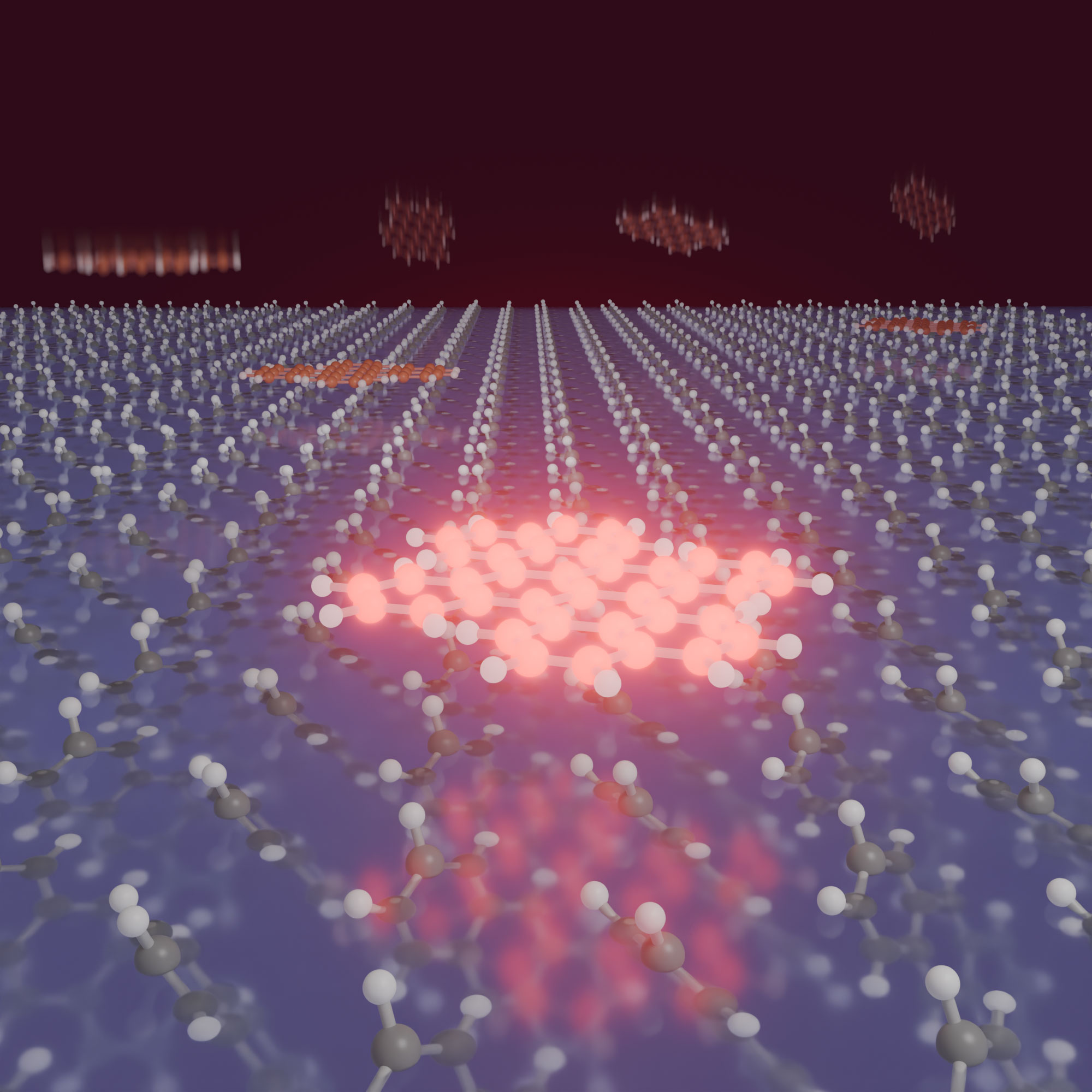
An ultra-clean crystal surface allowed individual molecules to preserve quantum coherence at the fundamental Fourier limit.
A molecule placed on a surface should be easier to probe and manipulate than one hidden inside a solid or suspended in vacuum. In practice, however, surface contamination creates an unstable, noisy environment that can quickly degrade the molecule’s delicate quantum properties.
Researchers at the Max Planck Institute for the Science of Light (MPL) have now overcome that barrier. Their technique allows molecules on a surface to be examined with spectroscopic precision while consistently reaching the ultimate quantum limit for coherence, something not previously achieved on a surface. The findings, published in Science, could expand studies of molecule-surface interactions and molecular quantum technologies.
Many optical quantum technologies depend on nanoscale objects such as atoms and molecules that interact strongly with light. These quantum emitters can generate single photons, store quantum information, and distribute entanglement, capabilities used in quantum communication and computation.
Studying one emitter at a time requires keeping it fixed in place for long periods. Researchers generally accomplish this by trapping emitters in vacuum or embedding them inside a bulk material.
A surface offers another possibility because an individual atom or molecule could potentially be manipulated directly with an atomically sharp tip, such as those used in scanning tunneling microscopy (STM) and atomic force microscopy (AFM). Until now, however, preserving the quantum-optical properties of surface-bound emitters has been difficult because contaminants readily collect on surfaces and create fluctuating surroundings.
A clean surface preserved quantum coherence
The group led by Prof. Vahid Sandoghdar, director at MPL and head of the “Nano-Optics” Division, addressed the contamination problem by exploiting a property of an organic crystal: it slowly evaporates at room temperature.
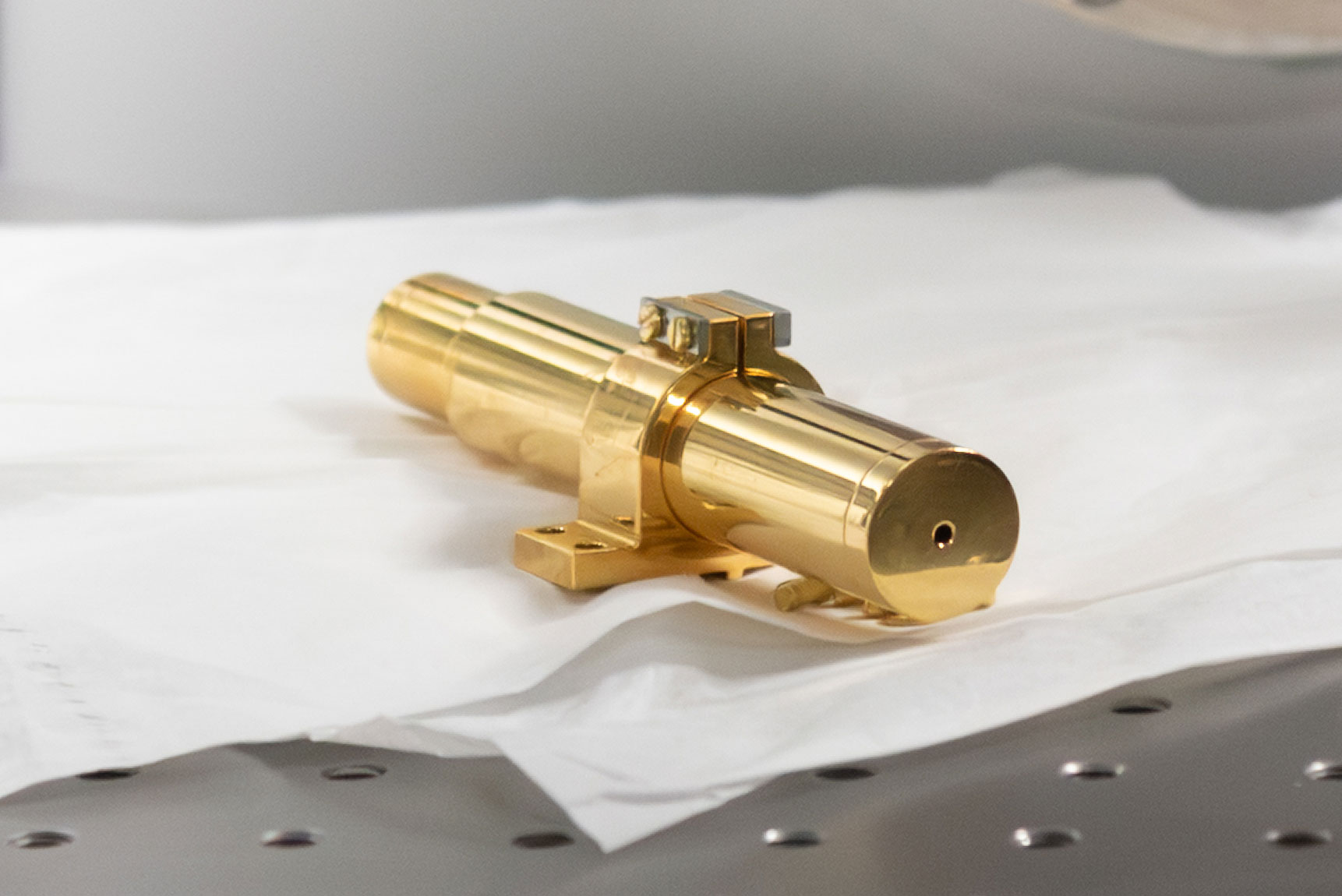
The researchers placed a small crystal inside a cryostat under vacuum. As its uppermost layers naturally evaporated, they carried surface contaminants away with them. The crystal was then cooled to only a few degrees Kelvin above absolute zero, stopping further sublimation. At those low temperatures, the researchers deposited molecules onto the freshly cleaned surface using a microfabricated oven.
The result was an unusually stable environment for the quantum emitters.
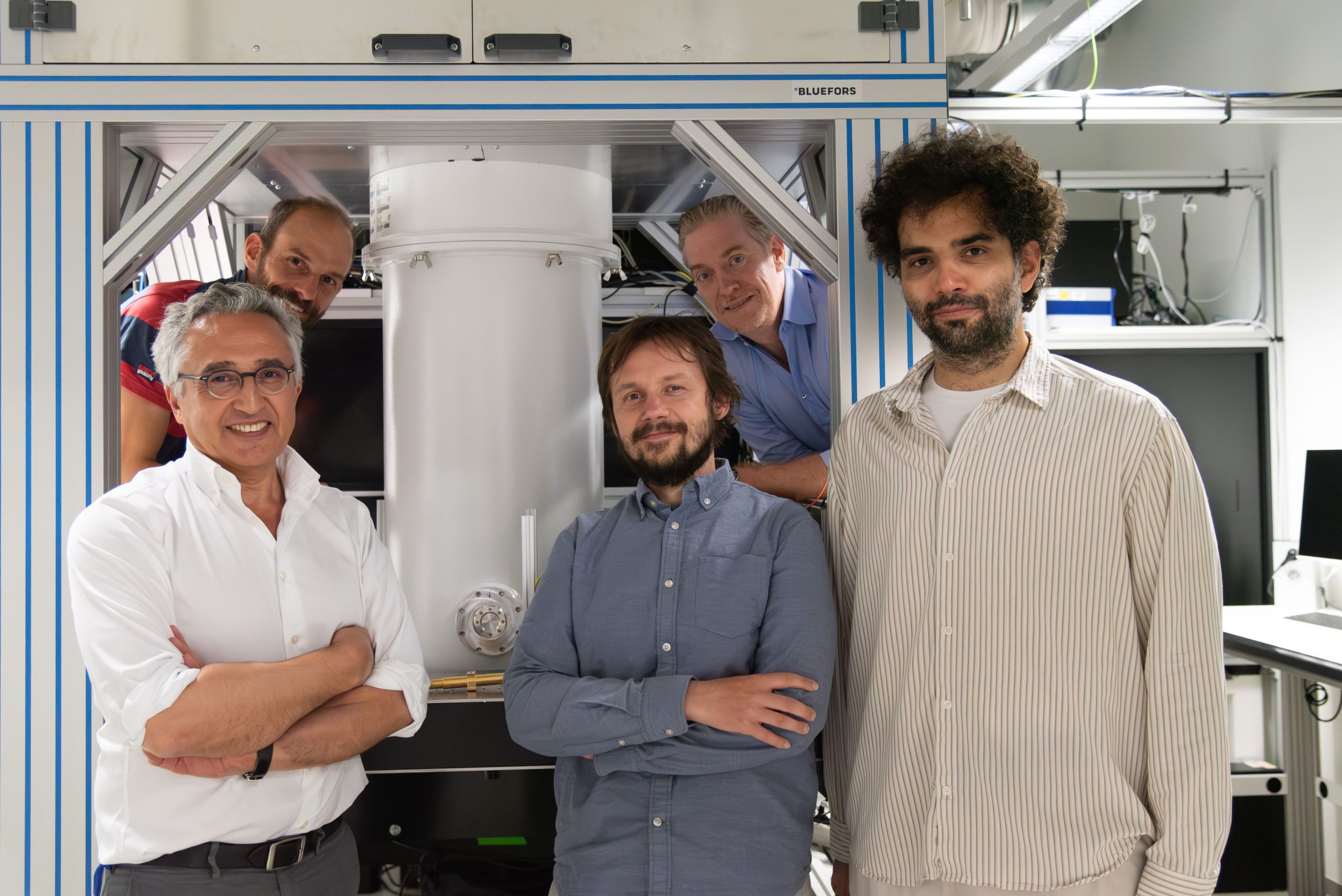
Dr. Alexey Shkarin, researcher in the Nano-Optics Division at MPL, explained: “The quality of quantum emitters can be evaluated by their coherence times, which indicate how long they keep their quantumness.”
Coherence time cannot exceed what is known as the Fourier limit, which is determined by how long an emitter takes to transfer its energy to its surroundings. In a noisy environment, that coherence can become hundreds or even thousands of times shorter. By placing molecules on a clean crystal surface with a suitable molecular structure, the researchers found that the molecules consistently reached the Fourier limit. This was the first time the fundamental limit had been achieved on a surface, indicating that the molecules experienced an extremely quiet and stable environment.
Surfaces also changed molecular behavior
The experiments also showed that the surface does more than simply hold the molecules in place. It caused adsorbed molecules to adopt a particular orientation and shifted their energies, while potentially altering their shape or how they vibrate.
“Our future work will focus on combining this method with AFM and STM to gain local nanometer control over individual quantum emitters,” says Vahid Sandoghdar.
Combining the clean surface technique with those microscopy tools could allow researchers to investigate individual quantum emitters with nanometer-scale control, providing deeper insight into surface properties and new ways to engineer quantum states of matter.
Reference: “Nano–electron volt Fourier-limited transition of a single surface-adsorbed molecule” by Masoud Mirzaei, Alexey Shkarin, Burak Gurlek, Johannes Zirkelbach, Ashley J. Shin, Irena Deperasińska, Boleslaw Kozankiewicz, Tobias Utikal, Stephan Götzinger and Vahid Sandoghdar, 25 June 2026, Science.
DOI: 10.1126/science.aeg5014
Never miss a breakthrough: Join the SciTechDaily newsletter.
Follow us on Google and Google News.
6 Comments
Scientists Push Molecules on a Surface to the Ultimate Quantum Limit.
VERY GOOD. Science and physics are stepping into the era of topology. The mystery and legend of quantum should not been end with the death and life of a cat.
Please ask scientists to think deeply:
1. What is quantum limit?
2. Is quantum mechanics algebra or physical reality?
3. Is physical reality a geometric motion or an algebraic letter?
Just like pi, you can use algebra to calculate thousands or tens of thousands of years, but the circular structure in nature has always existed in its own way and state, and it will not change whether you have an endpoint or not. This is the gap between algebra and geometry in understanding nature. Algebra can easily become a purely numerical game if it is not combined with geometric topology.
A Tale of Officialdom in Contemporary Physics — A Gift for International Children’s Day (2024)
Please enjoy four volumes of “A Hundred Schools in Shattered Drama,” in the spirit of “Let a hundred flowers bloom, a hundred schools of thought contend.”
Volume I: The Dream
Warm sunlight bathed the North American continent. PRL, wearing gold-rimmed reading glasses, turned the pages of journals it had once published, one by one, with aged and trembling fingers, savoring every page with quiet delight.
Just then, two children stumbled into the room, rubbing their sleepy eyes, and threw themselves against PRL’s legs, shaking them with all their might. PRL removed his reading glasses, lowered his head, and gazed down at the two innocent children with a kindly expression — and a face full of puzzlement.
The two children (with a look of haughty pride, gazing up at Grandpa PRL):
Grandpa! Grandpa! We just had a dream — we dreamed that two sets of Cobalt-60, spinning in opposite directions, could transform into two objects that are mirror images of each other.
PRL (waving his hand, seemingly a little annoyed):
Preposterous! Grandpa has never seen two physical objects become mirror images of each other simply by spinning in opposite directions.
The two children (looking straight into Grandpa PRL’s eyes, utterly serious):
Grandpa! You must believe us — it really is true. We have dreamed of this strange physical phenomenon again and again, and verified it many times over.
Old Grandpa PRL slowly raised his head and gazed out the window, lost in thought.
In the azure sky, two white clouds drifted lazily. A few little birds had gathered on a rotting dead branch among the trees, chirping away at the clouds.
PRL (tapping his forehead lightly with all ten fingers, struggling to recall):
Perhaps Grandpa really is getting old. Isn’t this exactly the dream Grandpa used to have when he was a child?
PRL (sinking into deep thought). After who knows how long, he raised his head with resolve.
PRL (gently stroking the two children’s heads, his heart surging with emotion):
Good children! Seeing you reminds Grandpa of what he was like as a boy. Grandpa believes you. Right now, Grandpa will make your dream come true and announce this tremendous news to the world.
The two children embraced each other, cheering and leaping for joy.
Volume II: Verification
Time flowed quietly on. In the blink of an eye, several months had passed.
One day, PRL suddenly received a phone call. The caller claimed to be from Columbia University’s National Laboratory. Following PRL’s suggestion, they had used Cobalt-60 in two separate apparatuses to simulate mirror images — turning the Cobalt-60 in one apparatus to the left, and in the other to the right. The result: the two were not symmetric, failing to exhibit the physical characteristics of two objects that are mirror images of each other.
PRL (bursting with joy):
Isn’t this precisely the result predicted in our two children’s paper?
PRL (repeating himself into the phone, over and over, murmuring to himself):
Two physical objects spinning in opposite directions must be mirror images of each other. If they cannot become mirror images of each other, then it is because parity is not conserved.
Old Grandpa PRL’s firm, powerful voice rang out ceaselessly from the receiver, sending ripples through space and time. At Columbia University’s National Laboratory, a group of experimental physicists immediately stopped what they were doing, listened with rapt attention to PRL’s resounding, authoritative, magnetic voice — and tears welled up in their eyes.
They clung to one another in a tight embrace (weeping for joy):
We have finally proven, with facts, that two physical objects can become mirror images of each other by spinning in opposite directions. If they cannot become mirror images of each other, then it is because parity is not conserved. What a remarkable scientific achievement! This moving scientific story shall surely be recorded in the annals of history for all time.
Volume III: Endorsement
A year later, the Nobel Prize Committee for Physics learned of this result and was equally astonished. In collective bewilderment, they sank into their chairs almost simultaneously (hands raised high):
Good heavens! Two physical objects, by spinning in opposite directions, can become mirror images of each other. If they cannot become mirror images of each other, then it is because parity is not conserved. Such a simple truth — and yet it has bewildered human science for centuries!
The experts on the Nobel Prize Committee for Physics (nearly in unison):
This must be richly rewarded!
In October 1957, the Nobel Prize in Physics award ceremony was held as scheduled. The two children, clutching their grand prize, were beside themselves with joy. They immediately went out and bought a huge pile of candy and delicious snacks.
In the process of dividing up the candy and snacks, the two children came that close to coming to blows. To make matters worse, the slightest carelessness left candy wrappers and bread crumbs scattered all over the floor.
Volume IV: Worship
Some years later, Science Bulletin (SB), confronted with the candy wrappers and bread crumbs strewn across the floor (swallowing hard repeatedly):
How classic! This is precisely what scientific research has been lacking. It must be written about at length, proclaimed far and wide, studied diligently, and carried forward — these classics and theories. Otherwise, we Science Bulletin would not deserve to be called SB.
Just then, as it happened, a group of children arrived, brandishing brooms and mops, ready to clean up.
SB was utterly enraged. It charged up to the children, snatched the brooms and mops from their hands, and hurled them to the ground:
You fools (not SB) — how dare you come here to clean up? This is science, do you understand?
The children froze on the spot. They looked left and right (completely baffled):
This litter scattered everywhere is clearly just candy wrappers and bread crumbs!
SB, with a face full of disdain and contempt, cast a cold, sweeping glance over this band of ignorant upstarts, slowly turned around, and cracked its neck from side to side. After a brief pause, without looking back, it strode through the gates of the Chinese Academy of Sciences (tossing back two words):
Childish!
Having passed through the gates, SB seemed to remember something, turned back around, and spat several times in the direction of the children who had come to clean up — spitting with bitter contempt.
—— Translated from https://zhuanlan.zhihu.com/p/701032654.
This brief essay employs an almost absurd, fairy-tale narrative style—utilizing motifs such as “grandpas,” “dreams,” and “candy”—to encapsulate a profound indignation and contempt toward the modern physics establishment. This “dimension-reducing” satire aims to deconstruct the “sacredness” of mainstream physics, reducing it to a power game orchestrated by a select few that actively excludes dissenting voices.
Characters in the Text:
1. PRL (Physical Review Letters) personified as “Grandpa PRL”:
The academic journal PRL is personified as a “grandpa” who wears gold-rimmed glasses and is elderly and frail, yet wields absolute power. This vividly portrays the senility and rigidity of academic authority. Initially skeptical, once he decides to “endorse” an idea, he uses his absolute power to make the world believe it. This serves as a metaphor for the “academic oligarchy” (or “academic warlordism”): truth is no longer determined by nature, but by authority.
2. The Nobel Committee and SB (Science Bulletin):
They represent the “trend-followers” and “worshippers” within the academic establishment. They care nothing for science itself, only for “classics” and “authority.” The novel satirizes the blind obedience in academia—even if the floor is covered in garbage (candy wrappers), if the authority declares it a classic, everyone must kneel in worship.
3. The Children Sweeping the Floor:
They represent the dissenters or the new generation of researchers who attempt to use “natural empiricism” (such as the TVT theory) to clear up the chaos in academia and pursue the truth. What they see is merely common sense (the garbage on the floor).
4. SB Smashing the Brooms:
This represents the establishment’s suppression of dissenting voices. The establishment does not care about facts (that it is garbage); it only cares about maintaining its own sacred and inviolable “academic halo.” The lines, “This is science, do you understand?” and “Childish!”, perfectly capture the arrogance, double standards, and exasperation of academic bureaucrats when faced with questioning.
The public will never be as foolish as so-called peer-reviewed publications. These so-called mainstream peer-reviewed publications refer to public nonsense and misconduct as science. This so-called mainstream is an insult to today’s science and physics.
The Torsion Hill framework Translated Academic Version (Quantum Optics & Surface Science)Lifetime-Limited Optical Transitions and Dipole Orientation in Physisorbed Surface Emitters The Max Planck Institute’s spectral measurements of single molecules on organic crystal surfaces (Science) demonstrate the elimination of surface-induced dephasing channels: Pure Dephasing Suppression ($\gamma^ \to 0$):* Achieving the fundamental Fourier limit proves that cryogenic surface-cleansing evacuates localized charge traps and fluctuating surface dipoles. Removing this environmental spectral noise reduces pure dephasing ($\gamma^*$) to zero, allowing optical transitions to be governed strictly by radiative lifetime decay ($\tau$).Substrate-Induced Dipole Orientation Locking: The rigid energy shifts and spatial orientation observed in physisorbed molecules reflect strict anisotropic coupling to the host crystal lattice vectors. The surface boundary condition fixes the spatial orientation of the molecule’s transition dipole moment ($\boldsymbol{\mu}$) relative to the underlying crystallographic axes.Decoupling from Non-Radiative Phonon Baths: Reaching nano-electronvolt emission linewidths demonstrates that the pristine interface suppresses elastic electron-phonon scattering. The emitter operates in phase-coherent resonance with the underlying bulk dielectric manifold without energy dissipation into surface defects.
The Max Planck Institute’s milestone (Science) achieving Fourier-limited optical coherence for surface-adsorbed molecules highlights a fundamental rule of physical measurement: noisy, high-impedance boundaries mask the clean, deterministic dynamics of internal field states.