
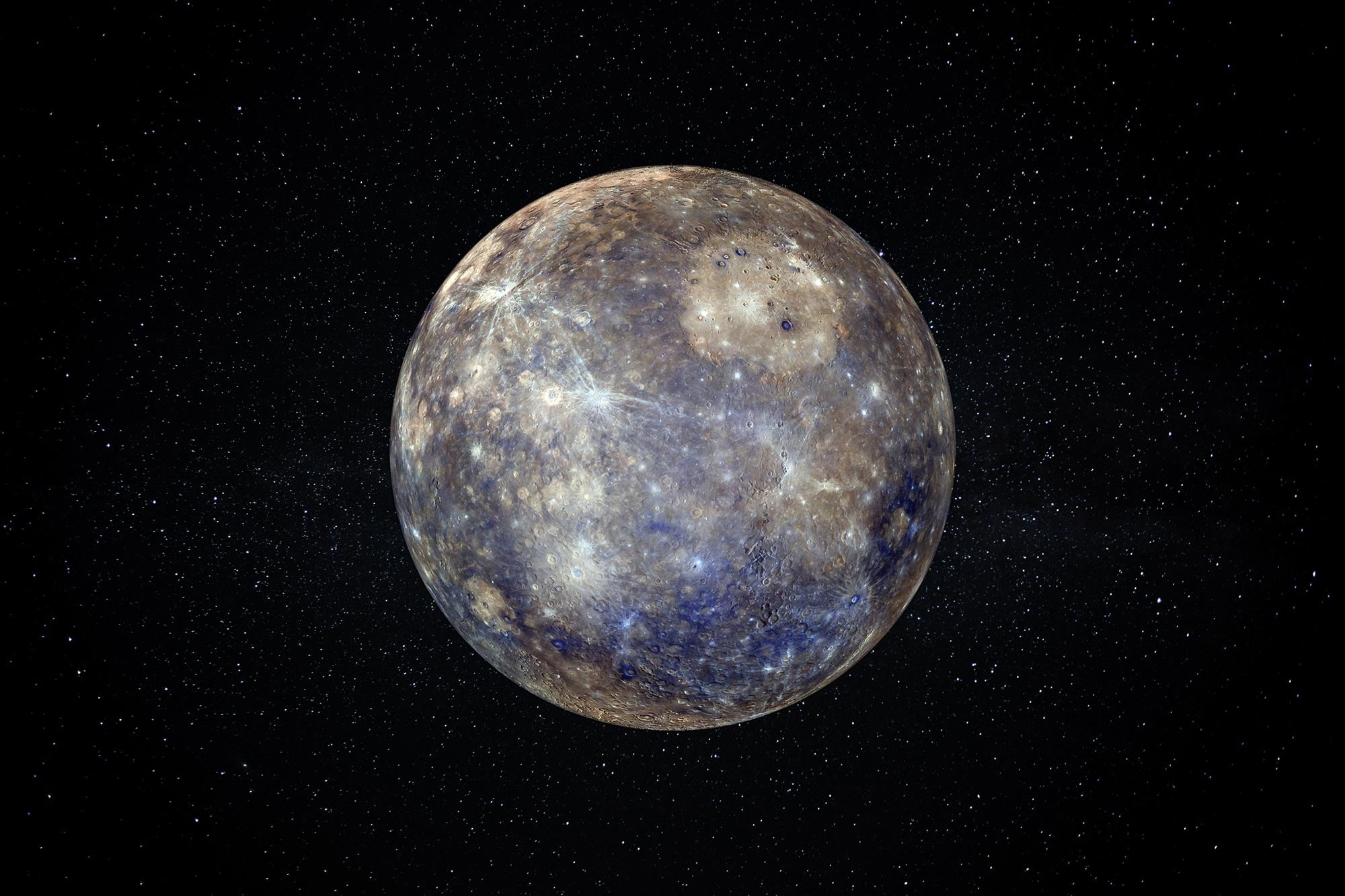
From tiny glass beads and a map of the Moon to Mercury, a new study uses an indirect method to determine the silicon dioxide content of Mercury’s surface.
Mercury’s surface appears to contain substantially less silicon dioxide than researchers previously estimated. A new analysis puts the compound at about 37 percent by mass, up to 25 percent below earlier estimates, a finding that suggests the planet’s volcanic rocks may have formed from mantle material that melted more deeply than once assumed.
The result offers a new window into a volcanic history that is very different from Earth’s. Mercury, the smallest planet and the closest to the Sun, likely cooled early. Its volcanic activity had largely ceased about one billion years after the planet formed, leaving behind a solid, continuous crust. Earth, by contrast, remains geologically active through volcanism and plate tectonics. The details of how Mercury’s early activity produced the surface seen today are still uncertain.
Researchers from the Max Planck Institute for Solar System Research and the Universities of Münster and Göttingen in Germany determined Mercury’s silicon dioxide content with greater accuracy than previously possible. Their findings are published in the journal Planetary Research.
Mercury has less silica than expected
Silicon dioxide, made from one silicon atom and two oxygen atoms, is common on Earth. It occurs in pure form as sand and makes up substantial portions of volcanic rocks including basalt, andesite, and granite, some of which contain as much as 75 percent silicon dioxide.
Mercury appears to be different.
“Our findings suggest that the volcanic rocks on Mercury formed from more deeply melted mantle material than previously assumed,” said Christian Renggli, lead author of the new study and head of the “Experimental Laboratory Magma Ocean” research group at the MPS.
The explanation lies in how a young planet’s mantle changes as it cools. The first rocks to solidify remove relatively little silicon dioxide from the remaining molten material. As cooling continues, silicon dioxide becomes increasingly concentrated in the melt, so lava reaching the surface later can contain more of it. A relatively low abundance at Mercury’s surface therefore points to high temperatures in the planet’s interior.
The researchers note another possibility. Mercury may once have had more silicon dioxide in its crust and gradually lost oxygen over time.
No samples means an indirect measurement
Determining which explanation is correct is difficult because scientists have no pieces of Mercury to analyze directly. No lander has reached its surface, and no rock samples have been returned to Earth. Researchers instead have to infer the planet’s composition from remote sensing observations made by telescopes and spacecraft.
Infrared radiation coming from Mercury’s surface provides one way to do that. But before those measurements could be translated into estimates of silicon dioxide abundance, the researchers needed a reliable way to calibrate them.
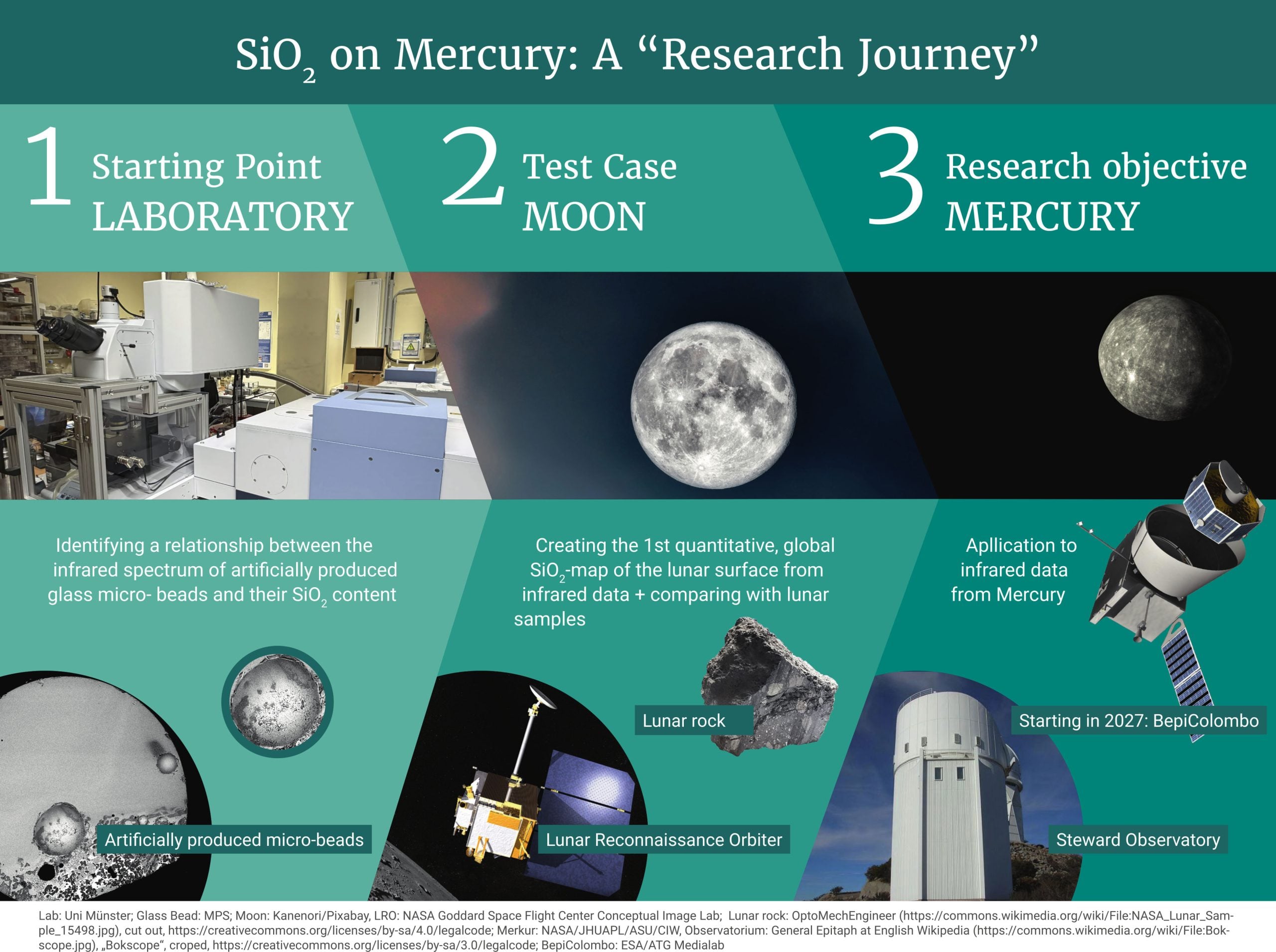
They began in the laboratory by making tiny glass beads about half a millimeter (0.02 inches) across, each with a precisely controlled proportion of silicon dioxide. They then measured the infrared properties of those samples.
“The glass beads serve a similar function to calibration weights on a scale,” explains Iris Weber from the University of Münster. “Their weight is known precisely. They therefore allow us to correctly interpret the scale’s balance. Similarly, the glass beads allow us to draw the correct conclusions from the properties of the infrared radiation.”
The Moon puts the method to the test
Before applying the calibration to Mercury, the team tested it on a much larger natural target with measurements that could be independently checked: the Moon.
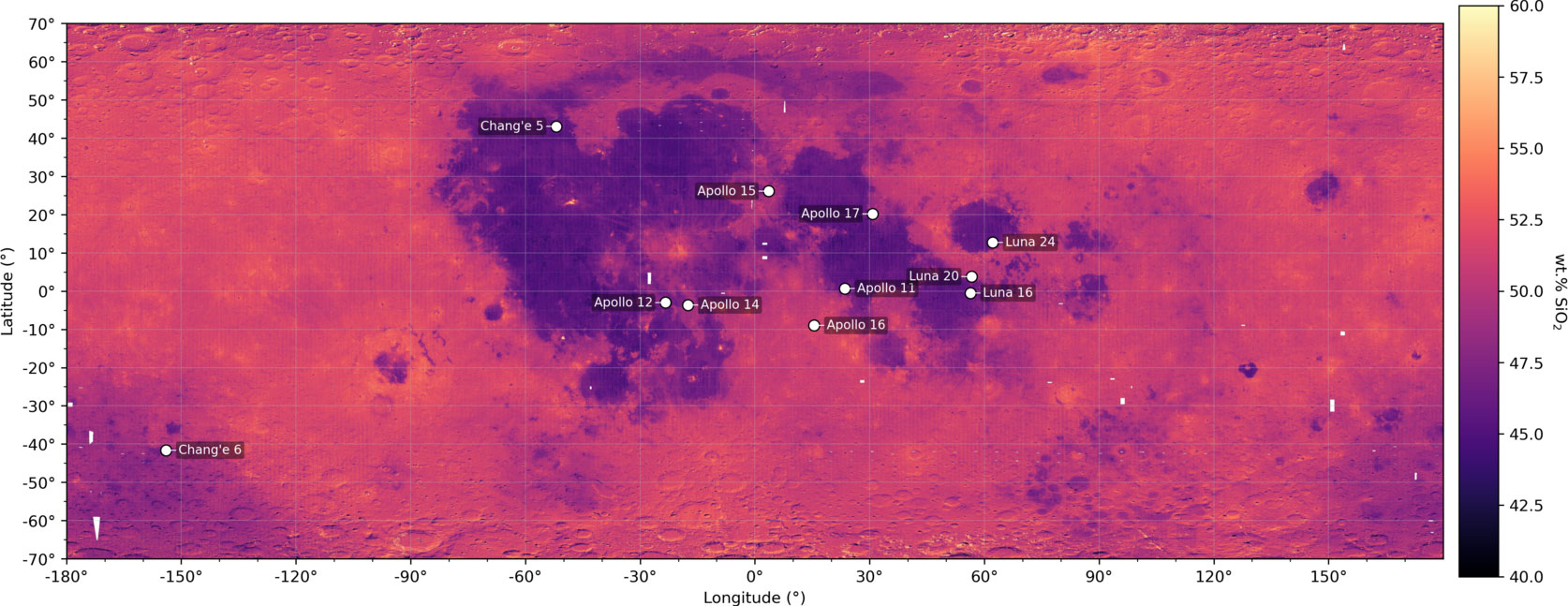
NASA’s Lunar Reconnaissance Orbiter, which has circled the Moon since 2009, has mapped infrared radiation from its surface at high spatial resolution. Using those observations, the researchers produced the first complete map of silicon dioxide across the lunar surface.
Crucially, they could compare the results with actual lunar rocks returned to Earth from different locations by crewed and uncrewed missions. The agreement provided a test of the relationship they had established between infrared radiation and silicon dioxide content.
“The Moon is a kind of touchstone for us – and an important conceptual stepping stone on our way to Mercury.” said Christian Renggli, first author and head of the “Experimental Laboratory Magma Oceans” research group at MPS.
Only after the method passed this lunar test did the researchers apply it to infrared observations of Mercury. Those data included measurements collected with the Bok Telescope at Steward Observatory in Arizona.
BepiColombo could sharpen the picture
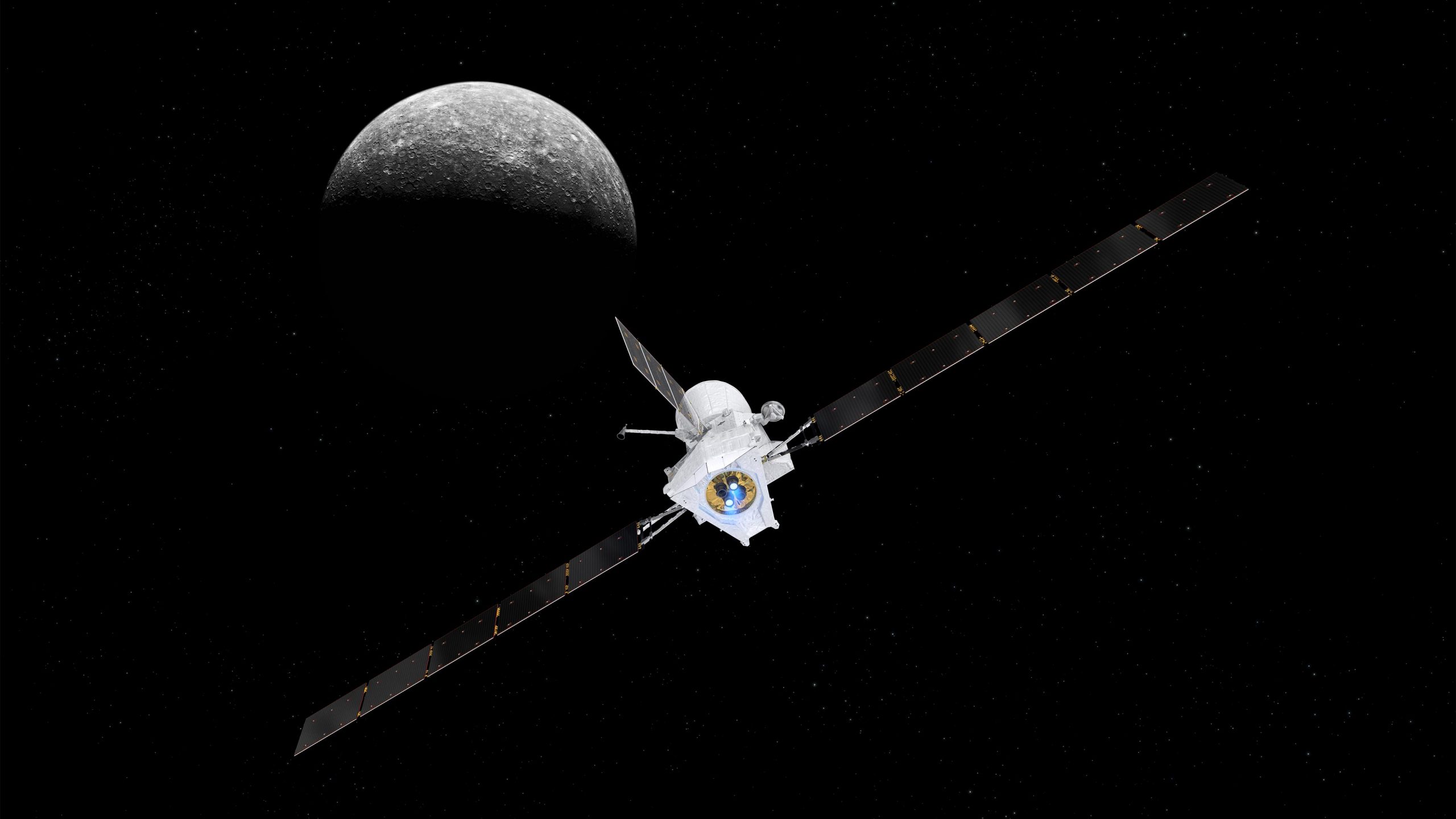
The researchers now hope that ESA’s BepiColombo mission will provide an independent test of Mercury’s unexpectedly low silicon dioxide abundance. The spacecraft, which consists of two separable probes supplied by ESA and JAXA, is scheduled to enter orbit around Mercury in November 2026.
Before then, the two probes are scheduled to separate from their transport module on September 3, 2026. BepiColombo’s MERTIS instrument, developed and built under the leadership of DLR together with the Institute for Planetology at the University of Münster, is expected to collect infrared measurements with substantially greater precision and spatial resolution.
“Our study lays the groundwork for deriving the most accurate information possible about the silicon dioxide content of Mercury’s surface from BepiColombo’s measurements,” said Christian Renggli.
Reference: “The SiO₂ abundance on the surfaces of the Moon and Mercury” by Christian Renggli, Andreas Morlok, Iris Weber, Maximilian P. Reitze, Tommaso Di Rocco, Jasper Berndt, Andreas Pack and Harald Hiesinger, 27 August 2026, Planetary Research.
DOI: 10.53480/br74-m226
Never miss a breakthrough: Join the SciTechDaily newsletter.
Follow us on Google and Google News.