
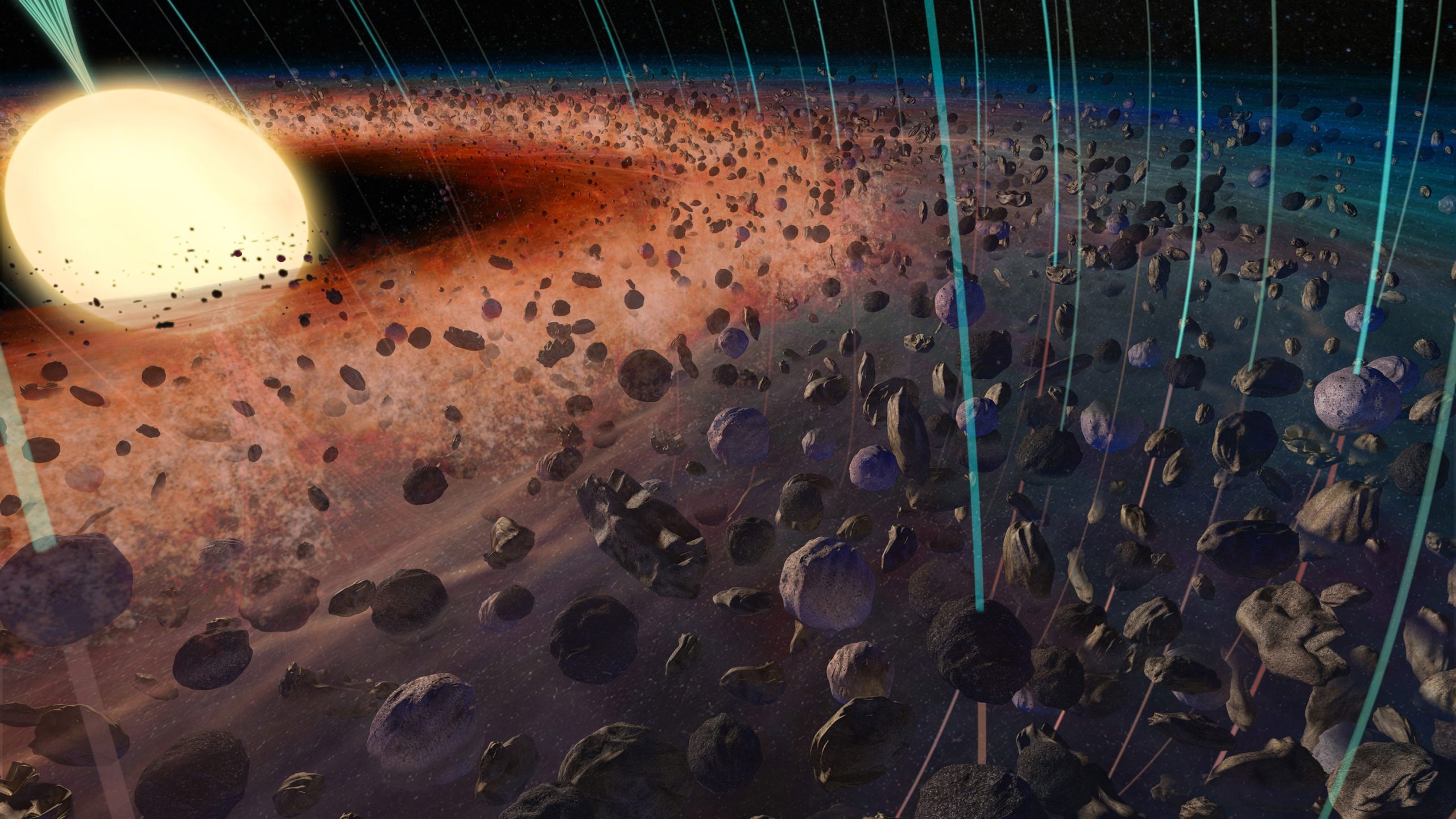
Ancient meteorite minerals reveal a surprisingly strong magnetic field from the solar system’s first 200,000 years.
About 4.6 billion years ago, before the Sun and planets existed in their familiar forms, the solar system was a vast cloud of gas and dust. Within a few million years, this “solar nebula” collapsed and flattened into a disk, setting the stage for matter to gather into the Sun and the planets that orbit it.
Gravity has long been considered the main force behind this transformation. New evidence from some of the oldest known meteorite material, however, suggests that magnetism was also involved.
MIT researchers detected traces of ancient magnetic fields in microscopic grains preserved inside a meteorite found in Antarctica in 2008. The grains, known as calcium-aluminum-rich inclusions, or CAIs, formed during the solar system’s first 200,000 years and are the oldest known material from this period.
The measurements indicate that a magnetic field was already present during the solar nebula stage. The researchers estimate that it was stronger than Earth’s magnetic field today and likely helped move primordial material inward as the early Sun was forming.
“This transition, from a spherical cloud to a protoplanetary disk, is one of the most significant events in all of solar system history,” says Benjamin Weiss, the Robert R. Shrock Professor of Earth and Planetary Sciences at MIT. “It has long been theorized that gravity caused this, but our measurements show magnetism likely played a role.”Weiss and his colleagues report the findings in a paper published in the Proceedings of the National Academy of Sciences.
Magnetism may have shaped the earliest solar system
Magnetic fields can arise when electrically charged matter moves. In the infant solar system, the collapsing cloud of gas and dust may have generated a plasma filled with charged particles. As those particles moved through the forming disk, they could have created and sustained a magnetic field.
If such a field existed, Weiss and his colleagues reasoned, it should have influenced material throughout the disk. As that material condensed, tiny magnetic minerals could have recorded the strength of the surrounding field and preserved that information for billions of years. If those minerals later reached Earth, their “remanent magnetization” could provide evidence of the ancient field and its possible role in shaping the solar system.
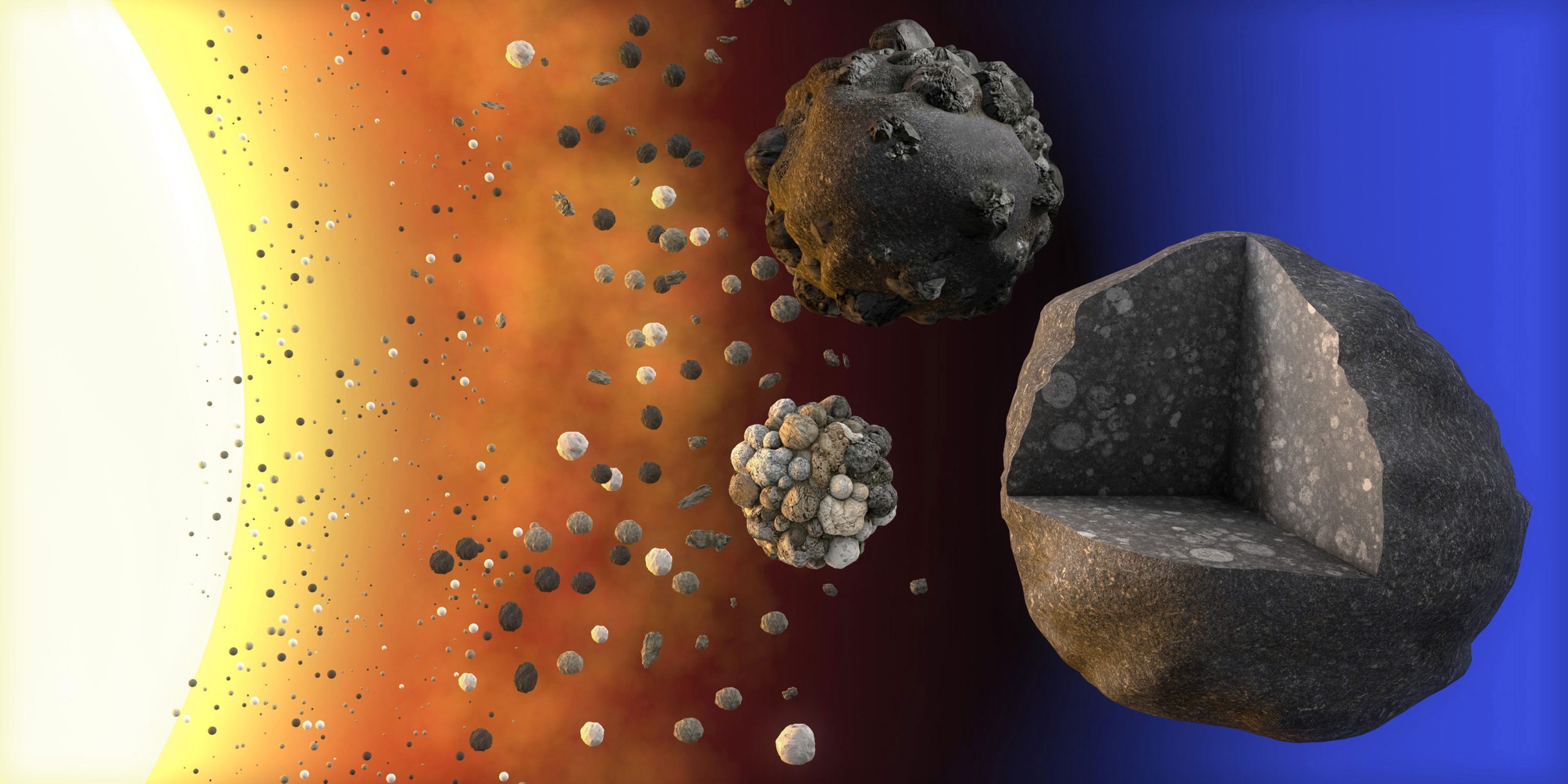
The researchers had already found signs of magnetism dating to about 2 million years after solar system formation began. By then, scientists think the Sun had formed, and the planets were beginning to assemble, suggesting that magnetic fields were involved during the early stages of planet formation.
“Nowadays people don’t debate whether magnetism is present when planets are forming. But the debate is around the very early solar system, before planets are forming, when there’s just a disk,” says Borlina, who led the new study as an MIT graduate student and is now an assistant professor at Purdue University. “That’s where the debate still resides, and that’s where we’re operating now.”
An unusually pristine meteorite preserved the record
The new work pushed the search farther back, asking whether a magnetic field was already present while the Sun itself was still coming together. The researchers examined DOM 08006, a meteorite discovered in 2008 in the Dominion Range along the East Antarctic Ice Sheet that has since been studied extensively.
DOM 08006 is among the most primitive meteorites ever found. It contains mineral grains dating to the earliest stages of solar system development, possibly from before the Sun had fully formed, and it has preserved much of its original mineral composition.
“Other meteorites went through many different processes over this 4.5 billion-year history,” Weiss says. “They were formed in the solar nebula, then added to bodies with water, then got destroyed, moved to the asteroid belt, and then landed here. But somehow, DOM has experienced less alteration than any other meteorite.”
That unusually pristine history made the meteorite a promising place to search for a magnetic record from the solar system’s infancy. CAIs embedded within DOM could potentially have retained traces of any magnetic field that surrounded them when they formed.
“We know they are the oldest things we have of the early solar system,” Borlina says. “But CAI’s are very complex and are not all the same, even within a 1-millimeter piece of the meteorite. So we have to carefully identify what types they are.”
The researchers separated tiny grains from pieces of the meteorite and identified several CAIs containing naturally magnetic minerals, including iron. They then subjected those grains to a series of measurements designed to detect any magnetism that remained.
The ancient field exceeded Earth’s today
The tests revealed traces of an ancient magnetic field preserved inside the grains. From those signals, the researchers estimate that the early solar system contained a field measuring roughly 150 to 600 microteslas, about three to 12 times stronger than Earth’s magnetic field today.
“We think these kinds of magnetic fields were helping to move gas from the protoplanetary disk, in toward this central star, the Sun,” Borlina says. “Gravity is also playing a role. But we are now showing that, if you want to fully understand how the Sun and planets formed, you should include magnetic fields in the ingredients that make them.”
Reference: “Paleomagnetic evidence for a nebular magnetic field from calcium-aluminum-rich inclusions” by Cauê S. Borlina, Benjamin P. Weiss, Xue-Ning Bai, Po-Yen Tung, Richard J. Harrison, Elias N. Mansbach, Nilanjan Chatterjee, François L. H. Tissot and Kevin D. McKeegan, 24 August 2026, Proceedings of the National Academy of Sciences.
DOI: 10.1073/pnas.2521660123
This research was supported, in part, by NASA.
Never miss a breakthrough: Join the SciTechDaily newsletter.
Follow us on Google and Google News.