
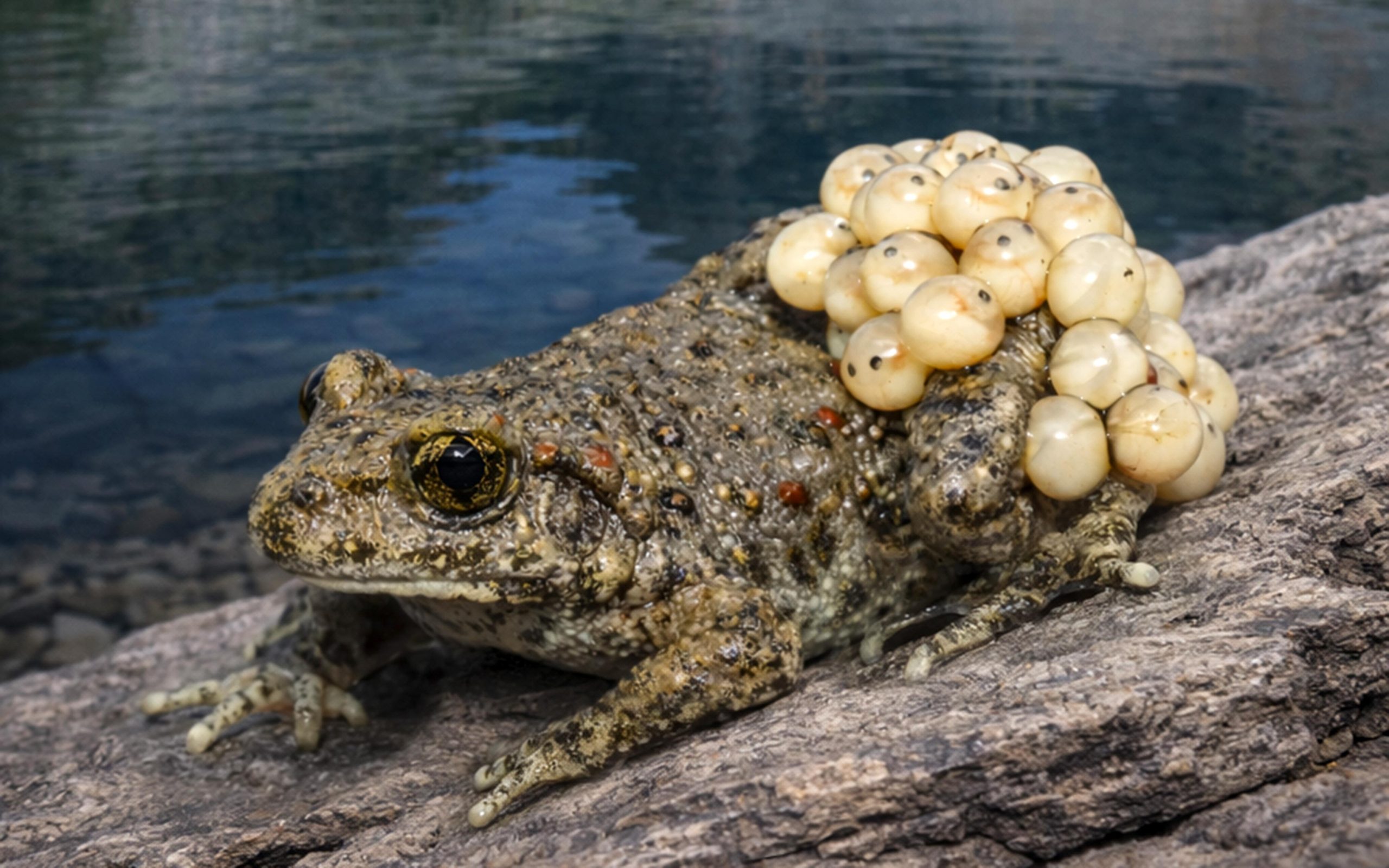
Earlier development of diverse antimicrobial peptides may help some toad populations survive devastating chytrid fungus outbreaks.
A deadly fungus has devastated frog and toad populations around the world, yet some groups eventually begin to recover even while the pathogen remains. Researchers led by University College London (UCL), ZSL, and Imperial College London have now identified a key difference that may explain why: the timing of the animals’ immune defenses.
The chytrid fungus, Batrachochytrium dendrobatidis (Bd), is a major driver of severe amphibian declines worldwide. Deaths often surge as animals leave the tadpole or larval stage and develop the tougher skin that the fungus can infect.
Published in Nature Chemical Biology, the research focused on common midwife toads around four lakes in the Pyrenees of France and Spain where Bd had severely reduced populations.
At one lake, large numbers of toads were still dying and the population was close to extinction. At the other three, populations had rebounded even though Bd remained present and continued causing some deaths.
Earlier immune defenses tracked recovery
The researchers focused on antimicrobial peptides, short chains of amino acids secreted from the skin that form an important part of the toads’ immune defense.
In populations that had recovered from Bd outbreaks, these defenses were much more likely to mature while the animals were still tadpoles. That earlier development meant the toads entered adulthood with greater protection already in place.
Lead author Dr Phillip Jervis, of UCL Chemistry, ZSL Institute of Zoology and Imperial College London, said: “Our study shows species that have declined heavily from this disease can still recover. They have the tools to fight off infection – it just depends on timing. The disease kills toads and frogs as they turn from tadpoles to adults. Getting mature immunity at the tadpole stage helps these toads survive and the population to continue.”

Bd causes chytridiomycosis, a disease that damages amphibian skin and disrupts the animals’ ability to regulate water, salts, and minerals.
The fungus feeds on skin containing keratin. Tadpoles and larvae lack this keratinized skin, so they become especially vulnerable only after metamorphosis into adults.
Dr Jervis said: “The next step is to look at what factors prevent these immune systems from maturing early. This could be down to genetics or environmental factors such as temperature or the presence of trout – a major danger for tadpoles that could drive them to develop into adults faster so they can leave the water, meaning less time for their immune system to develop.”
Toads carried far more peptides than expected
To examine the toads’ chemical defenses in detail, the researchers used mass spectrometry to analyze the mixture of peptides (short chains of amino acids) released from their skin. The results revealed a much larger collection of compounds than anticipated.
The researchers identified 1,152 peptides, only seven of which had been known previously.
Populations whose tadpoles secreted a greater variety of peptides, meaning their defenses had matured before adulthood, were thriving despite Bd outbreaks. By contrast, populations whose tadpoles produced relatively few peptides were still experiencing high mortality.
The peptides could have wider value
Senior author Professor Alethea Tabor (UCL Chemistry) said: “We discovered a far greater diversity of peptides than we expected. We now need to understand how they work to control pathogens and which ones are anti-microbial.
“A lot of medicines for humans were initially found in the natural world – penicillin came from fungi, for example. So these peptides are new leads that could be used to help human health, especially as we have our own problems as a species with the rise of antimicrobial resistance, which is requiring us to find new ways to treat infections.”
Mass spectrometry allows scientists to measure molecular masses with very high precision. For this study, researchers at UCL Chemistry used tandem mass spectrometry, breaking peptides into fragments and measuring the mass of those pieces to determine the overall structures of the molecules. Using this approach, they identified and sequenced a large number of peptides in the samples.
Co-author Dr Kersti Karu (UCL Chemistry) said: “The ability to analyze hundreds to thousands of molecules in parallel has only emerged over the past decade. This approach is more commonly applied in human health research, for example to distinguish cancer cells from normal tissue, but is increasingly being extended to other areas of biological investigation.”
Reference: “Early maturation of host antimicrobial peptide defences is associated with host–pathogen coexistence” by Phillip A. Jervis, Gonçalo M. Rosa, Kieran A. Bates, Kersti Karu, Aamina Murtza, Thomas Defuentes, David Firer, Sam Edwards, Kevin Hopkins, François Le Mauff, Christopher J. Michaels, Tresai Jordine-Morgan, Christina Nylander, Christopher Sergeant, Emily J. Skelly, Tam T. Bui, Donald Sheppard, Xavier A. Harrison, Johanna Rhodes, Benjamin Tapley, Jaime Bosch, Trenton W. J. Garner, Matthew C. Fisher and Alethea B. Tabor, 15 July 2026, Nature Chemical Biology.
DOI: 10.1038/s41589-026-02254-6
The research received funding from the UK’s Natural Environment Research Council (NERC) and Leverhulme Trust.
Never miss a breakthrough: Join the SciTechDaily newsletter.
Follow us on Google and Google News.