

The longer we stay awake, the more certain brain cells appear to turn up the pressure to sleep, eventually making rest nearly impossible to resist.
Sleep drive is the biological pressure to rest that builds during waking hours, making it increasingly difficult to stay alert. After prolonged wakefulness, it typically produces longer, deeper recovery sleep, yet scientists have struggled to explain how the nervous system tracks time awake and converts it into an escalating need for rest.
Researchers led by Professor Alex Schier at the Biozentrum, University of Basel, have now identified two groups of brainstem neurons that appear central to this process. The work was conducted with scientists from Beth Israel Deaconess Medical Center and Auburn University.
“We have identified neuronal populations that monitor prolonged wakefulness and actively promote sleep,” says Schier. “This is an important missing piece of the puzzle in understanding why we become sleepy.”
Neurons That Track Time Awake
The researchers mapped brain activity in mice during normal periods of sleep and wakefulness, forced sleep deprivation, and recovery sleep. Their analysis highlighted brain regions whose activity changed according to how long the animals had been awake.
Within one of these regions, the team identified two important neuronal populations: GABAergic neurons and serotonergic neurons. GABA and serotonin are chemical messengers with broad roles in brain function, but these particular cells appear to contribute to the buildup of sleep pressure.
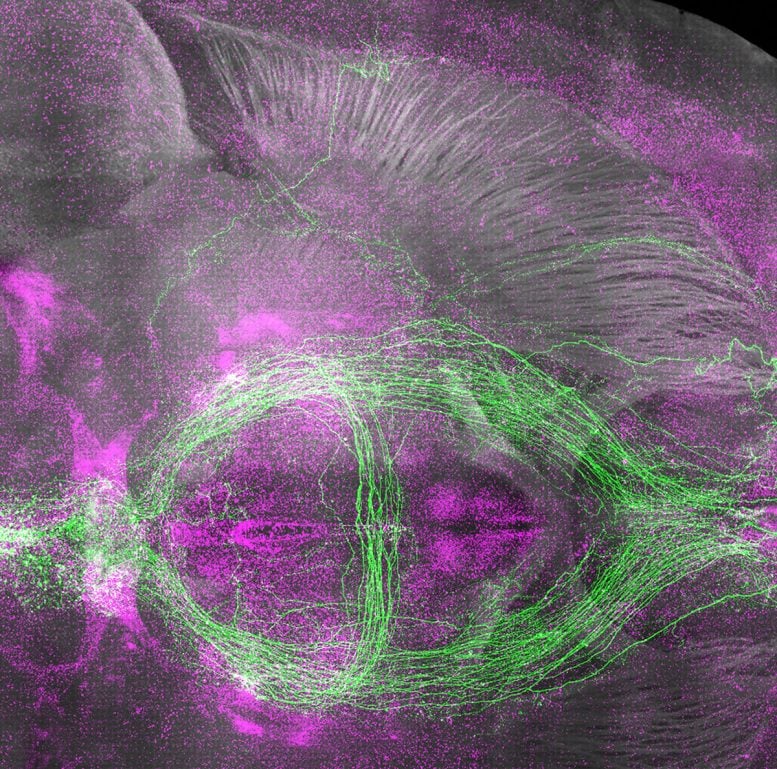
Both groups became increasingly active as wakefulness continued. Their activity then declined after sleep began, suggesting that the neurons were responding to an accumulating biological need rather than simply marking whether the animals were awake or asleep.
Turning Sleep Pressure Up or Down
To determine whether the neurons merely tracked wakefulness or actually caused sleep, the researchers experimentally altered their activity. Activating both populations made the mice sleep longer and more deeply, producing a pattern similar to the recovery sleep that normally follows extended wakefulness.
Inhibiting the same neurons had the opposite effect. The mice slept far less and remained alert, showing that the cells do more than record time awake. They actively help transform prolonged wakefulness into an urge to sleep.
“These neurons do not simply signal that an animal has been awake,” says Schier. “Our experiments show that they are crucial to promote sleep and that they may be key components of the neural circuitry that generates sleep drive.”
The results provide unusually direct evidence that neurons active during wakefulness can generate sleep pressure. It separates the brain systems that create the need for sleep from those that merely detect or respond to it.
Mice Slept 70% Less
The most striking result emerged when both neuronal populations were inhibited over an extended period. The mice slept approximately 70% less than usual, yet most did not display some of the severe behavioral problems normally associated with sleep deprivation.
That unexpected response suggests that sleep duration and sleep need may be more separable than previously assumed. The neurons appear to influence not only how long an animal sleeps but also how strongly the pressure to sleep accumulates.
“Future studies could reveal how these neurons interact with the rest of the brain and how sleep drive is generated at the molecular level,” says Dr. William Joo, first author of the study. “Our ability to stably transform sleep behavior also allows us to explore adaptations to long-term sleep loss—this may eventually reveal ways to confer resilience to sleep deprivation and other physiological challenges.”
Why the Sleep Circuit Matters
In summary, the findings identify brainstem GABAergic and serotonergic neurons as active drivers of sleep pressure in mice. They become more active during prolonged wakefulness and help initiate the compensatory sleep that follows.
Understanding how the brain makes sleep feel unavoidable could eventually improve research into sleep disorders, chronic sleep loss, and the ways organisms adapt to physiological stress.
Reference: “Wake-activated neuronal populations that regulate sleep drive” by William Joo, Clare Diester, Vassilis Bitsikas, Myrto Panopoulou, Amelia Hidalgo, Konstantinos Ntemos, Rodrigo C. G. Pena, Fabia Imhof, Iris Odstrcil, Flavio Donato, Geoffrey Fucile, Daniel Kroeger, Thomas E. Scammell and Alexander F. Schier, 19 August 2026, Nature.
DOI: 10.1038/s41586-026-10928-3
Never miss a breakthrough: Join the SciTechDaily newsletter.
Follow us on Google and Google News.
2 Comments
It’ll be a big mistake to alter this requirement as the whole ecosystem would be thrown out of balance.
A simple example is if a cat sleeps less they’ll kill more and probably kill every bird on earth ☢️
How to sleep longer.what helps GABA to improve sleep