
Close Menu
    Facebook X (Twitter) Instagram
    SciTechDaily
    • Biology
    • Chemistry
    • Earth
    • Health
    • Physics
    • Science
    • Space
    • Technology
    Facebook X (Twitter) Pinterest YouTube RSS
    SciTechDaily
    Home»Biology»Scientists Uncover Brain Mechanism That May Explain Why Sleep Helps You Learn
    Biology

    Scientists Uncover Brain Mechanism That May Explain Why Sleep Helps You Learn

    By Society for NeuroscienceJuly 27, 2020No Comments2 Mins Read
    Facebook Twitter Pinterest Telegram LinkedIn WhatsApp Email Reddit
    Share
    Facebook Twitter LinkedIn Pinterest Telegram Email Reddit
    Perineuronal Net Mouse Brain
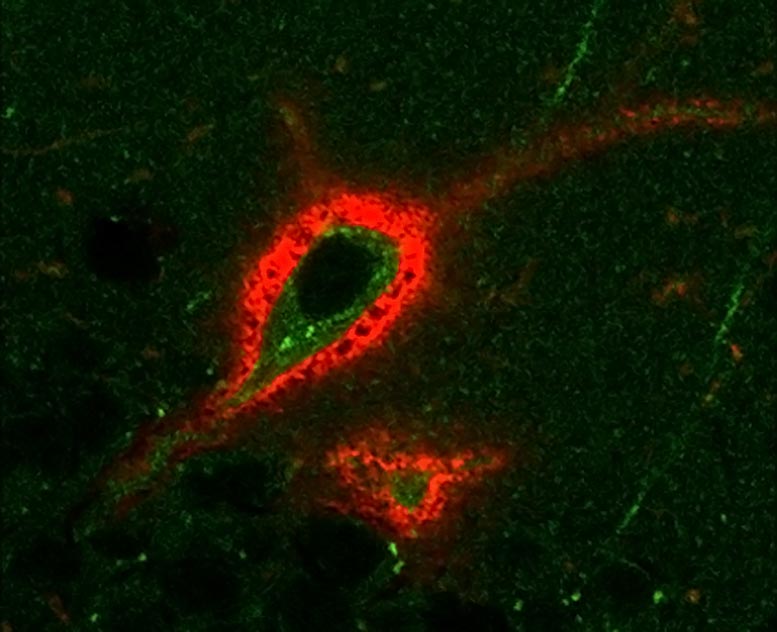
    A perineuronal net (red) in the mouse brain, surrounding a neuron expressing Arc (green), a protein involved in memory processing. The holes in the perineuronal net may represent sites of memory storage that are regulated during sleep. Credit: Pantazopoulos et al., eNeuro 2020

    Changes in Brain Cartilage May Explain Why Sleep Helps You Learn

    Scientists uncover a potential mechanism behind sleep-induced memory changes.

    The morphing structure of the brain’s “cartilage cells” may regulate how memories change while you snooze, according to new research in eNeuro.

    Sleep lets the body rest, but not the brain. During sleep, the brain accounts for a day of learning by making strong memories stronger and weak memories weaker, a process known as memory consolidation. But changing memories requires changing synapses, the connections between neurons. Sleep-induced changes need to overcome perineuronal nets, cartilage-like sheaths that not only surround and protect neurons, but also prevent changes in synapses.

    Pantazopoulos et al. investigated how perineuronal nets varied during sleep in mice. By documenting whether or not they could tag the nets with a protein that binds to a specific sugar chain, they could observe the changes in synapses. A decrease in the number of tagged nets would indicate an increase in the number of neurons allowing synaptic changes.

    Tagging increased during wakefulness and decreased during sleep. Sleep deprivation prevented this change. The levels of a net-altering enzyme expressed by brain immune cells cycled in opposition, hinting that it may be responsible for the change. The research team also compared levels of tagged nets in human brain tissue with the donor’s time of death. Human brains displayed similar sleep-centric rhythms in net structure. Altering the structure of perineuronal nets may be one of the mechanisms behind sleep-induced memory changes.

    Reference: “Circadian Rhythms of Perineuronal Net Composition” by Harry Pantazopoulos, Barbara Gisabella, Lindsay Rexrode, David Benefield, Emrah Yildiz, Phoebe Seltzer, Jake Valeri, Gabriele Chelini, Anna Reich, Magdalena Ardelt and Sabina Berretta, 27 July 2020, eNeuro.
    DOI: 10.1523/ENEURO.0034-19.2020

    Never miss a breakthrough: Join the SciTechDaily newsletter.
    Follow us on Google and Google News.

    Brain Neuroscience Sleep Science Society for Neuroscience
    Share. Facebook Twitter Pinterest LinkedIn Email Reddit

    Related Articles

    Feeling Disconnected? Loneliness Alters Your Brain’s Social Network

    A Child’s Unique Brain Activity Reveals Their Memory Ability

    Unlocking the Neuroscience of How Experiencing Traumatic Stress Leads to Aggression

    Researchers Discover How Stress Restructures the Brain

    Brain Waves of Sleeping Sheep Maaay Offer Clues to Human Brain Disease

    Healthy Sleep Linked to Earthquake-Like Brain-Wave Bursts of Intrinsic Arousal Activations

    Functional Magnetic Resonance Imaging Shows How the Brain Repurposes Unused Regions

    Intense Brain Activity Drives Need for Sleep, Not Just How Long You’ve Been Awake

    Traumatic Memories Manipulated in Sleeping Mice

    Leave A Reply Cancel Reply

    • Facebook
    • Twitter
    • Pinterest
    • YouTube

    Don't Miss a Discovery

    Subscribe for the Latest in Science & Tech!

    Trending News

    Largest-Ever Study Finds Medicinal Cannabis Ineffective for Anxiety, Depression, PTSD

    250-Million-Year-Old Egg Solves One of Evolution’s Biggest Mysteries

    Living With Roommates Might Be Changing Your Gut Microbiome Without You Knowing

    Century-Old Cleaning Chemical Linked to 500% Increased Risk of Parkinson’s Disease

    What if Your Memories Never Happened? Physicists Take a New Look at the Boltzmann Brain Paradox

    One of the Universe’s Largest Stars May Be Getting Ready To Explode

    Scientists Discover Enzyme That Could Supercharge Ozempic-Like Weight Loss Drugs

    Popular Sweetener Linked to DNA Damage – “It’s Something You Should Not Be Eating”

    Follow SciTechDaily
    • Facebook
    • Twitter
    • YouTube
    • Pinterest
    • Newsletter
    • RSS
    SciTech News
    • Biology News
    • Chemistry News
    • Earth News
    • Health News
    • Physics News
    • Science News
    • Space News
    • Technology News
    Recent Posts
    • Challenging the Narrative: New Study Shows U.S. Life Expectancy Is Rising Across All States
    • Mystery Illness Kills 5 in Burundi As Doctors Scramble for Answers
    • Bone-Strengthening Discovery Could Reverse Osteoporosis
    • The Most Elusive Number in Physics Just Got Even More Mysterious
    • Scientists Uncover Hidden Trigger Behind Stem Cell Aging
    Copyright © 1998 - 2026 SciTechDaily. All Rights Reserved.
    • Science News
    • About
    • Contact
    • Editorial Board
    • Privacy Policy
    • Terms of Use

    Type above and press Enter to search. Press Esc to cancel.