
A tropical warming event helped drive record snowfall and a temporary 695-billion-ton ice gain in East Antarctica without reversing long-term Antarctic ice loss.
Between 2021 and 2023, the Antarctic Ice Sheet gained about 695 billion tons of mass, the largest increase recorded by the GRACE satellites. New research traces much of that unusual gain to sustained warming thousands of miles away in the tropical western Pacific and eastern Indian Ocean, which altered atmospheric circulation and sent more moisture toward East Antarctica.
The finding stands out against Antarctica’s longer trend. Over the past two decades, the ice sheet has lost mass at an average rate of about 140.5 billion tons per year, making its future contribution to global sea-level rise a major source of uncertainty. The temporary gain did not reverse that decline, but it revealed how conditions in the tropics can influence Antarctic snowfall over several years.
The study was published in Nature.
Researchers led by the Institute of Oceanology of the Chinese Academy of Sciences (IOCAS) combined gravity-satellite observations, ice-core snow-accumulation records, water-vapor tracking, and atmospheric circulation simulations to investigate what caused the 2021–23 event.
Tropical warming redirected moisture south
During those years, the tropical warm pool where the western Pacific meets the eastern Indian Ocean remained unusually warm. According to the study, that sustained warming triggered a Rossby wave train that propagated toward high southern latitudes and reshaped atmospheric circulation over East Antarctica.
Eddy-mean flow feedbacks strengthened and maintained the pattern, producing a north–south dipole with low-pressure anomalies south of Australia and high-pressure anomalies along the East Antarctic coast. The resulting circulation redirected moisture from the midlatitude Indian Ocean toward Antarctica and increased the number of atmospheric rivers reaching the continent.
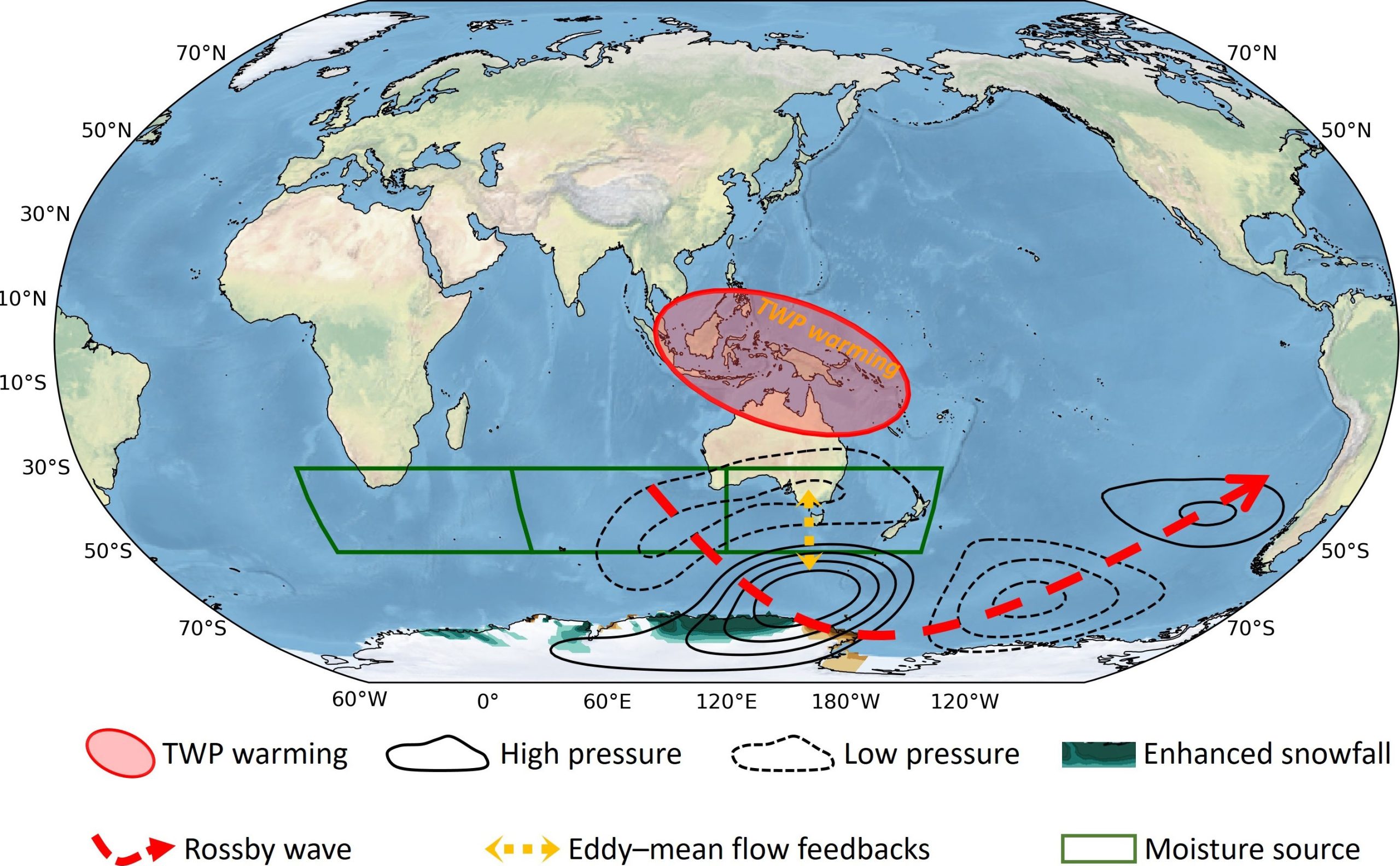
Water-vapor tracking simulations showed that this influx of moist air produced persistent heavy snowfall across the Queen Mary Land–Wilkes Land region, adding mass to the ice sheet.
Atmospheric circulation experiments identified the tropical warm pool as the direct driver of the circulation and snowfall response. By comparison, the increase in regional snowfall attributed to anthropogenic forcing amounted to only 9% of the observed snowfall anomaly, indicating that atmospheric moistening associated with global warming was not the primary cause of the event.
The researchers also found that similar periods of sustained tropical warm-pool warming occur roughly once a decade. This recurring connection suggests that conditions in the tropical ocean can influence multiyear changes in snowfall and ice mass across East Antarctica.
The ice gain does not reverse losses
Despite the temporary increase, Antarctica remains on a long-term trajectory of ice-sheet mass loss. The West Antarctic Ice Sheet continues to lose ice, while some outlet glaciers in East Antarctica face basal melting of their ice shelves and faster ice flow driven by warm ocean waters.
The study identifies the north–south dipole circulation over East Antarctica as a key link between tropical warming and changes in Antarctic ice mass, providing a mechanism for how distant ocean conditions can alter snowfall across the continent.
“We found a previously underrecognized ‘tropical warm pool–East Antarctic Ice Sheet’ teleconnection pathway,” said Yunhe Wang from IOCAS, first author of the study. “Our research provides a theoretical basis for understanding Antarctic ice-sheet mass changes and conducting future research on the East Antarctic climate.”
Reference: “Multiyear tropical warm pool warming drives slowdown in Antarctic mass loss” by Yunhe Wang, Qinghua Ding, Xiaofeng Li, Thomas J. Ballinger, Yoshihiro Nakayama, Dániel Topál and Eric J. Steig, 19 August 2026, Nature.
DOI: 10.1038/s41586-026-10912-x
Never miss a breakthrough: Join the SciTechDaily newsletter.
Follow us on Google and Google News.
84 Comments
Isn’t everything on Earth “temporary?”
So gaining 850 billion cubic feet of ice is not a reversal??? If I was losing 15 pounds a year for many years and the I gain 85 pounds in 2 years that is not a reversal of my weight loss.
You are correct that a reversal means an increase in the trend over several years. However, the question should be, “What is an appropriate length of time for characterizing the behavior of a glacier?” Two years for any geological process is probably not appropriate.
Also, on the by-the-by wonderment from a passerby, What ice tonnage was gained in the Northern Hemisphere Arctic Winter in January, 2026?
Cause it snowed on the east not on the west, the warm waters on the west are still taking ice from the shore. So one side gains ice the other side still loses ice.
Unless you only gained weight in your left thigh, you would be correct. Antarctica apparently only has more ice in one corner, while having lost ice everywhere else. In your case, it would be an indication of a massive problem in your left thigh, not a reason to stop worrying about weight loss.
“Antarctica apparently only has more ice in one corner, …”
It is NOT just one corner! West Antarctica is roughly half the continent, probably the majority.
Above, I should have said, “… probably the minority.”
You might want to read the Nature article here: https://www.nature.com/articles/s43247-026-03242-3 While you are there, take a look at the map of Antarctica; West Antarctica is on the left.
“Despite the temporary increase, Antarctica remains on a long-term trajectory of ice-sheet mass loss.”
Yes, the combined, or average trajectory for Antarctica does seem to be downward. However, I think the question should be asked, “Why is is that two contiguous, conjoined land masses that rotate around the same pole every 24 hours have different meteorological behaviors?” Clearly, West Antarctica is experiencing a net loss, while East Antarctica is static or even increasing slightly. It is difficult to certain about the long-term behavior when the annual change is very small. A one-millimeter annual increase would be difficult, if not impossible, to measure reliably over even a couple of years, but if it continued for 1 million years, it would amount to 1,000 kilometers of snow! I think that researchers should be looking at other explanations such as the relatively recent discovery of sub-glacier volcanoes and associated geothermal fields.
It is convenient to call two adjacent land masses by one name, but that doesn’t necessarily mean that they are geologically similar. Naming convenience shouldn’t take precedence over obvious differences.
The above “1,000 kilometers” should of course be 1,000 meters — still a substantial increase of more than a half-mile of ice.
Use your words and stop getting answers from ai like the writer of this article clearly did.
Idiot.
Hmm so if floating ice is already displacing the ocean water and it floats because it’s full of air bubbles so when it melts and evaporated how is water levels going to rise. My thoughts are the reclaimed land to build houses and ports on pushing warmer levels up plus erosion and waste washi6into oceans daily that setting in the oceans will increase the Volume and make water levels rise.
There are two kinds of floating ice. sea ice and ice shelves. An ice shelf is an extension of a glacier out over the water. It does sit on solid sea bed near the shore though, at what’s called the grounding line, the last place it sits on sea bed. . Ice shelves hold bad glaciers from advancing into the sea. The Manhattan size berg that just broke away was part of an ice shelf.
Floating ice doesn’t affect sea level.
“Ice shelves hold bad [sic] glaciers from advancing into the sea.”
Which experiences more friction, grounded ice or floating ice? If floating ice has so little friction that it can be blown around by the wind, how can floating ice provide substantial resistance to an advancing glacier? You have just repeated a common ‘urban legend’ for which I have not seen a compelling supporting argument.
Fill a glass half full of water and then top it off with ice. The glass will never overflow as the ice melts. Follow the TRUE science.
Sure, a glass half full of water topped off with ice won’t overflow. But in this case we are adding additional water to your glass — from the melting of ice formed on bedrock in Antartica and Greenland. This melt water was never in the ocean before, so of course it is adding to the total volume.
That’s a poor analogy because land ice does not float on or displace sea water. It simply adds to it when it melts and flows. So as Greenland melts, and non-sea ice melts, the ocean does in fact rise.
Ice does not float because it’s full of air bubbles. Ice floats because frozen water is lighter than liquid water. That’s because water molecules form crystals that take up more space than water does. There are a fair number of chemicals that use up more space when they change from liquid to solid, but it’s really fairly unusual. It’s much more common for solids to be heavier , and liquids tend to get heavier as they get colder. That’s one of the special things about water.
“Why is is that two contiguous, conjoined land masses that rotate around the same pole every 24 hours have different meteorological behaviors?” -Clyde
This shouldn’t even need to be asked. East Antarctica is large, thick and shield-shaped, with an average elevation (including ice) of 3000 meters. Much of its relatively smooth perimeter traces the Antarctic circle, which gets at least a little sunlight every day, and it doesn’t have a lot of large ice shelves. Its placement relative to the South Pole is very asymmetric, with the pole sitting less than 300 km from the Transantarctic Mountains that separate East from West Antarctica. West Antarctica couldn’t be more different. It is low elevation, long and skinny, with much of it tucked far away from the Antarctic circle, thus allowing for a lot of ocean water to get much closer to the South Pole, but also featuring a number of large ice shelves. It does have one large peninsula stretching towards the southern end of South America, thus constricting the Antarctic Circumpolar Current when passing through the Drake Passage. East Antarctica does not have any close neighbors.
So the short answer is “It’s not even close to being axisymmetric.”
Like all dynamic and complex systems the earth’s climatic systems will tend towards new equilibrium states over time in response to stresses.
Tell us climate change is a hoax without telling us its a hoax…
It’s a hoax the way the politics of this world is saying it but yes the planet is warming but only because earth is coming out of an ICE age therefore gaining heat at a rate that is commensurate with that event and nothing that we do is going to reverse that
This earth needs a minimum of 440ppm of CO2 to 880ppm as it was in the time of tge dinosaurs if we go done to 220ppm as the “green people” want us to then this planet starts to die as at 180ppm trees can no longer produce Oxyhen which funnily enough we need to breath
“because earth is coming out of an ICE age”
FALSE
The warming that ended the last ice age stopped 9,000-8,000 years ago at the Holocene Thermal Optimum. Then global temperature stabilized for about 2,000 years, before a slow gradual cooling began 6,000-5,500 years ago. That cooling continued right up to into the 1800s.
In 146 years, we have increased global avg. temperature more than TWICE the amount of the cooling over those ~6,000 years.
—————–
“This earth needs a minimum of 440ppm of CO2 to 880ppm as it was in the time of the dinosaurs”
Also FALSE – A denier SLOGAN, NOT SCIENCE
Over the 800,000 years prior to the mid 20th century, global avg. temperature was NEVER over 300pp. The range was 170-300ppm.
And we are liikely increasing CO2 at the fastest rate in Earth’s history.
During the reign of Dinosaurs the word was far too hot for humans or any large mammals to evolve or exist.
Nature caused CO2 increases over the last 450,000 years, from ice core data
80ppm increase — took 50,000 years
110ppm increase — 25,000 years
120ppm increase — 20,000 years
60ppm increase — 20,000 years
90ppm increase — 15,000 years
100ppm increase — 24,800 years
the fastest natural CO2 increase above was 90ppm taking 15,000 years.
WE have done that in about the last 65 years.
————————————————
Humans increased CO2 by 25ppm in the last 10 years
Humans increased CO2 by 45ppm in the last 20 years.
Humans increased CO2 by over 80ppm in the last 60 years
Humans increased CO2 by 100ppm in the last 70 years
Humans increased CO2 by 146ppm in the last 144 years
———
The numbers for 800,000 years would be similar, based on a graph, from ice core data going back that far.
————————————————————-
“As the Earth moved out of ice ages over the past million years, the global temperature rose a total of 4 to 7 degrees Celsius over about 5,000 years.
In the past century alone, the temperature has climbed 0.7 degrees Celsius, roughly TEN TIMES FASTER than the average rate of ice-age-recovery warming.”
NASA Earth Observatory
—————————
That is from 2010. The warming since 1880 is now about double the 0.7C warming NASA was referring to. about 1.4C warming now
——————————-
THIS IS WHY – (CO2 greenhouse effect has been known for 170 years)
“The maximum rate of change in CO2 concentrations from the ice core records is around 100 ppm in 10,000 years, or around 1 ppm per century.
The current rate of change in CO2 concentrations is 1 ppm every 21 weeks.”
NASA Climate Change
—————-
That comes to 236 times faster CO2 increase Now.
—————————————–
“As the Earth moved out of ice ages over the past million years, the global temperature rose a total of 4 to 7 degrees Celsius over about 5,000 years.
In the past century alone, the temperature has climbed 0.7 degrees Celsius, roughly TEN TIMES FASTER than the average rate of ice-age-recovery warming.”
NASA Earth Observatory
—————————
That is from 2010. The warming since 1880 is now about double the 0.7C warming NASA was referring to. about 1.4C warming now
——————————————————————————
And this is why. CO2’s green house effect has been known since 1856.
——-
“The maximum rate of change in CO2 concentrations from the ice core records is around 100 ppm in 10,000 years, or around 1 ppm per century.
The current rate of change in CO2 concentrations is 1 ppm every 21 weeks.”
NASA Climate Change
—————-
That comes to 236 times faster CO2 increase Now.
————————————————————————–
During the 800,000 years I mentioned, about 5 ice ages came and went.
The last time CO2 was 400ppm was during the Pliocene, 2.6-5 million years ago. The world was about 4C warmer and sea levels higher than now.
You might want to study SCIENCE, because nothing you said is science.
You advised Gary Miller, “You might want to study SCIENCE, because nothing you said is science.”
You might want to take that advice to heart for yourself. What I see coming from you are false claims cut and pasted from alarmist sites. When I last corrected you, you didn’t reply. I take that as meaning that you didn’t have a rebuttal.
“The warming that ended the last ice age stopped 9,000-8,000 years ago at the Holocene Thermal Optimum. Then global temperature stabilized for about 2,000 years, before a slow gradual cooling began 6,000-5,500 years ago. That cooling continued right up to into the 1800s.”
Not everyone agrees with the simplistic summary of Marcott et al. (2013)
https://c14750.wpmucdn.com/1810/files/2018/12/All_palaeotemps.png
“During the reign of Dinosaurs the word was far too hot for humans or any large mammals to evolve or exist.”
During the Paleocene and Eocene, the world was warmer than during the Cretaceous. Yet, the Eocene is known for the rapid evolution of mammals, including significant increase in size, and particularly for the first primates (humans had not yet evolved). Again, see https://c14750.wpmucdn.com/1810/files/2018/12/All_palaeotemps.png
The magnetic South Pole is moving East at about 15 miles per year. Eaztern ice is thickening and weztern ocean ice is thinning. Australia had to get a buge 25,500 tonne ice breaker to service our Stations of Casey Davis and Mawson. The magnetic South pole is near 24degrees East and will soon stop then slowly move west. The North pole will also reverse directin. Climat change is theSCAM of this century. PS I have spent 17 months at Casey and 20 months at Mawson.
Nature caused CO2 increases over the last 450,000 years, from ice core data
80ppm increase — took 50,000 years
110ppm increase — 25,000 years
120ppm increase — 20,000 years
60ppm increase — 20,000 years
90ppm increase — 15,000 years
100ppm increase — 24,800 years
the fastest natural CO2 increase above was 90ppm taking 15,000 years.
WE have done that in about the last 65 years.
————————————————
Humans increased CO2 by 25ppm in the last 10 years
Humans increased CO2 by 45ppm in the last 20 years.
Humans increased CO2 by over 80ppm in the last 60 years
Humans increased CO2 by 100ppm in the last 70 years
Humans increased CO2 by 146ppm in the last 144 years
———
The numbers for 800,000 years would be similar, based on a graph, from ice core data going back that far.
————————————————————-
“As the Earth moved out of ice ages over the past million years, the global temperature rose a total of 4 to 7 degrees Celsius over about 5,000 years.
In the past century alone, the temperature has climbed 0.7 degrees Celsius, roughly TEN TIMES FASTER than the average rate of ice-age-recovery warming.”
NASA Earth Observatory
—————————
That is from 2010. The warming since 1880 is now about double the 0.7C warming NASA was referring to. about 1.4C warming now
——————————-
THIS IS WHY – (CO2 greenhouse effect has been known for 170 years)
“The maximum rate of change in CO2 concentrations from the ice core records is around 100 ppm in 10,000 years, or around 1 ppm per century.
The current rate of change in CO2 concentrations is 1 ppm every 21 weeks.”
NASA Climate Change
—————-
That comes to 236 times faster CO2 increase Now.
—————————————–
“That comes to 236 times faster CO2 increase Now.”
You are implying that only humans have or can cause rapid increases in CO2. How do you explain the PETM spike?
Lastly, your a breaking a cardinal rule of science by directly comparing present instrumental temperatures with estimated proxy temperatures. One of the problems confronting such work is that time tends to act as a low-pass filter. Radiogenic age dating typically has a fixed percentage error; the farther one goes back in time the larger the absolute time error. Isotopic proxies for things like temperatures are subject to perturbation by bottom-dwelling organisms, diffusion through sediments, and the fact that few if any proxies have a perfect correlation with measurements they are substituting for. All of those issues tend to suppress the amplitude and width of peaks in time-series.
Your list above suggests that you think than CO2 is constant on the globe with the seasons and latitude, neither of which are true, and that estimates from plant stomata are as reliable as ice cores. Nowhere do you list 1 or 2-sigma uncertainties for the nominal estimates you are throwing out. You are a science debutante that obviously doesn’t have an in-depth understanding of science.
No, it’s warming primarily because of greenhouse gas emissions. We know this for many independent lines of evidence. It is not difficult to learn about them.
“No, it’s warming primarily because of greenhouse gas emissions.”
That is what Mercer would have us believe. However, he, like you, doesn’t present any compelling evidence for the claim. Just asserting that something is so, doesn’t make it so. Mercer presents evidence for a correlation between rising CO2 and rising temperatures. However, it is well known that while causation results in a correlation, it alone doesn’t establish which variable is responsible for the causation. You and he have a simplistic understanding of how things work.
The best argument presented for causation is based on the difference in isotopic ratios of carbon in volcanic gases and in the atmosphere. Unfortunately, the relationship, based on the assumption that fossil fuel burning is changing the ratio, is not well supported because every time a carbon molecule changes phase or partakes of a chemical reaction, the lighter isotope is commonly favored because it takes less energy for a 12C carbon dioxide molecule to escape than for a 13C molecule. The isotopic fractionation coefficient has to be known for all the possible phase changes and chemical reactions to model that. To the best of my knowledge, the studies and modeling haven’t been done. Please feel to educate me if that isn’t the case. You imply that you have learned about such things. It shouldn’t be difficult for you to point out the study(s).
That’s not the point. Read more carefully!
Does Trump get credit for this?
” Our study gives us a theoretical basis”
OR NOT
Climate scientists know 10,000 times what you think they know and a million times what you know.
“climate scientists” are a farce of grifters
That is obviously hyperbole that you would like to believe is true. However, you present no studies to support the claim.
So…”CLIMATE CHANGE!!!!” creates more ice?
I thought Polar Bears and penguins were dying?
Al Gore will NOT like this…
So, you didn’t read the article, or didn’t understand a word of it.
Al Gore has NOTHING to do with the science. The approximately 100,000 peer reviewed studies do up to now do.
ONLY people who know less than nothing about the science keep bringing up Al Gore.
And Al Gore got it mostly right.
NOTHING from the massive PR machine of disinformation the fossil fuels industry funds is right.
I hope a cow don’t fart!!
“NOTHING from the massive PR machine of disinformation the fossil fuels industry funds is right.”
Another Urban Legend being propagated like juicy gossip. I have asked Copilot to provide specifics on when, how much was paid to whom, and by whom, and Copilot said that there is no public record of the claim(s). If you were to make a similar claim about an individual citizen, you would find yourself the subject of a libel suit. You should exercise more caution in your accusations.
Can you produce one demonstrably true thing the fossil industry has said that would prove that they never tell lies or bend the truth?
Nice try! It is the person making a claim that has the responsibility for proving it. Carl Sagan famously said, “Extraordinary claims require extraordinary proof.”
If a woman charged a man with rape, and the man’s defense attorney used as defense “Can you produce one demonstrably true thing the — woman — has said that would prove that they never tell lies or bend the truth?”, do you think that would fly in court? Besides, it is illogical. A person may be truthful their whole life and suddenly decide to lie about something. One never knows when that one-time event will take place.
No, an unusual weather pattern 2 years in a row dropped a whole bunch of snow on one corner of a continent. It’s interesting, and it would be good to figure out why that happened, but it proves nothing. My neighbor got 5 more inches of rain than I did. Do you know why?
It can be attributed to a probability distribution. It is rare that it is raining on one side of a street and not the other. There may be a diminution in intensity as one moves away from the center of a storm; however, it is rare that there is an abrupt change with absolutely no rain on one side of a line while it is pouring on the other side!
The climate has never stop changing and never will, with or without humans…
And if governments really did care about the climate, they stop deforestation. And stop creating more and more concrete jungles.
Climate always changes is a denier SLOGAN, NOT SCIENCE
Warming TEN TIMES as fast as the warming that ends ice ages is NOT NORMAL and and NOT NATURAL.
——————————-
“As the Earth moved out of ice ages over the past million years, the global temperature rose a total of 4 to 7 degrees Celsius over about 5,000 years.
In the past century alone, the temperature has climbed 0.7 degrees Celsius, roughly TEN TIMES FASTER than the average rate of ice-age-recovery warming.”
NASA Earth Observatory
—————————
That is from 2010. The warming since 1880 is now about double the 0.7C warming NASA was referring to. about 1.4C warming now
————————————————————————————————-
And THIS is the Cause
“The maximum rate of change in CO2 concentrations from the ice core records is around 100 ppm in 10,000 years, or around 1 ppm per century.
The current rate of change in CO2 concentrations is 1 ppm every 21 weeks.”
NASA Climate Change
——————————————————————–
That comes to 236 times faster CO2 increase Now.
and the Earth is 30% greener now according to NASA
“The maximum rate of change in CO2 concentrations from the ice core records is around 100 ppm in 10,000 years, or around 1 ppm per century.”
That is the result of the low-pass filter effect effect of time. It is not uncommon for the top meter of snow to melt in the Summer time, releasing some of the trapped CO2.
“The current rate of change in CO2 concentrations is 1 ppm every 21 weeks.”
That number is about right for the Mauna Loa Observatory, but is not right for the globe because the rate of increase is lower for southern hemisphere latitudes.
https://wattsupwiththat.com/wp-content/uploads/2023/12/iu1-1701486314.2372.jpg
Incidentally, several governments are attempting to reduce deforestation. The USA may be trying to increase harvests in the national forests, but many places are working on restoring habitats to more appropriate conditions. That does include working to reduce the number of eucalyptus trees in places they don’t belong so other, native plants that don’t guzzle water can thrive. It’s important to understand the situation in each case, rather than decide that more trees or fewer trees is the solution. In parts of Africa, non native eucalyptus trees were growing in such profusion that the rivers were drying up, creating serious hardship for millions downstream. Don’t worry, there will always be eucalyptus trees in Africa. It would take centuries to get rid of them if hundreds of people had full time jobs cutting them down.
When ice melts it shrinks 10 % so how are melting icebergs going to raise sea levels ? Remember 90% of solid icebergs are below surface level .
You’re correct that melting floating icebergs doesn’t substantially raise sea level.
The major source of sea-level rise from melting ice is therefore not floating icebergs or Arctic sea ice. It is ice currently sitting on land—particularly the Greenland and Antarctic ice sheets and mountain glaciers. When that ice melts or flows into the ocean, it adds water that wasn’t previously displacing ocean water.
“When that ice melts or flows into the ocean, it adds water that wasn’t previously displacing ocean water.”
In the meantime, while the glacial ice is moving towards the ocean, water is evaporating from the ocean, lowering sea level. What is important is the net difference between accumulation and wasting.
The Manhattan size berg that just broke away was part of an Ice Shelf.
Ice shelves are extensions of glaciers on land, that extend out over the sea. But they sit on the sea bed near shore. They hold back glaciers on land from advancing into the sea.
Floating ice does not affect sea level though. No scientist has ever said otherwise.
Ice bergs that just break off from land glaciers (calving) DO raise sea level.
How can you know SO LITTLE about the science, and think you know better than climate scientists?
“How can you know SO LITTLE about the science, and think you know better than climate scientists?”
Don’t be so arrogant! What percentage of calving ice comes from grounded ice versus floating ice? When a glacier surges, does it not temporarily raise sea level? What if exposed shelf ice loses volume from sublimation? Does that not cause the sea level to drop? You just think that you know a lot.
The 10% above the surface melts at the same time. The amount of water doesn’t change. So sea level rises when more icebergs fall into the sea and melt.
Did you not read my comment before making your comment? The thinking currently is that the 10% above water does NOT melt at the same time. The air is very cold while the water is above the melting point of ice. Thus, the icebergs melt below the water line first.
Three dimensional thought is what’s needed by expert, public enthusiasts,… and yes AI.
Consider the following:
-Earth is in an Interglacial cycle of our present day Ice Age where glaciers continue to melt by natural forces.
-We humans are now contributing to global warming in ways that is likely to tip the scale.
-The question then becomes, what will “tip the scale look like”?
-The massive weight of Glaciers that had existed at maximum just 20,000 years ago on the NorthAmerican Continent had depressed the Earth in an event known as isostatic adjustment (depression in this case).
-AND (now thinking 3-D), this isostatic adjustment occurred on a tectonic plate that has “curvature”.
-AND, the massive glacial weight caused a certain degree of this curvature to be lost.
-AND, the earth beneath dipped down, … but that’s not all that happened…
-AND, about 80,000 years of glacier growth during the Ice Age glacial cycle had caused a ripple effect
-AND, the ripple caused a forebulge surrounding the growing glaciers.
-AND, this ripple effect continued outward across the entire tectonic plate.
-AND, this resulted in the curvature flattening and stretching out to an eventful degree (over 80,000 years)
-AND, today the earth is rebounding in a reverse ripple effect in a process of regaining its curvature.
-AND, what mostly matters, is that the outer periphery of our North American tectonic is resettling.
-AND, then there’s the fact of ocean levels rising from glacial melt, but that’s not all that happens.
-AND, ocean level rise is offset by the fact that the excessive weight is now shifted to other tectonic plates.
-AND, distributed mainly on the massive Pacific Plate, that then undergoes isostatic depression.
-AND, the Pacific Plate mainly in the North and West edges, sub-ducts under adjacent Plates.
-AND, this forces the plate down and in turn creates massive trenches that hold greater volume of weight.
-AND, this forces a greater gap that exposes even more of the hot semi molten inner portion of earths crust.
-AND, this causes more intense “flash explosions” (ie: geysers are the result of “flash explosions”).
-AND, this causes faster currents and warming of the ocean.
-AND, this causes greater winds,… so more hurricanes at ever increasing force.
-AND, this force pushes moist warm air further into the upper atmosphere, and further North into SNOW.
-AND, this snow begins to regrow the glaciers further North that in itself creates a negative feedback.
-AND, this is the result of glaciers reflecting sunlight (and so lost warmth) that encourages glacial growth.
-AND, the rest is history,… as are so many of our present day cities and people within them if we don’t begin to stretch our 3-D brain waves to stretch out into ways of saving the day.
You started your comment with a FALSE statement. The world is NOT still coming out of the last ice age (glacial period).
The warming that ended the last ice age ended 9,000-8,000 years ago at the Holocene Thermal Optimum. That was followed by about 2,000 years of global temperature plateau.
Then 6,000-5,500 years ago, a slow gradual cooling began, and lasted up to the 1800s.
In 146 years, we’ve warmed the planet by over TWICE that ~5,500 years of cooling.
Your long winded comment is just a demonstration of you having absolutely NO CLUE what you’re talking about
“Your long winded comment is just a demonstration of you having absolutely NO CLUE what you’re talking about”
Once again, you are showing your arrogance. Glaciologists are of the opinion that we are experiencing an interglacial that is a continuation of the Pleistocene Ice Age. There is a minority opinion that the interglacial has peaked and we are already headed into the next glacial. We will only be able to determine that in hindsight. In the meantime, expect variations in temperature, both up and down.
The big question is: if the changes are due to human activity, do we really want to wait and see whether those changes will result in a world our grandchildren will have a hard time living in, or do we want to at least try to let the earth self regulate without putting undue pressure on it by adding more carbon dioxide to the atmosphere than is necessary? If a farmer overgrazes a few sections of land, some other use can probably be found for that land, but wouldn’t it be better to remove a few cows so the grass can continue to grow?
It is possible that Earth could be hit by another asteroid like the one that exterminated the dinosaurs. Or you could be hit in the head by a small meteorite. The probabilities are small. But, just to be safe, as you suggest, have you created a store of food that will sustain you for several years, and live in an underground home, and wear a hard hat when you go outside?
Or, like most people, have you considered the probabilities and come to the conclusion that the costs of preparing for an unlikely event unreasonable when there is no evidence to suggest such an event is likely in your lifetime? If the latter, why do you have different standards of behavior for a climate event that is problematic?
Nsidc org has interactive sea ice graph for Antarctic and arctic , just click on the last 14 years.
The lowest minimum was over 14 years ago, and more recent in Antarctica. Can anyone explain why the modest gains in ice area goes against all this record heat? Check the graphs on nsidc.
To think we, as a species, “understand” global events is REALLY narcissistic. We understand nothing in the frame of 10,000 years etc.
The science knows THOUANDS of times more than you think it does.
And likely a MILLION times what you know.
I can tell, after spending about 20,000 hours studying the science.
Deniers do not study the science. They study the disinformation and LIES about the science, with ZERO SKEPTICISM, believing every word with religious fervor.
You are not scientific skeptics by any stretch of the imagination.
Deniers love to flock to science articles, mobbing the comments, about science they know less than nothing about.
“I can tell, after spending about 20,000 hours studying the science.”
Your time has not been well spent. It is my observation that self-taught people often have glaring holes in their knowledge resulting from skipping over reading things they are not interested in, or not having something explained to them that they didn’t understand when they read it.
“Deniers do not study the science.”
Your choice of the word “deniers,” and the broad-brush characterization of the people you are denigrating, tells me that you are not objective or a deep thinker. You have no statistical or logical support for your claim. I thus reject its validity.
Many – but not all – answers to the multitude of questions scientists have about the causes and effects of global warming, climate change, and the oceans’ surface levels changing can be found in my set of books on those topics: “Facts and Fallacies of Climate Change on Our Planet”; “The Big Picture of Climate Change on Planet Earth”; “Dealing with the Real Climate Change”; and “The Science and Technologies of Global Warming” (2nd Edition just now coming on the street). I researched and analyzed databases environmental scientists do not acknowledge even exist and have forensically generated over 20 significant quantified findings and conclusions for those three major topic areas, reported and documented in that set of books. I hold no affiliation to any organization or corporation and reject royalties on the books sales. (They are donated to the Emergency Relief Division of the Salvation Army). Am without pre-conceived bias and corny as it sounds I expended 15 years of my retirement life as a system safety engineer seeking an understanding for how/why a small group of my peer scientists intentionally have misled the public to believe that if Man stops using fossil fuels which create a trace of “greenhouse gas emissions” in the atmosphere it will cause global warming and climate change to improve. None of my books end “and they lived happily ever after.” No, I do not possess a Ph.D. in Earth Science – only have a Mensa mentality for solving “Big Picture” problems such as global warming and climate change “for the betterment of humanity”. My mentors include Copernicus, Galileo, Kepler, Newton, and Hubble – and a father who taught his sons “Things do not just happen. They are caused to happen.” Herbert A. Hutcvhinson, BS AE, MS AE
Thanks for your fossil fuels funded disinformation. LOL
“a small group of my peer scientists intentionally have misled the public to believe that if Man stops using fossil fuels which create a trace of “greenhouse gas emissions” in the atmosphere it will cause global warming and climate change to improve.”
99.9% of climate scientists AGEE with AGW
NO HONEST climate scientists agree with that BUNK about CO2 being a trace gas, ONE of Dozens of denier arguments, that take a kernel of truth and TWIST IT INTO AN EGREGIOUS LIE.
ALL the greenhouse gases combined are only about 0.5% of the atmosphere. Yet without them, Earth would be a snowball in space.
——————————————————
My favorite debunking of that disinformation:
comment by scientist Jim Eager at Open Mind blog, on CO2 as a trace gas,
“You see, less than 0.5% of earth’s atmosphere is responsible for 100% of the natural greenhouse effect that keeps earth from being a frozen over slush ball. The other 99.5% of the atmosphere—the nitrogen, oxygen, argon and a host of truly trace gases—acts only as a heat reservoir for the warming caused by that 0.5%.
(O2, N2, and Ar — 95-98% of the atmosphere — are transparent to the part of the spectrum that greenhouse gases block.)
That means by volume CO2 comprises slightly less than 10% of the greenhouse gases in earth’s atmosphere—far more than that 0.04% figure would suggest, which is no doubt why someone told you to think of it in that way.
But even that 10% figure doesn’t give a true measure of how much of the greenhouse effect CO2 accounts for. Because CO2 absorbs so effectively at the very peak of earth’s radiating spectrum, it actually accounts for around 20% of the greenhouse effect, with H2O doing most of the rest, with a little help from methane, nitrous oxide, ozone and a slew of man-made gases present in truly minute amounts.
So, by adding a bit of perspective we’ve gone from 0.04% of the total atmosphere to 20% of the total greenhouse effect.
Now, does that new perspective change your understanding of how increasing the amount of CO2 in the atmosphere will increase that 20%, and thus “do it”?”
And, water vapor only acts as a feedback, because it’s a CONDENSING greenhouse gas, with atmosphere resident time of 2-10 DAYS.
If the air cools, it condenses out. HEAT is what puts it in the atmosphere or keeps it there.
CO2 and Methane are Non Condensing.
CO2’s atmosphere resident time is Centuries, even 1000s of years.
Methane (CH4) has a resident time of about 12 years.
————————————————————-
Atmospheric CO2: Principal Control Knob Governing Earth’s Temperature
Andrew A. Lacis*, Gavin A. Schmidt, David Rind, Reto A. Ruedy
Abstract
“Ample physical evidence shows that carbon dioxide (CO2) is the single most important climate-relevant greenhouse gas in Earth’s atmosphere. This is because CO2, like ozone, N2O, CH4, and chlorofluorocarbons, does not condense and precipitate from the atmosphere at current climate temperatures, whereas water vapor can and does. Noncondensing greenhouse gases, which account for 25% of the total terrestrial greenhouse effect, thus serve to provide the stable temperature structure that sustains the current levels of atmospheric water vapor and clouds via feedback processes that account for the remaining 75% of the greenhouse effect. Without the radiative forcing supplied by CO2 and the other noncondensing greenhouse gases, the terrestrial greenhouse would collapse, plunging the global climate into an icebound Earth state.”
http://science.sciencemag.org/content/330/6002/356
THIS is NOT natural
Nature caused CO2 increases over the last 450,000 years, from ice core data
80ppm increase — took 50,000 years
110ppm increase — 25,000 years
120ppm increase — 20,000 years
60ppm increase — 20,000 years
90ppm increase — 15,000 years
100ppm increase — 24,800 years
the fastest natural CO2 increase above was 90ppm taking 15,000 years.
WE have done that in about the last 65 years.
————————————————
Humans increased CO2 by 25ppm in the last 10 years
Humans increased CO2 by 45ppm in the last 20 years.
Humans increased CO2 by over 80ppm in the last 60 years
Humans increased CO2 by 100ppm in the last 70 years
Humans increased CO2 by 146ppm in the last 144 years
Keep in mind that the greenhouse effect of CO2 has been known for 170 years, and is FAR BETTER Understood today.
“… it’s a CONDENSING greenhouse gas, with atmosphere resident time of 2-10 DAYS.”
But it doesn’t go away after a week. It is continuously replenished by evapotranspiration, albeit supply limited, and thus the concentration in any given climate class tends to stay constant for a season. The air over the oceans (which cover 70% of Earth’s surface) tend to have high humidity year round, with high latitudes having much lower humidity, particularly in the Winter. What one needs to do is look at the average humidity for a first-order estimate of the effect, rather than dismiss it because any individual water molecule has a short residence time.
“Thanks for your fossil fuels funded disinformation. LOL”
It is pathetic that you can’t conceive that someone can disagree with you about facts and you have to rationalize it as them being bought. It speaks to your arrogance.
Woman will need to stop fossil fuel usage also.
Global warming.
If you look at 250 year data on temps not 50 year data you will see that currently were are in a cooling trend.
At what point will we decide that more people=the need for more water resources and make the connection. Do we need water or polar bears? I love polar bears but I do not need their resources to survive, I do however, need water.
“If you look at 250 year data on temps not 50 year data you will see that currently were are in a cooling trend.”
The alarmists are telling us the Earth is warming and we are facing droughts and dislocation of climate refugees. Which is it? Warming or cooling, and how can we be sure?
Sheesh, I’m glad I don’t hang out here. I don’t think I can afford to continuously loose IQ points reading all the warmist nonsense from the Church of the Satanic Gases brahmins.
Follow the grant money and it’s required conclusions. No discussion of eccentricity, solar activity or cow farts, etc etc etc
😀👍🇺🇸
STOP TECTONIC SHIFT…
Before someone gets hurt
Don’t worry, a couple of very large volcanic eruptions will cause global cooling in the following 2-3yrs. Oxbridge historian Peter Frankopan, in his book ‘The Earth Transformed’, looks at climate change over the last 20,000 yrs and shows that very large eruptions occur every few hundred years after warm, wet periods and are followed by global cooling, drought, crop failures, pestilence and civilizational collapse if corruption and loss of resilience has occured. We need to be prepared. Artificially cooling the earth is the last thing we should be doing. Nature will do it for us.