
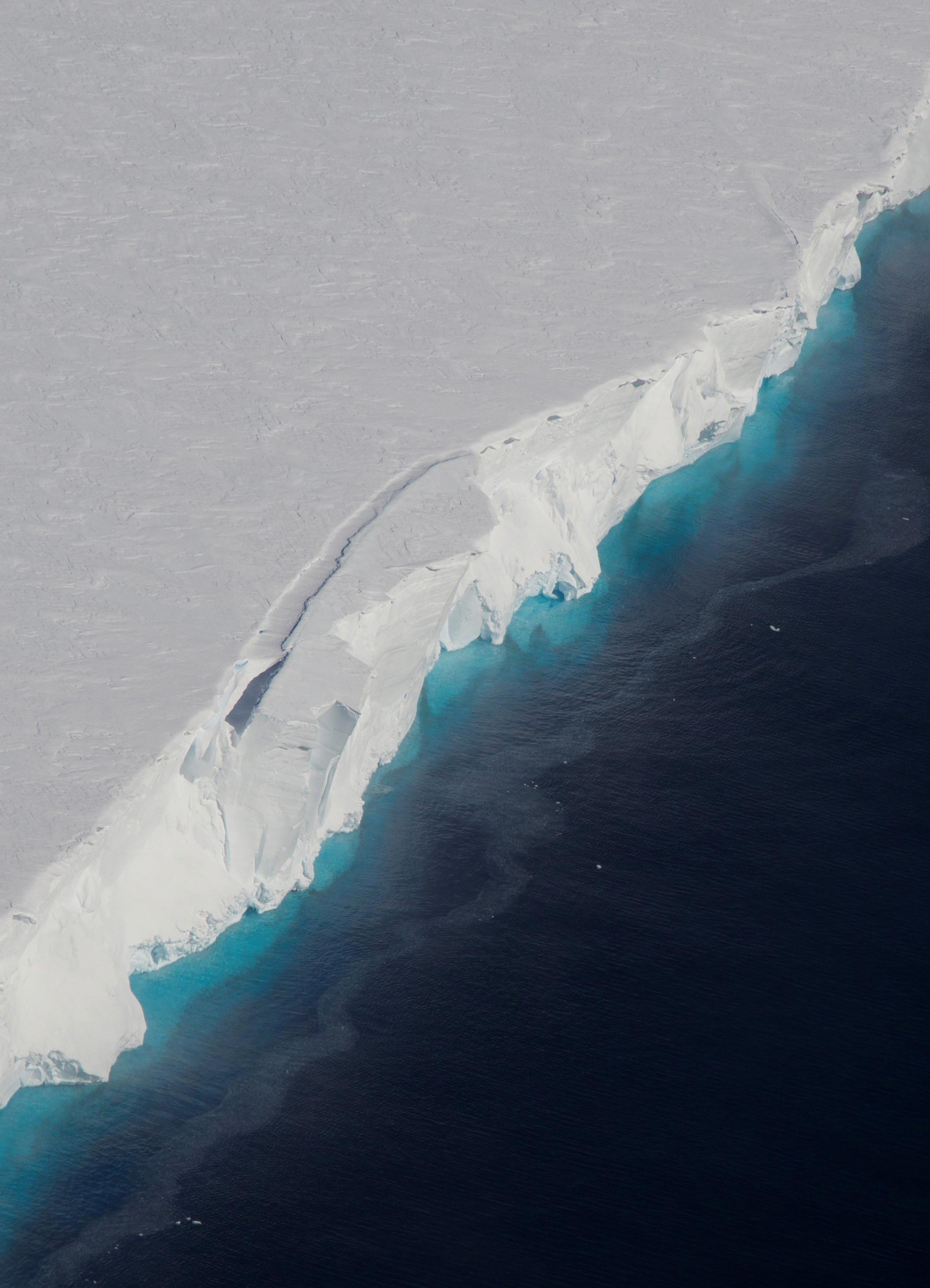
New research reveals powerful Antarctic winds that could be accelerating glacier melt and rising seas.
In the far reaches of West Antarctica, along the rugged coastline of the Amundsen Sea Embayment, scientists have discovered powerful winds racing over the icy landscape. These fast-moving currents, called low-level jets (LLJs), sweep across the Thwaites and Pine Island ice shelves and stretch out over the open ocean.
These previously unknown atmospheric forces could hold the missing piece in the puzzle of why two of Antarctica’s most important glaciers are melting so rapidly. One of them, Thwaites Glacier, has earned the dramatic nickname “Doomsday Glacier” because of its potential to trigger catastrophic sea-level rise.
Now, a groundbreaking study published in Advances in Atmospheric Sciences by researchers from the Indian Institute of Technology and the British Antarctic Survey is shining new light on these powerful winds. By focusing on the low-level jets skimming over the Amundsen Sea Embayment, the team has uncovered important clues about how the Thwaites and Pine Island glaciers are losing ice at an accelerating pace, contributing more and more to rising sea levels worldwide.
Unveiling the Winds’ Role in Glacier Melt
“We wanted to understand how often these LLJs happen and what causes them. Understanding these strong winds is critical as they could perhaps have important impacts on the redistribution of snow over both the Thwaites and Pine Island ice shelves, as well as affecting the ocean circulation and movement of sea-ice. These processes could potentially influence the rate at which Thwaites and Pine Island glaciers melt, and thus their contribution to sea-level rise,” said Sai Prabala Swetha Chitella, the lead author.
Earlier research has shown that LLJs often develop when cold, dense air flows down from Antarctica’s high interior, which are known as katabatic winds. Swetha’s new study explored whether nearby low-pressure systems, called cyclones, could also play a role in strengthening these katabatic winds even further, resulting.
Measuring the Invisible Forces
To investigate this, the team used data from instruments attached to weather balloons, called radiosonde measurements, that had been launched from a ship near the Amundsen Sea Embayment coast in late summer to measure wind and temperature in the lower atmosphere. They then ran simulations using a high-resolution weather model to better understand the wind patterns responsible for the wind jets.
What they found was surprising: 11 out of 22 of the radiosonde measurements showed these LLJs, and 10 of them were blowing out to sea (offshore). Additionally, their simulations showed the LLJs extending over large areas of the Amundsen Sea Embayment, resulting in substantially enhanced near-surface wind speeds over both the Thwaites and Pine Island ice shelves, as well as the open ocean. Additionally, the simulations showed that the strengthening of the katabatic winds by cyclones played a critical role in producing the jets.
“The most important thing we found is that LLJs happen often in this part of Antarctica and are usually made stronger by passing storms,” said Dr Andrew Orr, one of the coauthors of the study.
What’s next?
“We plan to continue our investigation of these extreme winds over this region of West Antarctica, including focusing on winter, when they are likely to be even stronger and more frequent. Additionally, we want to also begin to investigate more explicitly the impacts of these winds on ocean circulation and movement of sea-ice in this critical region,” said Dr Pranab Deb, another co-author of the study.
The researchers hope the study can help improve future predictions about melting ice and sea level rise and give scientists, policymakers, and communities more tools to plan for our changing climate.
Reference: “Radiosonde Measurements and Polar WRF Simulations of Low-Level Wind Jets in the Amundsen Sea Embayment, West Antarctica” by Sai Prabala Swetha Chittella, Andrew Orr and Pranab Deb, 28 May 2025, Advances in Atmospheric Sciences.
DOI: 10.1007/s00376-025-4398-5
Never miss a breakthrough: Join the SciTechDaily newsletter.
Follow us on Google and Google News.
7 Comments
“…, the team has uncovered important clues about how the Thwaites and Pine Island glaciers are losing ice at an accelerating pace, contributing more and more to rising sea levels worldwide.”
It sounds like they are talking about sublimation, not actually melting. Sublimation is the process of going directly from the ice phase to vapor. Until such time as the vapor condenses and precipitates out, it doesn’t go into the oceans. If it comes back down as snow on land, then it doesn’t go back into the ocean and doesn’t contribute “more and more to rising sea levels worldwide.”
Thus, the wind direction is important, particularly for the surface winds that can be expected to be carrying almost all of the sublimated water vapor. The abstract for the article remarks that the “jet core heights [range] from 80 to 800 m. Because winds change direction with altitude and surface friction, the direction of the winds at the surface are of more importance than the direction of the core winds. It is noted above that “What they found was surprising: 11 out of 22 of the radiosonde measurements showed these LLJs, and 10 of them were blowing out to sea (offshore).” What direction were the LLJ surface-winds blowing? Were they also blowing out to sea?
Did you read the whole article?
Yes I did. I even read the the original published peer-reviewed article. I even quoted some of the claims from the article. I stated that one quote was from the abstract. Did you read my whole comment? Did you understand that I was asking about the change in direction of wind with altitude? What is the obscure point you failed to make with your snide remark?
One might wonder what happens with the katabatic winds common in such places as Commonwealth Bay, East Antarctica. One might expect katabatic winds to engage in more in turbulent flow rather than laminar flow, albeit that the cold mass of air, which may not be overly high, would overall move assorted sublimates down slope to eventually dump them in the sea. How much sublimate gets dumped where presumably also depends on the length of time the katabatic wind persists and indeed on the frequency of such katabatic winds.
.
Why do you “expect katabatic winds to engage in more in turbulent flow rather than laminar flow,” and why do you assume that they will end up in the sea, which is the essence of my question? What are your assumptions and facts to support your conjectures?
Commonwealth Bay is occupied by sea-water. The katabatic winds that I have experienced were not pure laminar flow. Some of the katabatic winds that I experienced in Antarctica did all not blow out to sea, and some did. My comments are based on my experience.
The question I asked was, ” Were they also blowing out to sea?”
You originally implied that ALL the sublimated snow ended up in the sea. Thank you for supporting my suspicion with your personal experience.