

Scientists have uncovered a new way to explore the complex transformations of 2D nanomaterials. By using nanoscale vibrating membranes, they observed how mechanical and magnetic properties shift at extreme temperatures.
Phase transitions, like water freezing into ice or boiling into vapor, cause dramatic changes in a material’s properties at specific temperatures. While these transitions are well understood in everyday materials, their behavior at the nanoscale remains a mystery. A TU Delft-led team has now demonstrated how magnetic and mechanical properties are closely linked in nanomaterials, shedding light on these intricate transformations and opening new possibilities for advanced sensor technology.
Unlocking the Secrets of 2D Nanomaterials
Scientists from TU Delft, in collaboration with colleagues from the University of Valencia and the National University of Singapore, have developed a groundbreaking method to study the complex phase transitions of 2D nanomaterials. Their focus was on FePS3, an ultra-thin material just a few atoms thick.
By suspending tiny membranes of FePS3 and vibrating them at high amplitudes while adjusting the temperature, they discovered how the material’s vibrations shift near its phase transition temperature, offering new insights into its magnetic properties.
A Magnetic Drum That Changes with Temperature
“Imagine a drum with a magnetic structure, where the laser light acts as the drumstick, continuously making it vibrate while its rhythm subtly shifts with changing temperature,” explains Farbod Alijani, associate professor at the TU Delft Faculty of Mechanical Engineering.
“While warm, this magnetic drum is loose, and its magnetic spins, which are natural turns in particles that make them act like small magnets, are in a disordered phase. But once cold, the drum tightens up, with the spins snapping into an orderly pattern. Now, imagine that while drumming, you slowly change the temperature from warm to cold. As you do, you notice not only when the drum starts to feel different but also that this change isn’t smooth (linear)—it unfolds in an intricate and irregular (nonlinear) manner, affecting its mechanical properties.”
Phase Transition Temperature: The Critical Shift
The researchers essentially measured this nonlinear change during the phase transition. By using a nanoscale drum, they could detect the temperature at which this sudden transformation occurs and study how the drum’s mechanical behavior changes in detail. “We pinpointed the phase transition temperature at around -160°C,” says Makars Šiškins, whose PhD work inspired this study. “Additionally, we found that the changes in the mechanical response driven by the temperature shifts are directly coupled to the material’s magnetic and elastic properties.”
Ultra-Sensitive Sensors
These membranes are exceptionally sensitive to both internal and external forces. Šiškins adds: “This sensitivity positions them as ideal candidates for sensors capable of detecting even very small environmental changes or internal stresses in the material itself.”
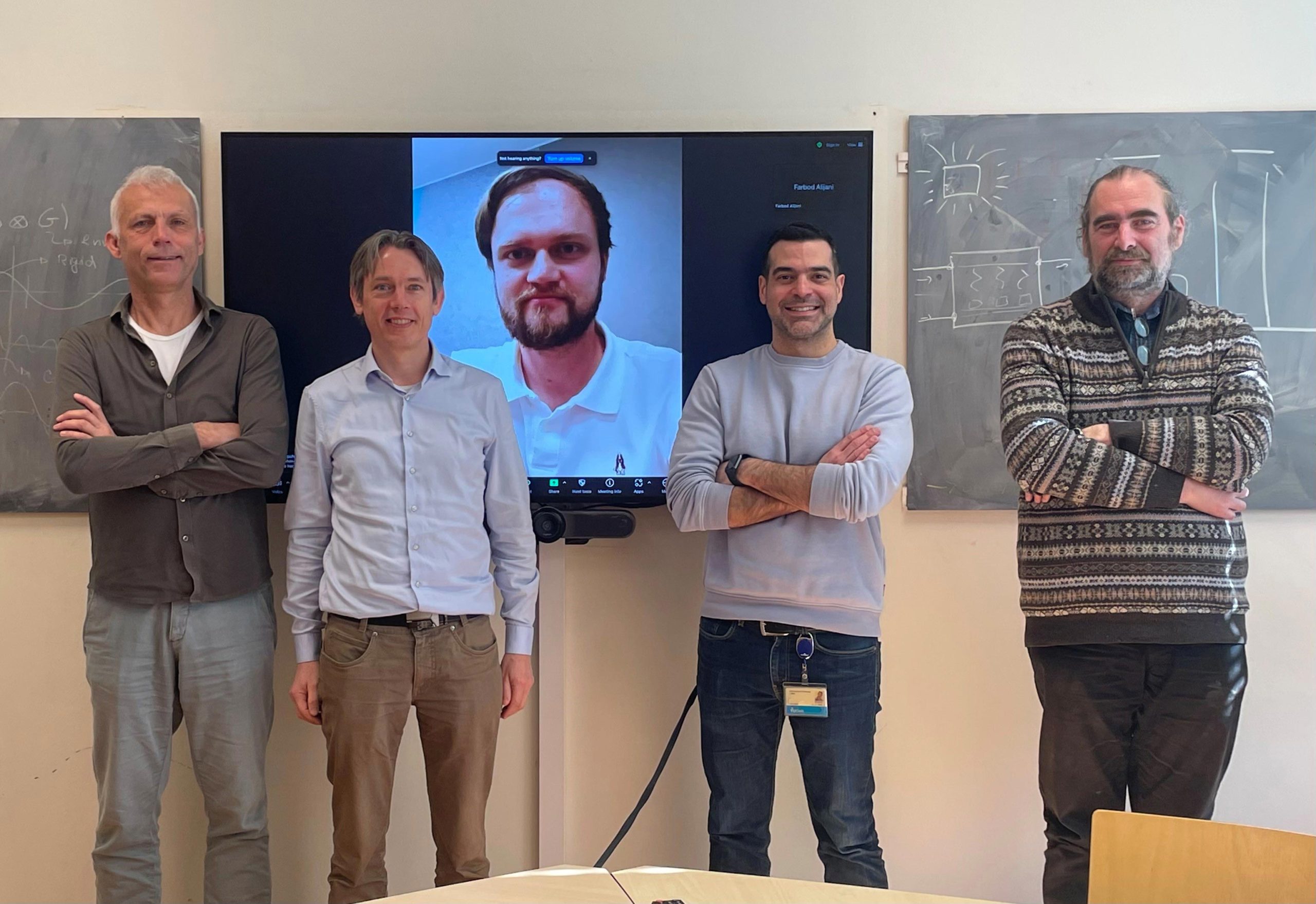
Pushing the Boundaries of Nanotechnology
The team plans to apply this methodology to unveil the secrets of phase transitions in other nanomaterials. Co-author Herre van der Zant: “In our lab, we will investigate whether we can detect so-called spin waves with the nanodrum. You can think of spin waves as carriers of information in a magnetic material, much like electrons are for conductive materials.” Alijani will focus on translating these findings into practical applications, such as improving sensor performance. “Understanding these nonlinear processes lays the basis for innovative nanomechanical devices, including ultra-sensitive sensors,” he notes.
Reference: “Nonlinear dynamics and magneto-elasticity of nanodrums near the phase transition” by Makars Šiškins, Ata Keşkekler, Maurits J. A. Houmes, Samuel Mañas-Valero, Maciej Koperski, Eugenio Coronado, Yaroslav M. Blanter, Herre S. J. van der Zant, Peter G. Steeneken and Farbod Alijani, 12 March 2025, Nature Communications.
DOI: 10.1038/s41467-025-57317-4
Never miss a breakthrough: Join the SciTechDaily newsletter.
Follow us on Google and Google News.
1 Comment
Ask the researchers:
Is the complex phase transitions of 2D nanomaterials related to the spin of topological vortices?
Scientific research guided by correct theories can enable researchers to think more. The rigor of science is worthless for some so-called academic publications, including Physical Review Letters, Nature, Science, Proceedings of the National Academy of Sciences, etc. They stubbornly persist and declare everywhere:
1. They insist on using a cat analogy to quantum.
2. Two sets of cobalt-60 can form mirror images of each other when rotated in reverse.
3. In research, using an anti-vortex with extremely complex space-time structure to deceive the public (https://pic2.zhimg.com/v2-4127b0b58fe8b88feb27c189fb705029_1440w.jpg?source=172ae18b).
4. They distort mathematics, mislead scientific research, and search everywhere for so-called Antimatter, God particles, etc.
To promote the progress of science and technology, more people need to bravely step forward and fight against rampant pseudoscience.