
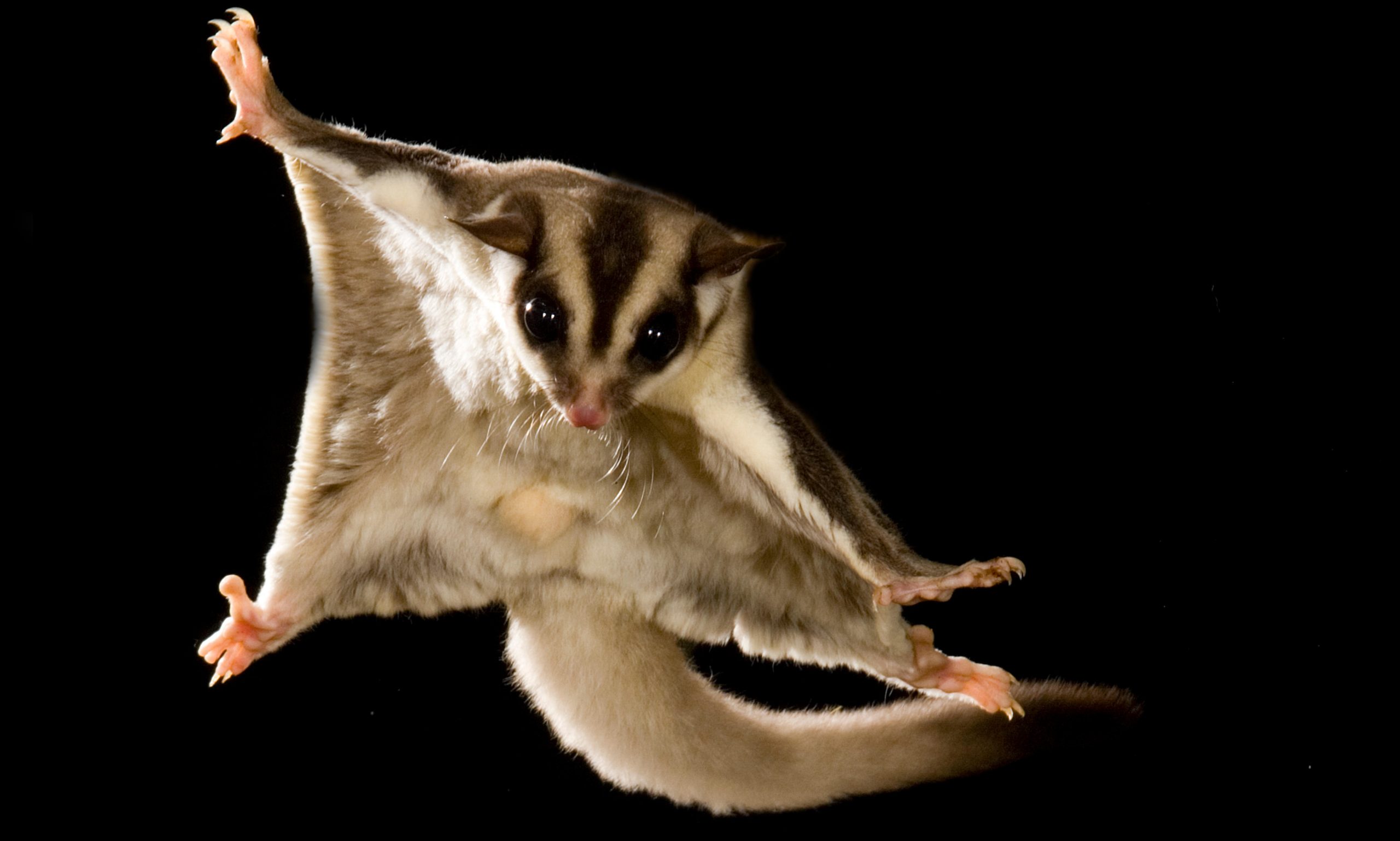
A crucial gene has been identified that clarifies the repeated emergence of gliding capabilities throughout the evolution of marsupials.
People say “When pigs fly” to describe the impossible. But even if most mammals are landlubbers, the ability to glide or fly has evolved again and again during mammalian evolution, in species ranging from bats to flying squirrels.
How did that come about? In a study recently published in the journal Nature, a team of researchers led by Princeton University and Baylor College of Medicine explains the genomic and developmental basis of the patagium, the thin skin membrane that allows some mammalian species to soar through the air.
“We don’t quite understand how novel traits and adaptations originate from a molecular and genetic perspective. We wanted to investigate how an evolutionary novelty arises,” said co-corresponding author Dr. Ricardo Mallarino, assistant professor of molecular biology at Princeton.
To better understand patagium evolution, the team focused on marsupials. That is because the ability to glide has developed repeatedly, using similar anatomical changes, in closely related marsupials like the sugar glider – a tiny marsupial small enough to fit in your pocket, and popular as an exotic pet.
Genetic Insights into Gliding
The Baylor team led the genome sequencing for 15 marsupial species, determining the DNA sequences in both gliding species and their non-gliding relatives. Comparing those sequences revealed accelerated evolution near a gene called Emx2.
“What’s interesting is that the sequence of the gene itself doesn’t seem to be where the most relevant changes are taking place. Instead, the key changes are in short DNA sequences, called ‘enhancers,’ that lie nearby in the genome. It’s those changing enhancers that alter how and where in the body Emx2 is active, and that drives the evolution of gliding,” said co-corresponding author Dr. Erez Lieberman Aiden, professor of molecular and human genetics and director of the Center for Genome Architecture at Baylor.
Evolutionary Mechanisms and Experimental Approaches
“Understanding the underlying changes that happen at the genomic level to give rise to these convergent traits is important because it can tell us whether evolution is targeting the path of least resistance. You can have the same outcome but different paths to get there,” said co-first author Jorge Moreno, a graduate student in Mallarino’s lab.
Next, the researchers wanted to test these ideas. To do so, they used one of the most unique characteristics of marsupials – their pouch. “Marsupial joeys are born at a much earlier stage in development than typical mammals,” said co-first author Dr. Olga Dudchenko, assistant professor of molecular and human genetics at Baylor and a researcher at the Center for Theoretical Biological Physics at Rice University. “Instead of continuing development in their mother’s womb, they crawl into her pouch, and stay there until they are ready to take on the world independently. The fact that they are right there in the pouch makes it much easier to study how individual genes, like Emx2, affect the marsupial’s development.”
The researchers showed that Emx2 gives rise to the marsupial patagium using a genetic program that probably exists in all mammals. For instance, Emx2 is active in the skin on the sides of both mice and sugar gliders, but in sugar gliders, it is expressed for far longer. As Dudchenko, also at the Center for Genome Architecture at Baylor, notes, “By modifying those critical Emx2 enhancers, one species after another has tapped into this universal program in order to develop the ability to glide.”
Encouraging news for pigs hoping to reach for the skies.
Reference: “Emx2 underlies the development and evolution of marsupial gliding membranes” by Jorge A. Moreno, Olga Dudchenko, Charles Y. Feigin, Sarah A. Mereby, Zhuoxin Chen, Raul Ramos, Axel A. Almet, Harsha Sen, Benjamin J. Brack, Matthew R. Johnson, Sha Li, Wei Wang, Jenna M. Gaska, Alexander Ploss, David Weisz, Arina D. Omer, Weijie Yao, Zane Colaric, Parwinder Kaur, Judy St. Leger, Qing Nie, Alexandria Mena, Joseph P. Flanagan, Greta Keller, Thomas Sanger, Bruce Ostrow, Maksim V. Plikus, Evgeny Z. Kvon, Erez Lieberman Aiden and Ricardo Mallarino, 24 April 2024, Nature.
DOI: 10.1038/s41586-024-07305-3
This work was supported by the National Institutes of Health (R35GM133758, UM1HG009375, RM1HG011016-01A1, F32 GM139240-01, T32GM007388, R01-AR079150); the Searle Scholars Program; the Sloan Foundation and the Vallee Scholars Program; the Welch Foundation (Q-1866), the U.S.-Israel Binational Science Foundation (2019276); the National Science Foundation (DGE-2039656, NSF DBI-2021795, NSF PHY-2210291); the LEO Foundation (LF-AW-RAM-19-400008, LF-OC-20-000611); and the W.M. Keck Foundation (WMKF-5634988).
Never miss a breakthrough: Join the SciTechDaily newsletter.
Follow us on Google and Google News.