
Close Menu
    Facebook X (Twitter) Instagram
    SciTechDaily
    • Biology
    • Chemistry
    • Earth
    • Health
    • Physics
    • Science
    • Space
    • Technology
    Facebook X (Twitter) Pinterest YouTube RSS
    SciTechDaily
    Home»Technology»New Research Could Lead to More Efficient Televisions, Computer Screens and Lighting
    Technology

    New Research Could Lead to More Efficient Televisions, Computer Screens and Lighting

    By University of St. AndrewsMay 10, 2024No Comments2 Mins Read
    Facebook Twitter Pinterest Telegram LinkedIn WhatsApp Email Reddit
    Share
    Facebook Twitter LinkedIn Pinterest Telegram Email Reddit
    Organic Light Emitting Diode
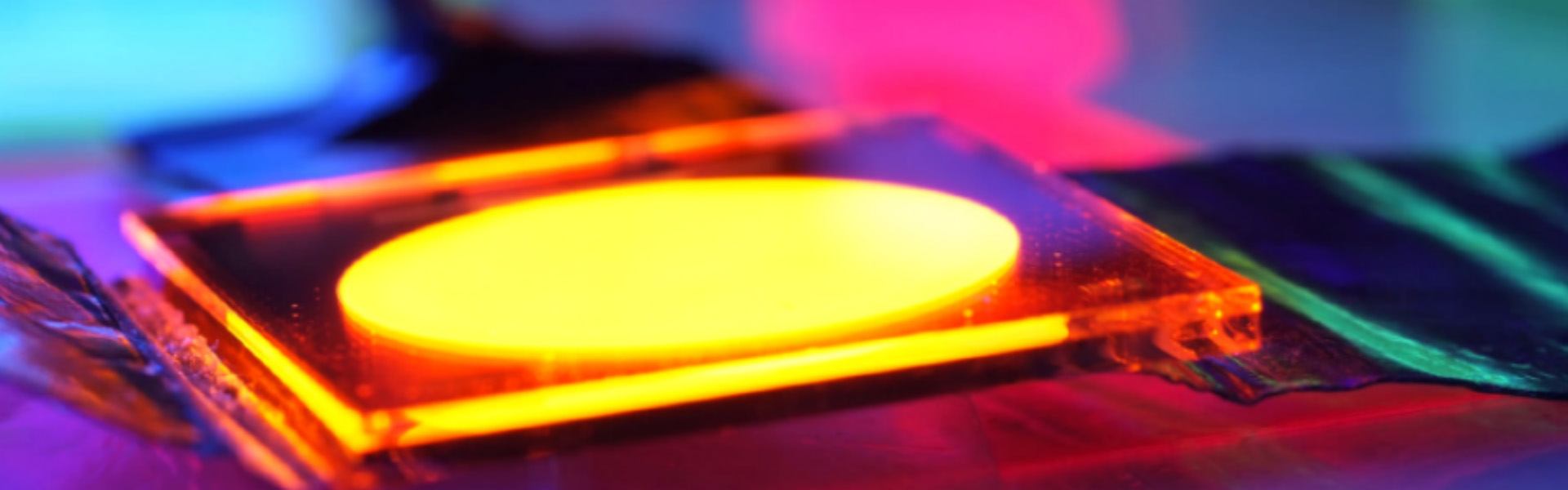
    New research from the University of St Andrews offers potential solutions for improving the efficiency of OLEDs at high brightness levels, broadening their application in technology and medicine. Credit: Professor Ifor Samuel

    New interdisciplinary research from the University of St Andrews has the potential to enhance the efficiency of televisions, computer screens, and lighting systems.

    Researchers at the Organic Semiconductor Centre in the School of Physics and Astronomy, and the School of Chemistry have proposed a new approach to designing efficient light-emitting materials in a paper recently published in Nature.

    Light-emitting materials are used in organic light-emitting diodes (OLEDs) that are now found in the majority of mobile phone displays and smartwatches, and some televisions and automotive lighting.

    Overcoming Efficiency Challenges

    The latest generation of emitter materials under development produce OLEDs that have high efficiency at low brightness, but suffer reduced efficiency as the brightness is increased to the levels required for lighting and outdoor applications. This problem is known as ‘efficiency roll-off’.

    Researchers have identified the combination of features of materials required to overcome this problem. Guidelines developed by the team of researchers, led by Professor Ifor Samuel and Professor Eli Zysman-Colman, will help OLED researchers develop materials that maintain high efficiency at high brightness, enabling the latest materials to be used for applications in displays, lighting, and medicine.

    Commenting on the research, Professor Zysman-Colman explained that the findings “provide clearer insight into the link between the properties of the emitter material and the performance of the OLED.”

    Professor Samuel said, “Our new approach to this problem will help to develop bright, efficient, and colorful OLEDs that use less power.”

    Reference: “A figure of merit for efficiency roll-off in TADF-based organic LEDs” by S. Diesing, L. Zhang, E. Zysman-Colman and I. D. W. Samuel, 27 March 2024, Nature.
    DOI: 10.1038/s41586-024-07149-x

    Never miss a breakthrough: Join the SciTechDaily newsletter.
    Follow us on Google and Google News.

    Engineering OLED Television University of St. Andrews
    Share. Facebook Twitter Pinterest LinkedIn Email Reddit

    Related Articles

    From Sci-Fi to Reality: New Breakthrough Could Bring Holograms to Your Phone

    Revolutionary OLEDs Could Replace Bulky Night Vision Goggles With Lightweight Glasses

    Inkjet-Printing System Could Enable Mass-Production of Large-Screen OLED Displays

    Quantum-Dot Technology Ready to Improve LCD TVs

    3D+2D Television Allows for Simultaneous 3D and 2D Watching

    Remote Controlled Cockroach Biobots

    Tensor Display Uses Several Layers of LCDs to Produce 3D Illusion

    NASA to Test Jet Engine With a Helping of Cereal and Crayons

    Engineered Capsule that Buckles Under Pressure

    Leave A Reply Cancel Reply

    • Facebook
    • Twitter
    • Pinterest
    • YouTube

    Don't Miss a Discovery

    Subscribe for the Latest in Science & Tech!

    Trending News

    JWST Finds a “Star” 100 Billion Times Brighter Than Any Star Should Be

    Scientists Find a Hidden Biological Link Across Different Forms of Autism

    Astronomers Discover a Ghostly River of Stars That Could Reveal Dark Matter

    Why Is Colorectal Cancer Rising in People Under 50? New Clues Point to the Environment

    Quantum Fluctuations Break a Crystal’s Symmetry Rules

    Why Does an Irregular Heartbeat Strike 40 Years Early in Some People?

    Scientists Reveal How ADHD Could Fuel Creative Thinking

    Scientists Find Just 3 Minutes of Sprinting Can Transform Blood Chemistry

    Follow SciTechDaily
    • Facebook
    • Twitter
    • YouTube
    • Pinterest
    • Newsletter
    • RSS
    SciTech News
    • Biology News
    • Chemistry News
    • Earth News
    • Health News
    • Physics News
    • Science News
    • Space News
    • Technology News
    Recent Posts
    • This Suitcase-Sized Spacecraft Could Detect a Signal From Before Stars Existed
    • Three Supermassive Black Holes Found in a Galaxy From the Dawn of the Universe
    • Breakthrough in a Bizarre Galaxy Could Help Unlock the Mystery of Dark Matter
    • 1 in 3 Middle-Aged Americans Struggle With Basic, “Everyday” Health Tasks
    • Just 4 Minutes of Daily Strength Training Can Quadruple Fitness in Older Adults
    Copyright © 1998 - 2026 SciTechDaily. All Rights Reserved.
    • Science News
    • About
    • Contact
    • Editorial Board
    • Privacy Policy
    • Terms of Use

    Type above and press Enter to search. Press Esc to cancel.