
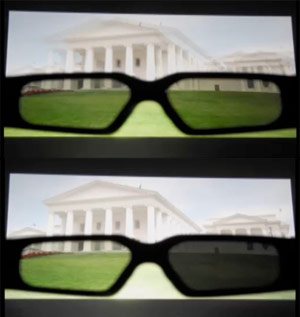
Engineers at UC Santa Cruz have developed a 3D+2D television that combines both 2D and 3D, allowing viewers with stereo glasses to see three-dimensional images, while viewers without the glasses see a normal two-dimensional image without blurriness.
With existing 3D television displays, viewers must wear stereo glasses to get the effect of seeing images on the screen in three dimensions, while viewers without the glasses see a blurry image. That’s because the 3D TV shows a different image to each eye through the stereo glasses, and a viewer without the glasses sees both images superimposed, resulting in “ghosting.”
“There are a lot of reasons why it would be desirable to not need the glasses,” said James Davis, associate professor of computer science in the Baskin School of Engineering at UC Santa Cruz, who led the project. “They can be expensive, so you wouldn’t want to buy extra pairs, and they can interfere with other activities.”
Davis developed the new technique with UCSC graduate students Steven Scher, Jing Liu, Rajan Vaish, and Prabath Gunawardane. His team will present their 3D+2D TV technology at SIGGRAPH 2013, the 40th International Conference and Exhibition on Computer Graphics and Interactive Techniques, on Thursday, July 25, in Anaheim. They have also described it in a paper in the June issue of ACM Transactions on Graphics.
Davis’s 3D+2D TV shows separate left and right images when viewed through glasses, but those without glasses see only the left image. The system also displays a third image, which is not seen through either lens of the glasses. The third image is the negative of the right image–bright where the right is dark, and dark where the right image is bright–canceling out the right image so those without glasses see only the left image.
With this simple version of the system, 2D viewers see a low-contrast image, because the darkest pixel is relatively bright. To restore acceptable contrast to 2D viewers, the researchers allowed the images seen by the left and right eyes of 3D viewers to have unequal brightness, where the left becomes brighter and the right dimmer. Then they conducted several experiments to determine the optimal brightness ratio between right and left images. They found that brightness ratios in the range between 20 percent and 60 percent were acceptable for viewers both with and without glasses.
The researchers also conducted experiments to quantify the “Pulfrich effect,” which slightly distorts depth perception of moving objects when one eye sees a darker image than the other, as if the darker image had been delayed a few milliseconds. They found that this “virtual time delay” is similar in magnitude to the actual time delay experienced with sequential-frame 3D displays, which show left-right image pairs with an 8-millisecond delay between left and right images on a 120-Hz display.
Their findings indicate that the Pulfrich effect is not an obstacle to using unequal brightness for right and left eyes in a 3D+2D TV. In fact, they found that the virtual time delay of the Pulfrich effect can be used to cancel the effect of the actual time delay in a sequential-frame stereo display.
The researchers built a prototype of their 3D+2D TV by aligning a 3D projector with a second, polarized projector used to project the negative of the right image. The image from the polarized projector is not visible through the LCD active shutter glasses synchronized to the 3D projector.
The researchers have filed a patent application, and one of Davis’s students, Jing Liu, has been working with students at Stanford University’s Graduate School of Business to look into starting a company based on this technology. They are off to a promising start, garnering positive feedback at Stanford’s “Startup Weekend” business plan event, Davis said.
Reference: “3D+2DTV: 3D displays with no ghosting for viewers without glasses” by Steven Scher, Jing Liu, Rajan Vaish, Prabath Gunawardane and James Davis, 4 July 2013, ACM Transactions on Graphics.
DOI: 10.1145/2487228.2487229
Never miss a breakthrough: Join the SciTechDaily newsletter.
Follow us on Google and Google News.
2 Comments
I really like this, thank you for sharing.
This is great for users who enjoy watching 2D and 3D movies.