
Close Menu
    Facebook X (Twitter) Instagram
    SciTechDaily
    • Biology
    • Chemistry
    • Earth
    • Health
    • Physics
    • Science
    • Space
    • Technology
    Facebook X (Twitter) Pinterest YouTube RSS
    SciTechDaily
    Home»Space»Juno Mission Prepares for Jupiter Flyby
    Space

    Juno Mission Prepares for Jupiter Flyby

    By DC Agle, Jet Propulsion LaboratoryDecember 9, 2016No Comments3 Mins Read
    Facebook Twitter Pinterest Telegram LinkedIn WhatsApp Email Reddit
    Share
    Facebook Twitter LinkedIn Pinterest Telegram Email Reddit
    NASA Juno Mission Prepares for December 11 Jupiter Flyby
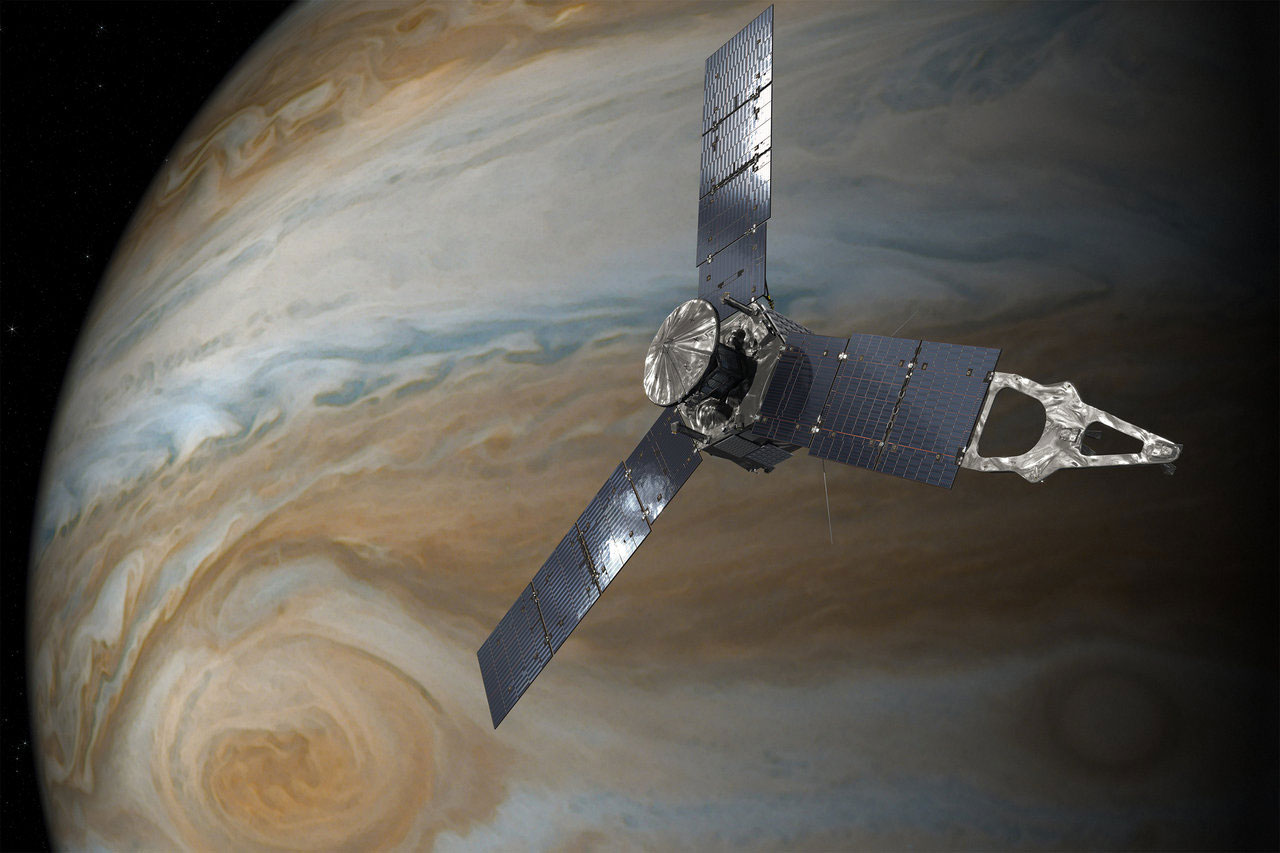
    Artist’s concept of the Juno spacecraft orbiting Jupiter.

    NASA’s Juno spacecraft will make its third science flyby of Jupiter on Sunday, December 11, at 9:04 a.m. PST.

    At the time of closest approach (called perijove), Juno will be about 2,580 miles (4,150 kilometers) above the gas giant’s roiling cloud tops and traveling at a speed of about 129,000 mph (57.8 kilometers per second) relative to the planet. Seven of Juno’s eight science instruments will be energized and collecting data during the flyby.

    “This will be the first time we are planning to operate the full Juno capability to investigate Jupiter’s interior structure via its gravity field,” said Scott Bolton, principal investigator of Juno from the Southwest Research Institute in San Antonio. “We are looking forward to what Jupiter’s gravity may reveal about the gas giant’s past and its future.”

    Mission managers have decided not to collect data with the Jovian Infrared Auroral Mapper (JIRAM) instrument during the December flyby, to allow the team to complete an update to the spacecraft software that processes JIRAM’s science data. A software patch allowing JIRAM’s operation is expected to be available prior to the next perijove pass (PJ4) on February 2, 2017.

    The spacecraft team continues to weigh its options regarding modifications of Juno’s orbital period — how long it takes for the spacecraft to complete one orbit around Jupiter. At present, Juno’s orbital period is 53.4 days. There had been plans to perform a period adjustment maneuver with the spacecraft’s main engine on October 19 to reduce the orbital period to 14 days. The team made the decision to forgo the maneuver in order to further study the performance of a set of valves that are part of the spacecraft’s fuel pressurization system. The period reduction maneuver was the final scheduled burn of Juno’s main engine.

    “We have a healthy spacecraft that is performing its mission admirably,” said Rick Nybakken, project manager for Juno from NASA’s Jet Propulsion Laboratory in Pasadena, California. “What we do not want to do is add any unnecessary risk, so we are moving forward carefully.”

    In collaboration with NASA and the Juno team, Apple will release an interactive guide to the mission (an iBook) on December 11.

    The Juno spacecraft launched on August 5, 2011, from Cape Canaveral, Florida, and arrived at Jupiter on July 4, 2016. During its mission of exploration, Juno soars low over the planet’s cloud tops — as close as about 2,600 miles (4,100 kilometers). During these flybys, Juno will probe beneath the obscuring cloud cover of Jupiter and study its auroras to learn more about the planet’s origins, structure, atmosphere, and magnetosphere.

    Juno’s name comes from Roman mythology. The mythical god Jupiter drew a veil of clouds around himself to hide his mischief, and his wife — the goddess Juno — was able to peer through the clouds and reveal Jupiter’s true nature.

    Never miss a breakthrough: Join the SciTechDaily newsletter.
    Follow us on Google and Google News.

    Astronomy JPL Juno Spacecraft Jupiter NASA Planetary Science Popular
    Share. Facebook Twitter Pinterest LinkedIn Email Reddit

    Related Articles

    A Halloween Treat: NASA’s Juno Mission Glimpses an Eerie “Face” on Jupiter

    40-Year Mystery Solved: Source of Jupiter’s Strange X-Ray Flares Uncovered

    NASA’s Juno Mission Expands Into the Future – To Explore Jupiter and Its Rings and Moons

    A Billion or More Jupiter-Like Worlds Could Be Orbiting Stars in the Milky Way

    First In-orbit View from NASA’s Juno Spacecraft

    Hubble Telescope Views Vivid Auroras in Jupiter’s Atmosphere

    “Habitable Zone” Might Help Extreme Life Forms Survive on Exoplanets

    NASA’s Curiosity Readies for First Drive on Mars

    Color HiRISE Image of Curiosity Rover on Mars

    Leave A Reply Cancel Reply

    • Facebook
    • Twitter
    • Pinterest
    • YouTube

    Don't Miss a Discovery

    Subscribe for the Latest in Science & Tech!

    Trending News

    Scientists Discover 132-Million-Year-Old Dinosaur Tracks on South Africa’s Coast

    Scientists Uncover the Secret Ingredient Behind the Spark That May Have Started Life on Earth

    Physicists Observe Matter in Two Places at Once in Mind-Bending Quantum Experiment

    Stanford Scientists Discover Hidden Brain Circuit That Fuels Chronic Pain

    New Study Reveals Why Ozempic Works Better for Some People Than Others

    Climate Change Is Altering a Key Greenhouse Gas in a Way Scientists Didn’t Expect

    New Study Suggests Gravitational Waves May Have Created Dark Matter

    Scientists Discover Why the Brain Gets Stuck in Schizophrenia

    Follow SciTechDaily
    • Facebook
    • Twitter
    • YouTube
    • Pinterest
    • Newsletter
    • RSS
    SciTech News
    • Biology News
    • Chemistry News
    • Earth News
    • Health News
    • Physics News
    • Science News
    • Space News
    • Technology News
    Recent Posts
    • 320 Light-Years Away, a Planet Confirms a Fundamental Cosmic Assumption
    • Astronomers Solve Decades-Long Mystery About Saturn’s Spin – “Something Strange Was Happening”
    • Scientists Uncover Strange New State of Matter Inside Uranus and Neptune
    • The Crown Jewel of Dentistry? Breakthrough Tech Could Transform Tooth Repair
    • The Surprising Non-Medical Factor That Determines Cancer Survival
    Copyright © 1998 - 2026 SciTechDaily. All Rights Reserved.
    • Science News
    • About
    • Contact
    • Editorial Board
    • Privacy Policy
    • Terms of Use

    Type above and press Enter to search. Press Esc to cancel.