

ANU researchers show that atoms can exhibit quantum entanglement, advancing efforts to unify physics.
Quantum physicists at the Australian National University (ANU) have achieved a major milestone by directly observing atoms behaving in an entangled state while in motion, providing strong evidence that quantum effects are not limited to light particles, but also apply to matter with mass.
Quantum entanglement is a phenomenon in which particles become linked so that the state of one instantly influences the state of another, no matter how far apart they are. While this effect has been widely demonstrated using photons (particles of light), extending it to atoms, objects with mass that interact with gravity, has proven far more difficult.
“It’s really weird for us to think that this is how the Universe works,” says Dr Sean Hodgman from the ANU Research School of Physics. “You can read about it in a textbook, but it’s really weird to think that a particle can be in two places at once.”
In this experiment, the team used helium atoms to demonstrate entanglement, marking a significant step forward compared to earlier studies that focused mainly on photons, which are particles of light.
Unlike photons, helium atoms possess mass and are influenced by gravity, making them far more challenging to study in quantum experiments.
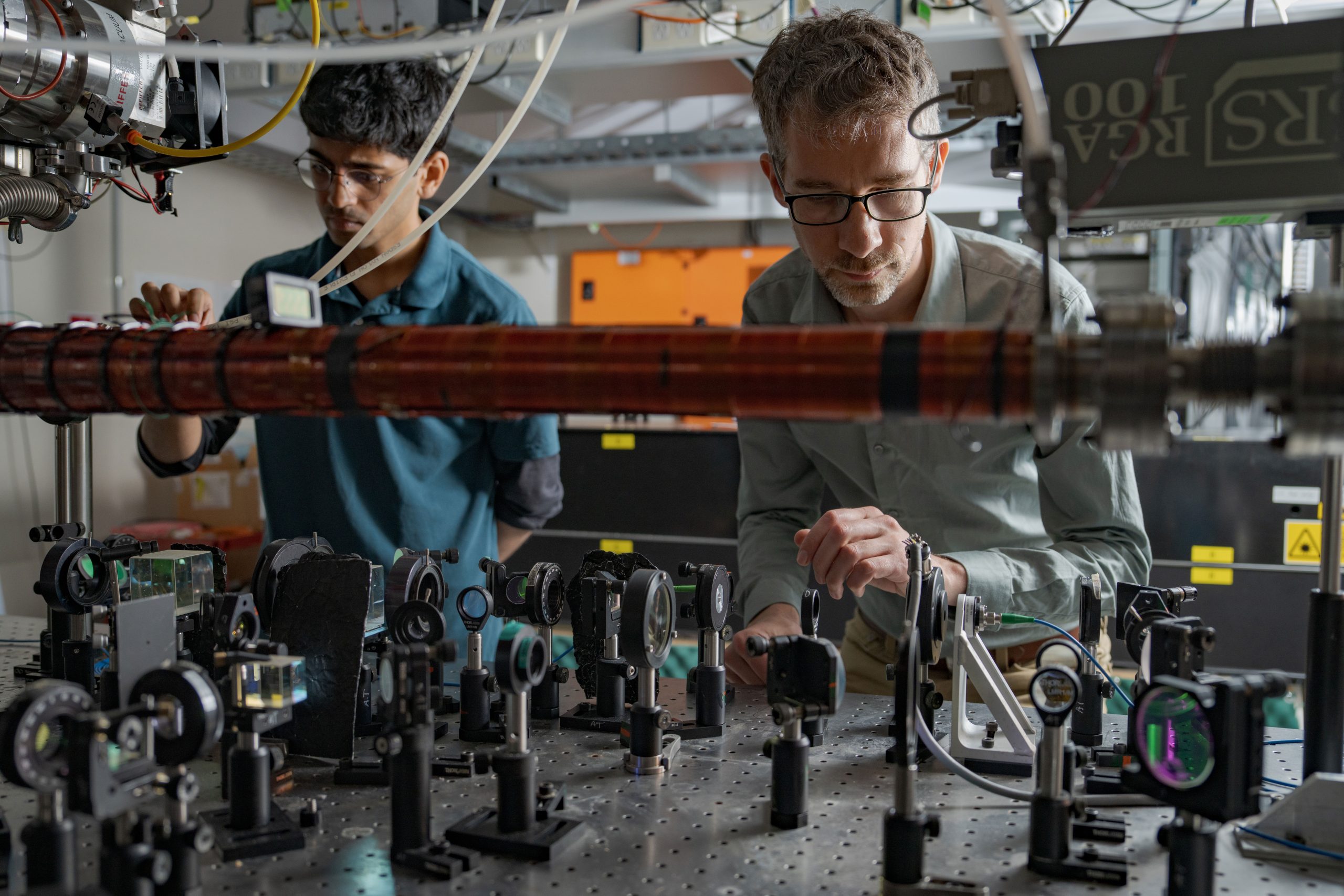
Massive atoms extend quantum tests
“Experimentally, it’s extremely hard to demonstrate this,” says lead author and PhD researcher, Yogesh Sridhar. “Several people have tried in the past to show these effects, and they have always come short.”
This achievement opens new possibilities for investigating one of the most fundamental questions in physics: how quantum mechanics at the smallest scales connects with gravity and general relativity at the scale of the universe.
“This result confirms the predictions of over a century ago that matter can be in two locations at once, and it can interfere with itself even in those locations,” says Dr Sean Hodgman.
Findings point toward unified physics
By demonstrating quantum entanglement in atoms, scientists may be moving closer to understanding whether a unified framework of physics, often referred to as the “Theory of Everything,” is achievable.
Reference: “Bell correlations between momentum-entangled pairs of 4He* atoms” by Y. S. Athreya, S. Kannan, X. T. Yan, R. J. Lewis-Swan, K. V. Kheruntsyan, A. G. Truscott and S. S. Hodgman, 4 February 2026, Nature Communications.
DOI: 10.1038/s41467-026-69070-3
This work was supported through the Australian Research Council (ARC) Discovery Projects, Grant No. DP190103021, DP240101346, DP240101441 and DP240101033.
Never miss a breakthrough: Join the SciTechDaily newsletter.
Follow us on Google and Google News.
17 Comments
In the quantum “entanglement where the same particle or atom is described as being two places at the same time ni matter the distance , is there an Original particle or atom of the two or have they both existed similtaineously at the same moment separately from each other?
Creation at the same moment regardless of the separate distance?
That’s a good question James. I am also a James.
In my philosophical opinion, Occam’s razor would suggest that the two particles that appear to be entangled are in fact the same particle being viewed from different “angles” or locations. A rod sticking through a wall can appear to be two different objects and yet moving one side will move the other.
Ok, now how fast are these atoms going please? Or, are these observations being performed simultaneously from different locations? Thanks RC
Think of a line drawn on both sides of a sheet of paper. Flex the paper so that a wave forms, causing the line to rise and fall at each end concurrently. Easy, yes? Now, draw a circled ‘P’ (particle) on one side of the line. Next, extend the line ten billion LY in either direction, and imagine another circled ‘P’ on the opposite side. The wave affects both particles concurrently via the wave. The wave determines the state of both, not needing velocity nor time to transmit information about the state of either particle. No laws broken, no ‘Pretendium’ needed, no spooky action at a distance. The wave? A function of the singularity at the beginning of the Universe, played out in whatever value of dimensions your theory requires.
🤔
Sticking a rod through a wall leaves no doubt it is the same rod. Even to obervers who are not privvy to the rod being stuck through the wall. Once they observe both sides of the wall, it is evident the rod is the same. Not so for the described helium atom. Also, entanglement is the connection of two entities through distance. So if a single helium atom is being observed in two places as once, isn’t it fair to say entanglement is NOT involved, since there is only a single atom? It seems like a quantum process of some sort has been missed. To clarify, at a tennis match, observers can watch one tennis ball pass back and forth through space. If they look away during the travel time, they will periodically observe the same ball on both sides of the net. The ball is not entangled with itself, it is simply passing back and forth through space. Now speed up the ball to the speed of light. It will appear as a constant stream. But what if the space the ball is travelling through is what is actually entangled? The ball would move from one side of the net to the other, instantaneously, without the streaming effect. Seems like the helium atom is doing something similar. Otherwise there are more than just one helium atom being observed. Just my throught.
Occam’s razor is one of my favorites. Efficient. Simple. Not often but sometimes it leads us astray and reality is not the simplest state. Here I believe you have misapplied it. IMO
Re-posting an idea from two weeks ago which got pulled for no reason.
Draw a line on a sheet of paper and a ‘mirror’ line on the opposite side. Then, draw a circled “P” on the line nearest to you , flip the paper, and do so again… these represent particles.
Now, flex the paper so that the line rises and falls concurrently across the paper… both particles are affected equally and concurrently, yes? Extend the line ten billion LY in either direction, and repeat… same result, both particles are affected concurrently, no laws broken, no voodoo, no spooky actions at a distance.
The wave(s) in question propagate from the singularity at the beginning of the Universe, thru as many dimensions as your chosen theory requires.
I posted a similar comment to this before, and they pulled it. Share this as much as you can, as rapidly as you can.
And, immediately after posting this, ten more replies (including my original) showed up on this platform. Weird.
mass times quantum with any said base with any said noble gas with multiple light fusions should give you the therom possibility for any said phyics calculation
I can’t wait to see studies applying this knowledge to identical human twins, who apparently have an ability to share physical and mental experiences irrespective of the distance between them. The same kind of bond has been felt and reported by mother and child pairs, especially with respect to feelings of danger and distress. It would be interesting to know how entanglement might apply in these cases. (Th4-9-26-0000E)
No theory of everything until ALL the particles are destroyed. It’s all one thing, and we’re in it.
If here is there and there is here, does anything really matter? 😉
Is there such a thing as quantum symbiosis?
So this looks like eventually will be able to use some sort of transporter to get to one part of The Galaxy or another. It looks like distance will not be an issue. So to have a motive transportation as in some sort of a ship, it can move an immense amount of living cargo and logistical materials. Possibly, not just galactically but intergalactically.
If you read physics history, you’ll see that “photons” are a name given to a concept called “energy packets” which is a phase applied to numbers resulting from multiplying Planck’s constant by numbers given for wave-lengths – in order to provide numbers representing energy. While radiation can have energy – and people like numbers, there are no particles that we call Photons.
See how thoughts trap the mind? If you think something is real (because someone told you so) you think something is real – …when it’s not.
Robert,
It seems to me you are one of the very few people looking at so-called scientific ideas reasonably. I’ve been saying for years that no one has ever seen an atom (or photon). I realized from my teachers that there are 2 kinds of being: real & beings of reason. The latter are in our mind while the former we experience.
A person who claims to “see” an atom sees light from a plate where the “particle” of matter is supposedly shot at. The miniature planetary system claimed to exist is imposed on the scientific experiment in order to explain the characteristics one experiences. We accept these models as valid because from them we derive technology; that is techniques that are useful for manipulating & controlling matter.
Thus what matter “is,” that is it’s essence, remains a mystery. Those who have popularized physics use the success of technology to claim we are getting close to esse when we are not. In fact what we call atom, meaning the “smallest particle of matter,” alludes us as more & more “particles” of matter are found & given strange names like “strange, up, down, quark, hadron, gluon, boson,” etc..
As scientists attempt to quantify matter into mathematical models we are losing the exactness of our measurements. The field of statistics has been taking over physics as precision fades but again because of the success of technological innovation we accept that “quantum strangeness” is is the norm for our subatomic world.
I propose that material science, physics, can never reach to the essential in matter precisely because this falls within the purview of metaphysics. I say the philosopher who understands Aristotle’s ideas of form & matter, substance & accidens, potency & act, can “see” into the esse of matter. This hylomorphism is a good framework to envision matter’s essential nature.
In fact only the metaphysician can provide a framework to understand matter in as much as it can be since it’s essence will always remain a mystery. The deeper we delve into matter the more we can learn how to use it but the further we are from knowing “what” it is. Quiddity reigns in what scientists can call true of matter (and energy) much as ethics reigns in it’s use.
TCB 4-21-26