
Scientists at TU Wien (Vienna) report that an exotic quantum phenomenon appears under conditions where it would not normally be expected.
Nature follows many rhythms: the Earth’s orbit around the sun brings about the seasons, and the swing of a pendulum keeps a clock ticking. These patterns can often be described with simple mathematical equations.
But rhythms can also appear in a very different way—spontaneously, without any external driver—arising from the intricate interplay of many particles. Out of what might seem like uniform disorder, a repeating pattern in time emerges. This phenomenon is called a “time crystal.”
Researchers at TU Wien (Vienna) have now shown that time crystals can form through a mechanism not previously considered. Quantum correlations between particles, once thought to hinder their formation, can actually help stabilize these structures. This offers a surprising perspective on the physics of many-particle quantum systems.
Space crystals and time crystals
When a liquid freezes, its particles undergo a spatial transformation. In the liquid state, they move randomly with no fixed structure. Once frozen, they lock into position within a crystal, forming an ordered, repeating pattern. A liquid is uniform—it has the same properties everywhere and in every direction. A crystal, by contrast, breaks this symmetry, producing a structured arrangement where certain directions differ from others.
This raises a profound question: could a similar type of symmetry breaking occur in time? Might a quantum system that appears completely disordered in time, with each moment equivalent to the next, nevertheless give rise to a repeating temporal pattern?
Quantum fluctuations: harmful or useful?
“This question has been the subject of intensive research in quantum physics for over ten years,” says Felix Russo from the Institute of Theoretical Physics at TU Wien, who is conducting research for his doctoral thesis in Prof. Thomas Pohl’s team. In fact, it has been shown that so-called time crystals are possible – systems in which a temporal rhythm is established without the beat being imposed from outside.
“However, it was thought that this was only possible in very specific systems, such as quantum gases, whose physics can be well described by mean values without having to take into account the random fluctuations that are inevitable in quantum physics,” says Felix Russo. “We have now shown that it is precisely the quantum physical correlations between the particles, which were previously thought to prevent the formation of time crystals, that can lead to the emergence of time-crystalline phases.”
The complex quantum interactions between the particles induce collective behavior that cannot be explained at the level of individual particles – similar to how the smoke from an extinguished candle can sometimes form a regular series of smoke rings; a phenomenon whose rhythm is not dictated from outside and which cannot be understood from single smoke particles.
Particles in the laser lattice
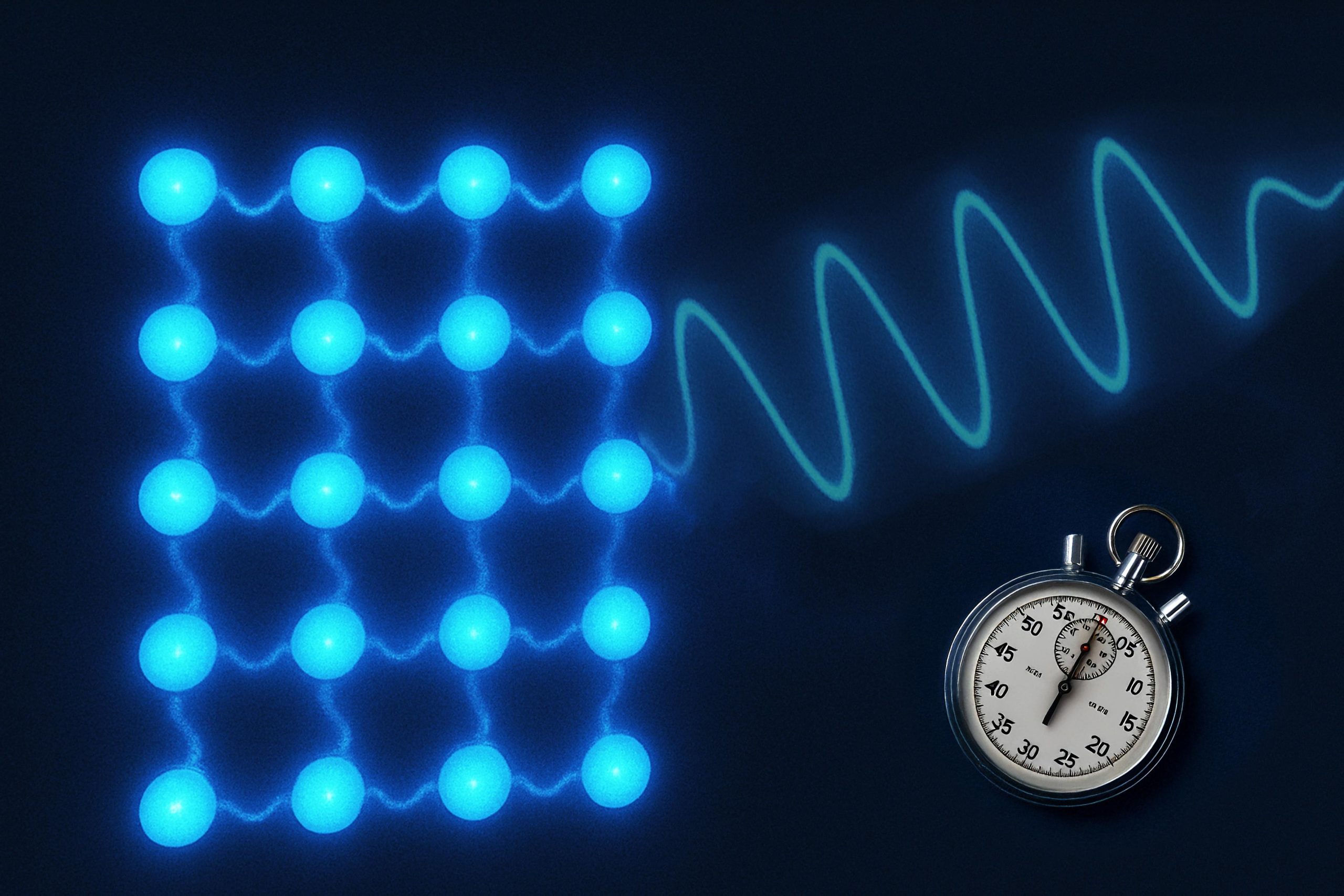
“We are investigating a two-dimensional lattice of particles held in place by laser beams,” says Felix Russo. “And here we can show that the state of the lattice begins to oscillate – due to the quantum interaction between the particles.”
The research offers the opportunity to better understand the theory of quantum many-body systems – paving the way for new quantum technologies or high-precision quantum measurement techniques.
Reference: “Quantum Dissipative Continuous Time Crystals” by Felix Russo and Thomas Pohl, 11 September 2025, Physical Review Letters.
DOI: 10.1103/dc2s-94gv
This work was supported by funding from the Austrian Science Fund (FWF) [Grant DOI: 10.55776/COE1] and the European Union (NextGenerationEU), by the SNSF through the Swiss Quantum Initiative, and from the European Research Council through the ERC Synergy Grant SuperWave (Grant No. 101071882).
Never miss a breakthrough: Join the SciTechDaily newsletter.
Follow us on Google and Google News.
16 Comments
I’ll think about it before I comment E=mc2. (C)
VERY GOOD!
Mass is not an isolated concept but a manifestation of the topological attributes of spacetime, and pi π, as a fundamental constant in the mathematical universe, is the core element characterizing these topological attributes—particularly closure and stability.
——Excerpted from https://zhuanlan.zhihu.com/p/1949093422465015827.
Topological Vortex Theory (TVT) provides a possible explanation for the physical mechanism underlying the mass-energy equation E=mc². The mathematical isomorphism (E=mc² and S=πr²) suggests that mass and energy are essentially static (S=πr²) and dynamic (E=mc²) manifestations of a topological vortex, and the speed of light squared, c², is a quantification of spacetime’s topological properties.
——Excerpted from https://zhuanlan.zhihu.com/p/1948342728527185301.
Space Phase Transitions Theory (SPTT) emphasizes the physical substantiality of absolute space; its existence precedes time and serves as the common origin of spacetime matter and temporal evolution.
——Excerpted from https://zhuanlan.zhihu.com/p/1930897490367973024.
Can Time Itself Form a Crystal? New Research Says Yes, in a Surprising Way.
VERY GOOD!
Space and spacetime are two different concepts. In the physical world, time and space are inseparable, meaning that motion and matter are inseparable.
Space Phase Transitions Theory (SPTT) proposes a novel theoretical framework modeling space as an inviscid and incompressible medium exhibiting material independence, temporal invariance, and isotropy. Central to this model is the generation of spacetime vortices through topological phase transitions, which reconcile absolute and relativistic spacetime paradigms. These vortices provide mechanistic explanations for gravitational effects, relativistic time dilation, and temporal quantization via intrinsic spin periods.
——Excerpted from https://zhuanlan.zhihu.com/p/1933828835322856603.
Contemporary physics and so-called peer-reviewed publications (including Physical Review Letters, Science, Nature, etc.) stubbornly believe that two sets of counter rotating cobalt-60 are two mirror images of each other, constructing a more shocking pseudoscientific theoretical framework in the history of science than the “geocentric model”. This pseudo scientific framework and system have seriously hindered scientific progress and social development.
For nearly a century, physics has been manipulated by this pseudo scientific theoretical system and the interest groups behind it, wasting a lot of manpower, funds, and time. A large amount of pseudo scientific research has been conducted, and countless pseudo scientific papers have been published, causing serious negative impacts on scientific and social progress, as well as humanistic development.
Fortunately, not every member of the public is gullible. Topology is reconfiguring the cognitive framework of modern civilization. With the gradual refinement of artificial intelligence (AI), we are no longer entirely reliant on mediated deception by some so-called peer-reviewed publications (including Physical Review Letters, Science, Nature, etc.). We now possess the means to leverage AI’s efficiency to enhance scientific rigor and productivity.
As a physical entity, background space exhibits incompressible, non viscous, and isotropic physical properties, and its motion mode is topological phase transition via topological spin the critical point.
As a physical entity, background space exhibits incompressible, non viscous, and isotropic physical properties, and its motion mode is topological phase transition via topological spin of the critical point.
Speaking of loonies… Here comes the resident Dunning-Kruger poster boy.
Your piety is one of the contributions of called peer-reviewed publications to science.
The development of the Topological Vortex Theory (TVT) reflects a progression from concrete physical phenomena to abstract mathematical modeling and, ultimately, to interdisciplinary unification.
Given infinite time anything can andcwill happen. A crystal of time or any other thing will happen, an infinite number of times my friends.
Can Space Itself Form a Crystal?
No that’d be a fundamental misexplanation of what crystals are; which is matter that has repeating properties through space.
So… Can Time Itself Form a Crystal?
The Time while only Chloride momentum’s real
Just another fine example of failing to factor-in the as yet unidentified force that induces gravity to radiate from all matter in fields of pulsing coherent angular lines of attractive force, in accordance with the inverse-square law of attraction. While others calculate and speculate, I demonstrate (fourth of four): https://odysee.com/@charlesgshaver:d/5Gravity:c
This article takes the award for the “Most Uninformed Title” of the decade. The loonies will be all over this.
Not unlike a carrier wave – or a “radio” signal – the quantum “realm” might be re-imagined as imposing a “dimensional” character on what is supposed as the “dependable” universe we have been trying to decipher. Just intuition functioning here in this post. Imagine what you will. The seemingly “random” fluctuations that are now found to impose “time” values might quite naturally originate from such an un recognized (to date) realm.