
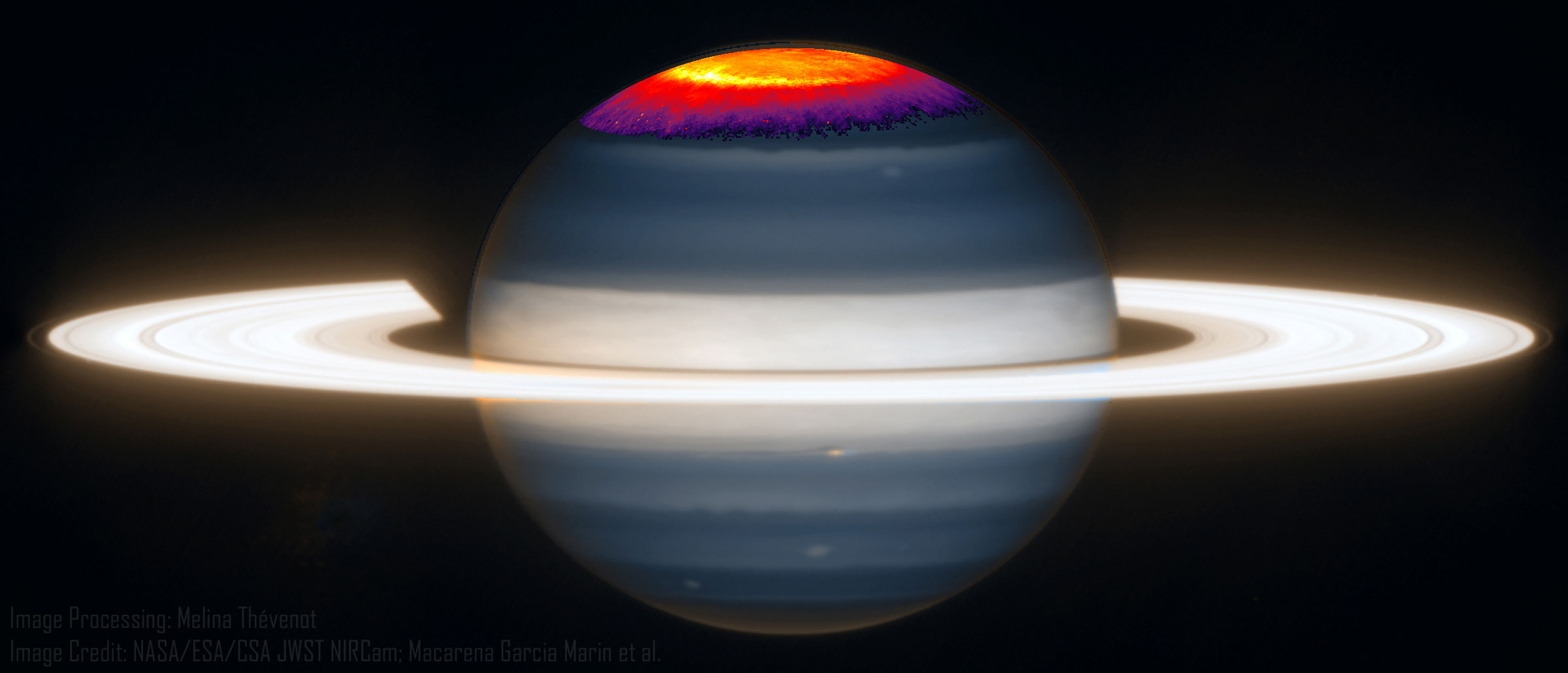
Saturn’s aurora acts as a localized energy source that drives winds and currents in a stable feedback system, producing the illusion of changing rotation.
Researchers at Northumbria University have turned to the most advanced space telescope ever constructed to tackle a long-standing mystery in planetary science: why Saturn seems to rotate at different speeds depending on how it is measured?
A new study published in the Journal of Geophysical Research: Space Physics offers a clearer explanation. For the first time, scientists have mapped how heat and charged particles are distributed within Saturn’s aurora, revealing that the phenomenon is sustained by a continuous feedback process driven by the planet’s own northern lights.
For decades, Saturn’s behavior has puzzled researchers. Data collected by NASA’s Cassini spacecraft in 2004 indicated that the planet’s rotation rate appeared to shift over time. That result conflicted with basic physics, since a planet’s spin should remain stable and not fluctuate in that way.
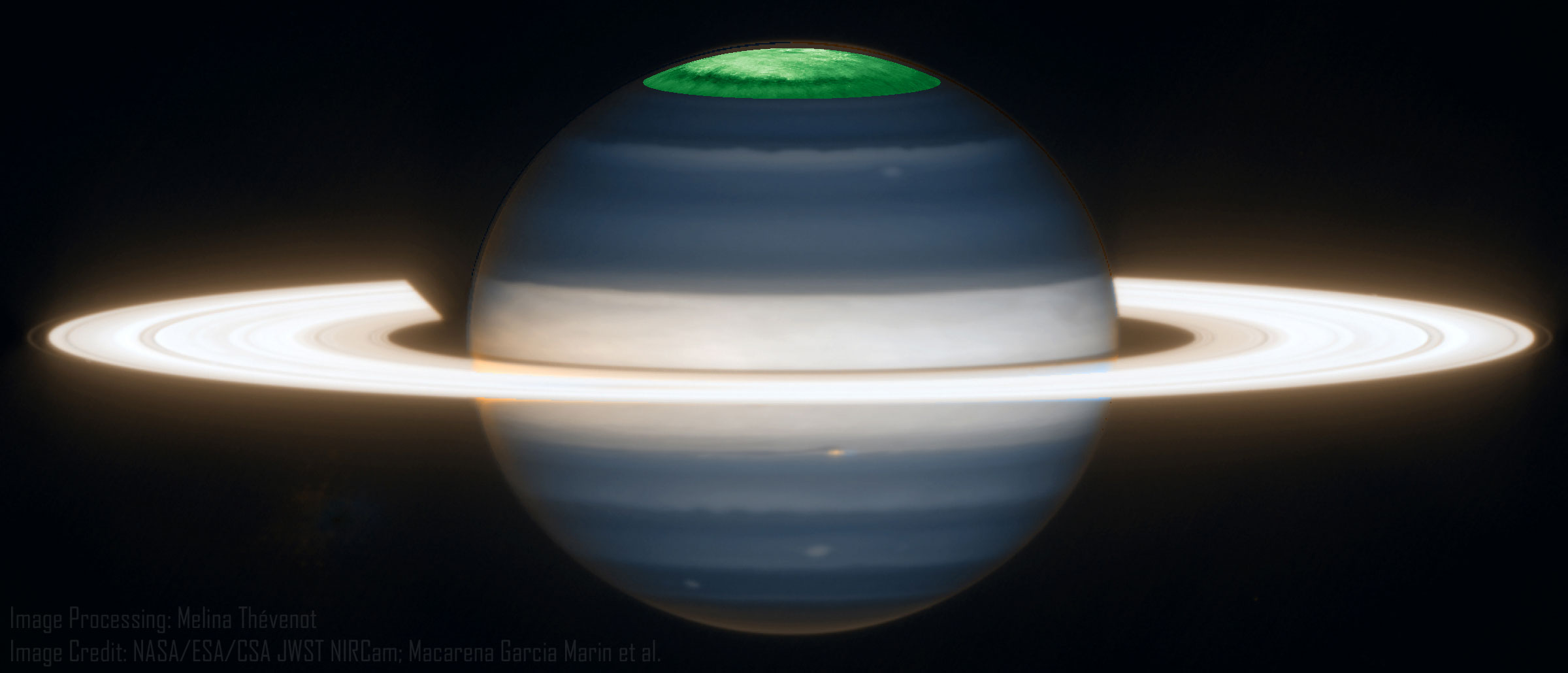
In 2021, a study led by Tom Stallard, Professor of Planetary Astronomy at Northumbria University, provided a key breakthrough. The team demonstrated that Saturn itself was not changing its rotation speed. Instead, high-altitude winds in the planet’s upper atmosphere were generating electrical currents, creating auroral signals that gave the illusion of a changing spin.
That explanation resolved one problem but introduced another. If atmospheric winds were responsible for the effect, what was driving those winds in the first place?

JWST maps resolve auroral energy input
New observations from Professor Stallard and collaborators across the UK and US now provide direct evidence that answers that question.
Using the James Webb Space Telescope (JWST), researchers monitored Saturn’s northern auroral region, similar to Earth’s northern lights, over the course of an entire Saturnian day. This continuous observation produced a level of detail that had never been achieved before.
The team focused on infrared emissions from a molecule known as trihydrogen cation, which forms in Saturn’s upper atmosphere and acts as a natural indicator of temperature. By tracking this signal, they generated the first detailed maps showing both temperature variations and particle density across the auroral region.
The improvement in precision was significant. Earlier measurements carried uncertainties of about 50 degrees Celsius, roughly the same scale as the variations scientists were trying to measure, and relied on averaging large sections of the polar aurora. In contrast, JWST data improved accuracy by a factor of ten, allowing researchers to resolve fine-scale patterns of heating and cooling for the first time.
Localized heating sustains the feedback cycle
The new data closely matches predictions from computer models developed more than ten years ago, but only when the source of heating is placed exactly where the main auroral emissions enter Saturn’s atmosphere.
This finding shows that Saturn’s aurora does more than create a visual display. It deposits energy into a specific region of the atmosphere, raising temperatures locally. That heating drives atmospheric winds, which then produce electrical currents that power the aurora. The cycle then repeats, maintaining the system over time.
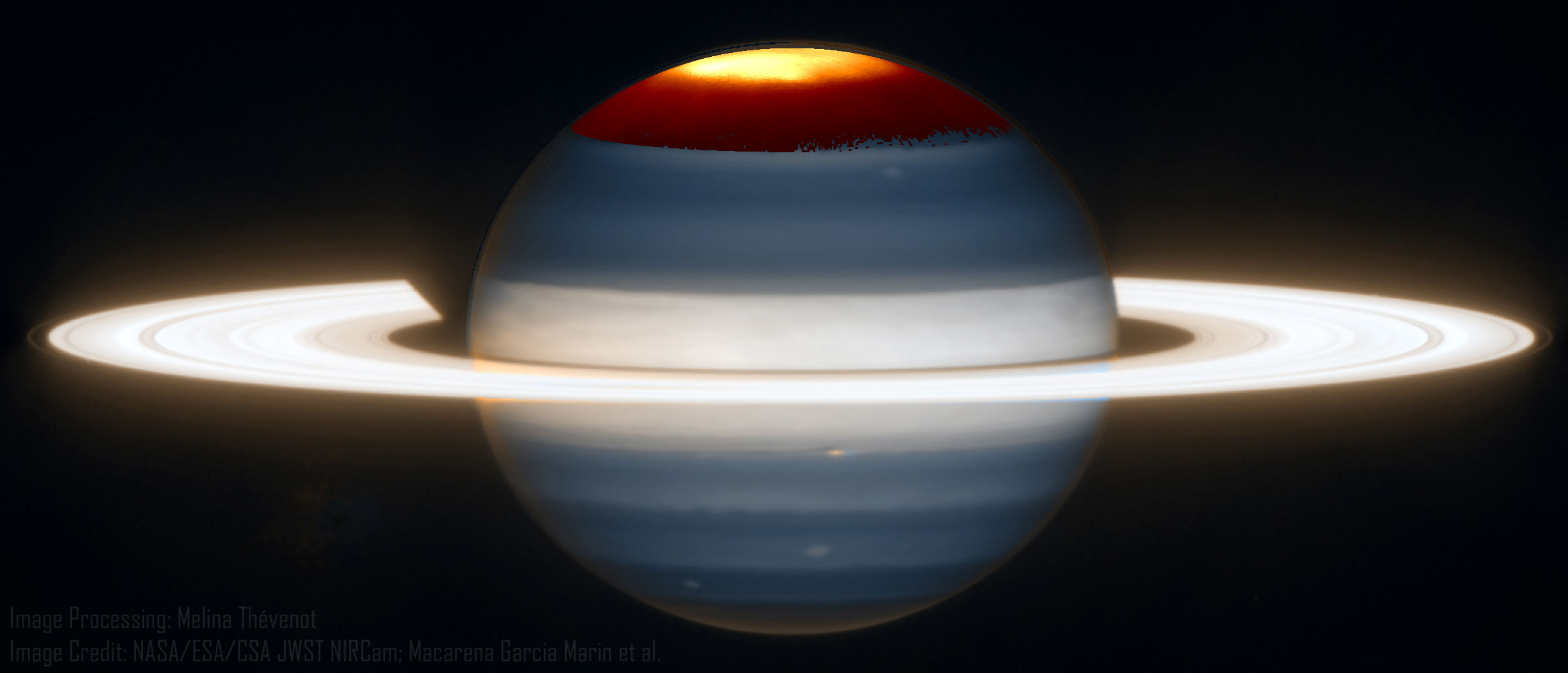
Lead researcher Professor Tom Stallard, said: “What we are seeing is essentially a planetary heat pump. Saturn’s aurora heats its atmosphere, the atmosphere drives winds, the winds produce currents that power the aurora, and so it goes on. The system feeds itself.
“For decades, we knew something strange was happening with Saturn’s apparent rotation rate, but we could not explain it. We then showed it was being driven by atmospheric winds, but we still did not know why those winds existed. These new observations, made possible by JWST, finally give us the evidence we needed to close that loop.”
Here, we show the asymmetric temperatures, density and intensity of the auroral ionosphere as viewed from above the auroral region, rotating to highlight how interconnected these different parameters are. Video shows these three parameters (top row) and the different from the median values at each latitude (bottom row) – here, red is higher and blue lower, revealing that not only the brighter regions but also weaker regions follow very similar patterns, driven by and driving the planetary-period currents flowing into and out of the planet. Credit: NASA/ESA/CSA, Tom Stallard (Northumbria University), Melina Thévenot, Macarena Garcia Marin (STScI/ESA)
Coupled atmosphere–magnetosphere interactions
Beyond explaining Saturn’s rotation puzzle, the results point to a broader connection between the planet’s atmosphere and its surrounding space environment. Processes occurring in the atmosphere appear to influence conditions within the magnetosphere, the region shaped by Saturn’s magnetic field, which in turn feeds energy back toward the planet.
This two-way exchange may explain why the observed effects remain stable over long periods. It also suggests that similar interactions could exist on other planets, linking atmospheric behavior with space environments in ways that are not yet fully understood.
Professor Stallard added: “This result changes how we think about planetary atmospheres more generally. If a planet’s atmospheric conditions can drive currents out into the surrounding space environment, then understanding what is happening in the stratospheres of other worlds may reveal interactions we have not yet even imagined.”
Reference: “JWST/NIRSpec Reveals the Atmospheric Driver of Saturn’s Variable Magnetospheric Rotation Rate” by Tom S. Stallard, Luke Moore, Henrik Melin, Chris G. A. Smith, Omakshi Agiwal, M. Nahid Chowdhury, Rosie E. Johnson, Katie L. Knowles, Emma M. Thomas, Paola I. Tiranti, James O’Donoghue, Khalid Mohamed, Ingo Mueller-Wodarg, John C. Coxon, Sarah V. Badman and Joe A. Caggiano, 12 March 2026, Journal of Geophysical Research: Space Physics.
DOI: 10.1029/2025JA034578
The research was supported by the Science and Technology Facilities Council (STFC).
Never miss a breakthrough: Join the SciTechDaily newsletter.
Follow us on Google and Google News.