
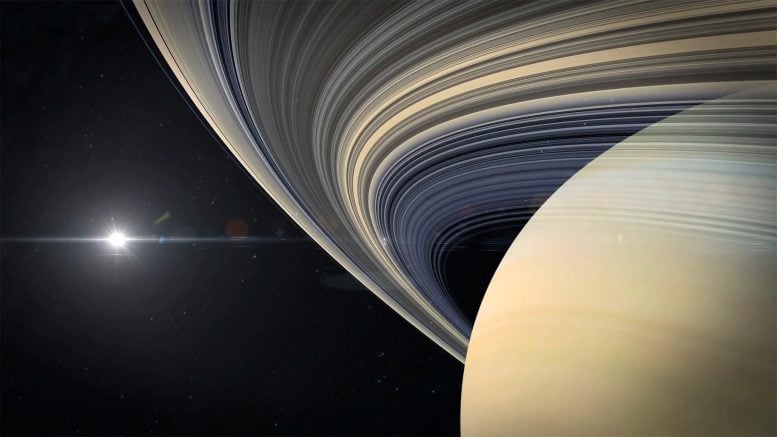
Scientists at Loughborough University have revealed a new computer model that could help solve the mystery of Saturn’s moonlets.
Research by Loughborough University physicists casts new light on Saturn’s moonlets – and could help solve some of the mysteries surrounding planet formation.
Saturn’s F ring has long been of interest to scientists as its features rapid change on timescales from hours to years, and it is probably the only location in the solar system where large-scale collisions happen on a daily basis.
When CASSINI began imaging the Saturn system back in 2006 the discovery of a proliferation of moonlets – small natural satellites – in Saturn’s F ring was an unexpected find. Powerful tidal forces were thought to minimize the clumping of particles necessary to create these moonlets and scientists were at a loss to explain the high population in Saturn’s rings.
As the processes at work in Saturn’s rings are comparable to those of a protoplanetary disk, understanding them could be key to unlocking the secrets of our own solar system. Writing in the journal Scientific Reports, researchers from Loughborough’s Department of Physics have revealed a new computer model which could help solve this mystery.
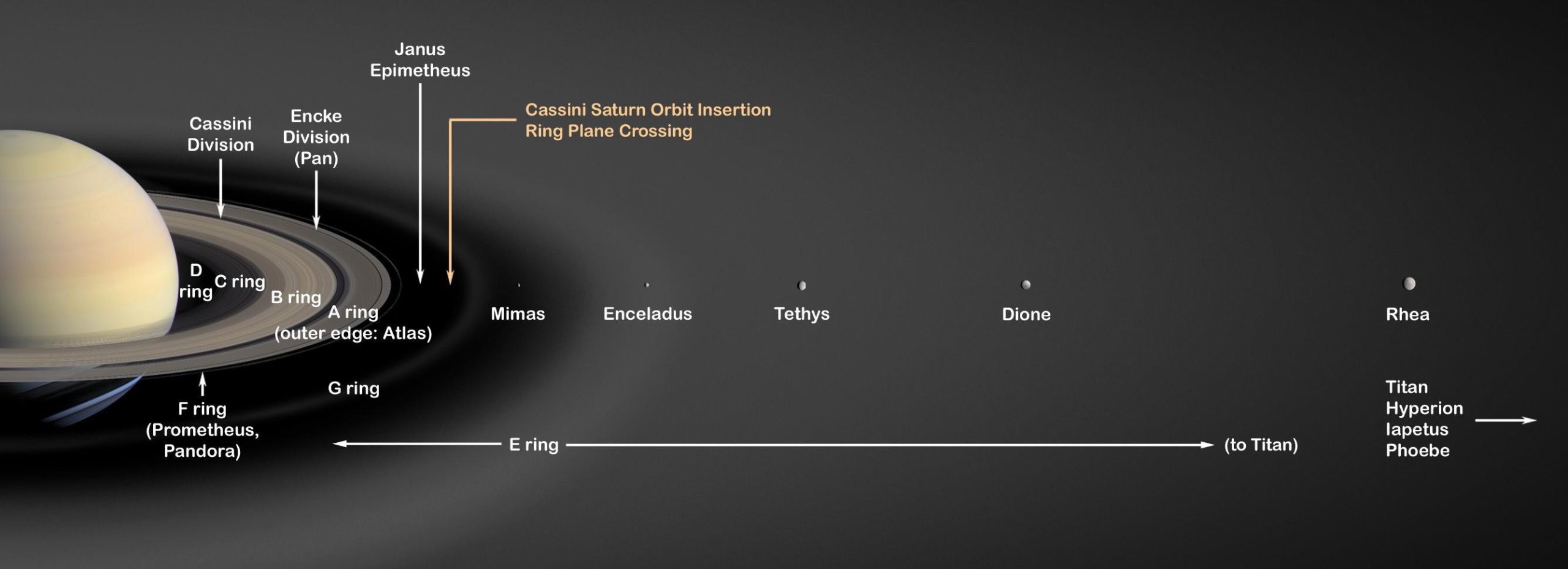
“Saturn’s rings offer a nearby astrophysical laboratory to study and observe – in real-time – many mechanisms and processes theorized to take place in astrophysical disks with the use of the CASSINI spacecraft,” explains Loughborough physicist Phil Sutton. “And Saturn’s F ring is probably the most active in the solar system. That’s why we think it is so fascinating.”
Work on Saturn’s F ring, the outermost of the dense rings, has shown that the nearby ‘shepherd’ moon Prometheus directly influences the formation of moonlets in the ring itself. These moonlets can themselves create structures within the F ring. The interaction between Prometheus and the F ring transpires because of the difference in alignment of the elliptical F ring and the elliptical orbit of Prometheus. Over time changes in the rotational axis alter this alignment, resulting in very close approaches to the F ring by Prometheus. During the closest approaches over the course of one orbital period Prometheus moves towards and then back away from the F ring, creating structures known as streamer-channels.
Previous numerical modeling has used a massless F ring (where particles were non-interacting with each other) interacting with Prometheus and showed that the density of particles at streamer-channel edges increased over a series of orbital periods after the original encounter. However, the modeling did not account for the fast growth of moonlets necessary to explain the large population observed by CASSINI.
“In our paper, we report the results of our numerical modeling that assumed an F ring with mass where all particles were gravitationally interacting,” Mr Sutton explains. “What we see is an accelerated growth of the density seen at the same places on the streamer-channel edges than previously reported. This increase is around 5% each orbital period for the first five orbits, compared with a 0% increase for the same regions over the same time period using the non-interacting model.
“Where all the particles in the F ring interact with each other we see a more fluid-like motion. It is this fluid-like motion that creates turbulence and subsequent vortices within the F ring as a perpendicular force to the flow (Prometheus) disrupts it.
“Vortices have extensively been shown to offer an accelerated mechanism for planetesimal formation in protoplanetary disks, concentrating particle towards their centers. Here we can show that the same idea can be applied to moonlet formation within Saturn’s rings – especially the F ring where tidal forces are constantly trying to destroy clumps or moonlets – and could provide a mechanism that would allow the proliferation of moonlets observed by CASSINI.”
Reference: “Gravitational Vortices And Clump Formation In Saturn’s F ring During An Encounter With Prometheus” by Phil J. Sutton and Feodor V. Kusmartsev, 14 February 2013, Scientific Reports.
DOI: 10.1038/srep01276
Never miss a breakthrough: Join the SciTechDaily newsletter.
Follow us on Google and Google News.